AI Caption Tools: Translation vs Localization
Use translation for quick, factual Instagram captions; use localization for tone, engagement, and better U.S. market fit.
Use translation for quick, factual Instagram captions; use localization for tone, engagement, and better U.S. market fit.
4.98 /5 - from 58k reviews
Trusted by 50,000+ creators — get real engagement delivered to your profile in minutes, not days.
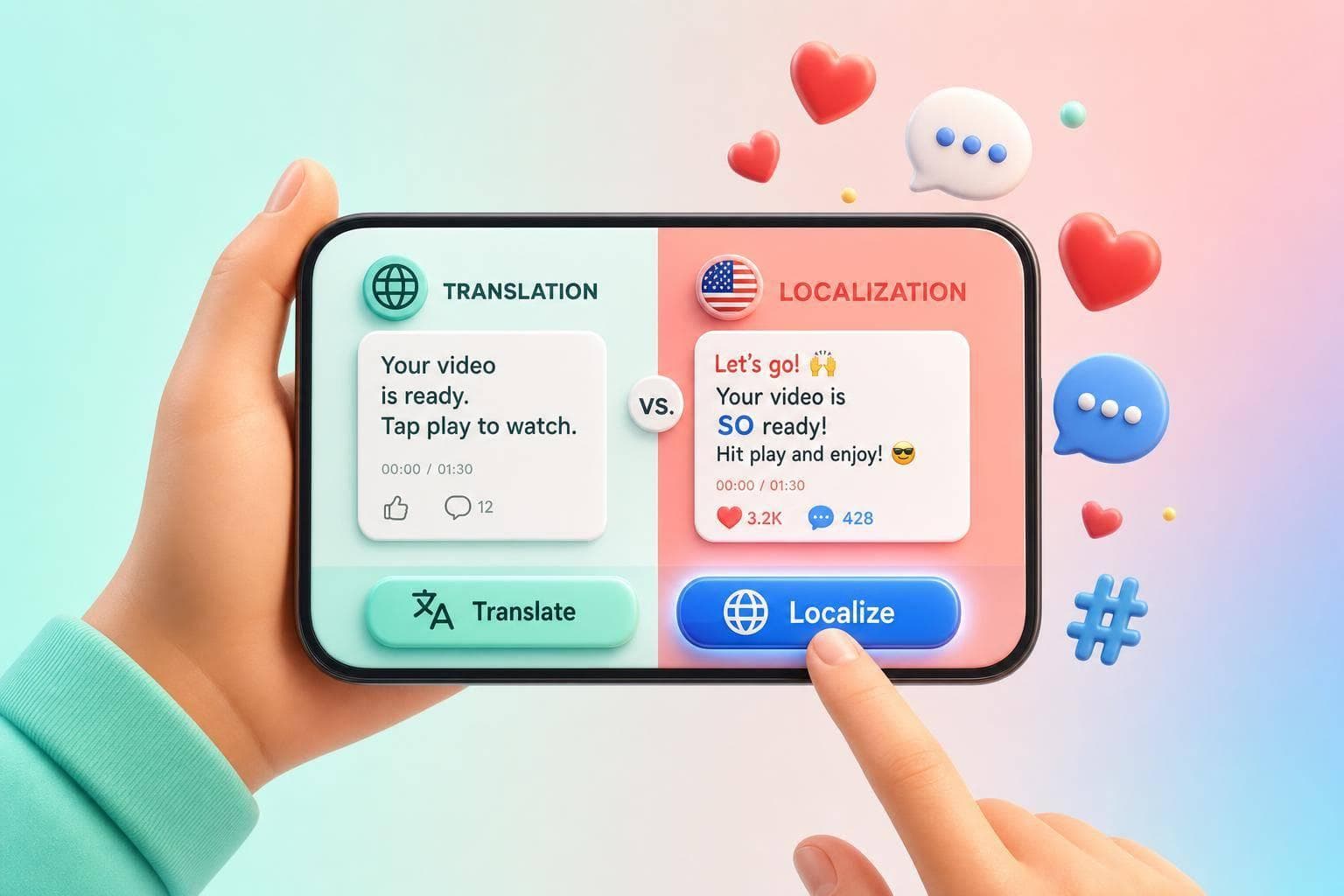
If I want Instagram captions to perform in the U.S., I don’t treat translation and localization as the same thing. Translation is best for clear, low-risk updates. Localization is better for posts where tone, phrasing, and audience fit affect clicks, comments, saves, and shares.
Here’s the short version:
My takeaway: if the goal is just to inform, translation is often enough. If the goal is engagement and market fit, I’d use localization.
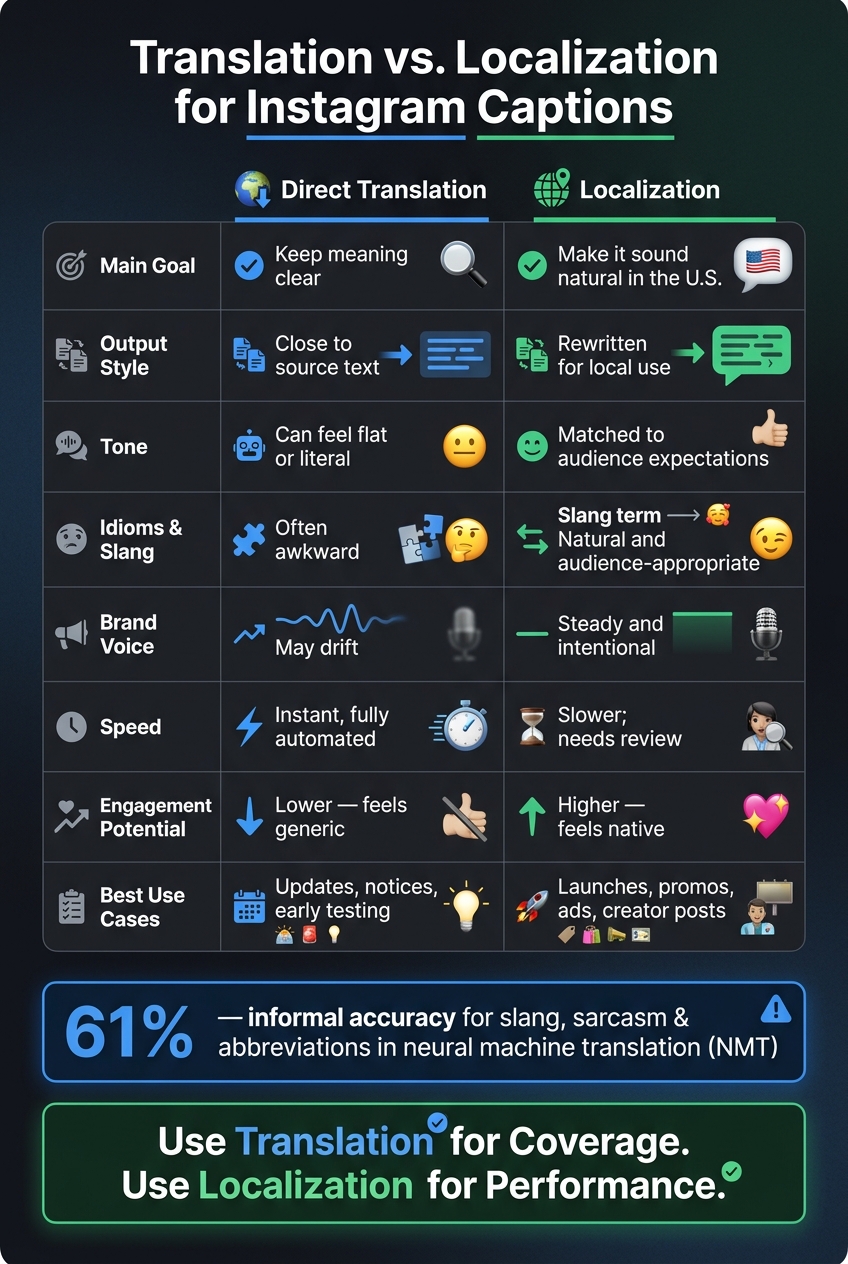
Translation vs Localization for Instagram Captions: Key Differences
| Criteria | Translation | Localization |
|---|---|---|
| Main goal | Keep meaning clear | Make it sound natural in the U.S. |
| Output style | Close to source text | Rewritten for local use |
| Tone | Can feel flat or literal | Better matched to audience expectations |
| Idioms and slang | Often awkward | More natural |
| Best for | Updates, notices, testing | Launches, promos, ads |
| Time needed | Less | More |
| Brand voice | May drift | More consistent |
| Engagement potential | Lower | Higher |
So if I’m choosing between the two, I’d keep it simple: use translation for coverage, and localization for performance.
AI caption tools usually translate a caption brief fast and keep the structure close to the source. Many tools use neural machine translation (NMT), which turns out quick, source-close translations. A brand can translate product update captions into Spanish, French, or German in minutes instead of rewriting each one from scratch.
UpGrow's AI caption generator, for example, produces 5 distinct caption options per request. That gives you some range without extra work. The tradeoff is simple: speed helps you scale, but it doesn't make a caption sound local.
This is where things start to feel awkward. A caption can be grammatically correct and still sound a little strange on Instagram. NMT often leans on literal output, and that can strip out rhythm, humor, and the personality that makes a caption land.
Research points to the same issue. A study on Meta AI's translation of Instagram captions for a beauty brand found that technical terms like "hydration" came through accurately, but idiomatic slogans and expressive phrases were frequently rendered literally and judged inadequate for marketing purposes. Another study on NMT for social media content found that while standard translation quality improved by 11%, informal accuracy for slang, sarcasm, and abbreviations stayed at just 61%.
You can see the gap in plain terms. "Tap the link in our bio to learn more" feels natural in English. A word-for-word version in another language often doesn't.
Direct translation works best in low-stakes cases where the main goal is clear communication. If a post is mostly informational, like a new product size, a shipping update, or a store closure notice, the caption doesn't need charm. It just needs to be clear.
It also makes sense for early market testing. Before putting money into localized content for a new region, a brand can run translated captions and watch for baseline interest as part of your Instagram growth strategies. If people respond, that's a sign it's time to move past straight translation and put more care into the copy.
A simple rule of thumb:
When the goal moves from coverage to engagement, localization is usually the better fit.
Translation keeps the meaning. Localization keeps the meaning and makes the caption feel right for a U.S. audience. It rewrites the line so it sounds native, not just correct.
Localization fixes details like dates, currency, spelling, and units. But the bigger job is phrasing. Those small signals tell people whether a brand sounds like it actually speaks their language.
This is where the gap shows up fast. A direct translation of the Spanish "No te lo puedes perder" might come out as "You can't lose it," which sounds off and confusing. A localized version would be "You don't want to miss this" - a much more natural CTA for U.S. Instagram users.
Straight translation can drain the personality out of a caption. A playful brand may end up sounding stiff. A casual voice can turn oddly formal. Localization helps keep the original tone while making it sound natural to U.S. followers.
In practice, that means a youth brand can keep its energy with "Let's go," while a premium lifestyle brand can stay more measured with "Discover what's next." AI pulls from brand guidelines, tone examples, and style rules to keep that voice steady. CTAs shift too. A flat "Click here to learn more" can become "Tap the link in bio" or "Comment if you agree" - the kind of phrasing U.S. users already expect on Instagram.
That’s why localization often does better than translation when the goal is engagement, not just basic understanding.
When a caption uses familiar idioms, a natural CTA, and references that connect with U.S. readers, people get it faster. And on Instagram, speed matters. Feeds move fast, and brands have only a moment to catch attention.
Localized captions cut the gap between reading and reacting. That can mean more saves, more comments, and more shares.
A profile that keeps sounding like it belongs in the U.S. market will usually build a more engaged audience than one that still feels translated. Over time, that market fit supports stronger engagement across the content calendar.
That difference becomes even clearer in a side-by-side growth comparison.
Use both. The key is to match the method to the post's job. In practice, this isn't just a language choice. It's a growth choice.
| Feature | Direct Translation | Localization |
|---|---|---|
| Speed | Instant, fully automated | Slower; needs review |
| Voice fit | Flat or literal | High; keeps brand voice intact |
| Local fit | Low; misses local nuances and slang | High; adapts to local trends and slang |
| Idioms and Slang | Frequently awkward or off | Natural and audience-appropriate |
| Brand Voice Consistency | Inconsistent across markets | Steady and intentional |
| Engagement lift | Lower - can feel generic | Higher - feels native |
| Best Use Cases | Simple updates, global news, low-risk posts | Launches, promotions, creator partnerships, ads |
The best method depends on post risk, not just language.
Direct translation works best when speed comes first. If you're posting a simple update, sharing a news item, or testing a new content pillar, translation lets you move fast without slowing your social media workflow. It's a good fit for low-risk posts where getting the message out matters more than fine-tuning every phrase.
Localization makes more sense for launches and paid campaigns. Product launches, regional promotions, creator partnerships, and ads carry more weight. If the caption feels off, the post can lose momentum fast. A weak line doesn't just sound awkward - it can hurt the outcome. For launches, promotions, creator partnerships, and ads, localization is usually the safer bet.
Before you write a caption, check three things: campaign goal, post risk, and expected ROI.
If the goal is speed and the post is low-priority, translate. If the goal is growth in a specific market and the post has real stakes, localize. Then check your analytics and compare engagement on translated captions versus localized ones before you scale. Once that choice is clear, the next move is using AI and analytics to target the right market.

After you choose translation or localization, the next step is simple: get the right caption in front of the right audience.
UpGrow gives teams more control over who sees their content. Its AI targeting filters segment audiences by language, location, age, gender, interests, and hashtags, so localized captions reach specific audience groups instead of a broad, generic one.
The Language Targeting feature helps direct content to followers who speak the intended language. When you pair that with Location Targeting, you can narrow delivery to specific cities or states and account for regional differences that plain translation can miss.
UpGrow also supports niche and interest alignment. That matters because a localized caption isn’t just about language. It also needs to sound right for people who already care about the topic, product, or brand voice behind it.
Once targeting is in place, you can compare how translated and localized captions perform based on actual engagement. UpGrow's live dashboard and analytics reports let teams measure translated and localized captions by real engagement, not just follower counts.
That gives you a clearer read on what’s working. A translated caption may get the message across, while a localized one may drive more interaction in a given market. The data helps you see that difference.
Direct translation is faster and works well when clarity matters most. Localization takes more effort, but it gives you more control over tone, market fit, and brand voice. When you combine both approaches with UpGrow's AI targeting and live analytics, you can support organic growth with a lot more precision.
Use translation for speed, localization for market fit, and analytics to confirm which one performs better.
Look at the post’s impact on your brand goals against the work it takes to make it. A post is high-stakes when it plays a big part in growth, like a product launch, authority-building educational content, or a campaign aimed at a new demographic.
A post is low-risk when it’s easy to test, tweak, or improve through A/B testing. Check metrics like engagement, saves, and shares to see if it’s helping move your brand goals forward.
AI localization can get very close when it uses regional idioms, local nuance, and clear brand guidelines. But human review still matters if you want the brand voice to stay consistent.
The best way to think about it is simple: AI is a strong drafting and research partner. It can help shape the first version fast. Then a human editor steps in for the final pass to make sure the tone, local fit, and flow feel natural and fully on-brand.
Track the metrics that show whether your localized content feels native and relevant to the people seeing it.
Pay close attention to engagement rate, save rate, CTR, profile visits, and comment quality. Those signals can tell you a lot. If one version gets more saves and better comments, for example, it’s often a sign that the message landed in a more natural way.
Use Instagram Insights or real-time dashboards like UpGrow to compare how each version performs across different audience segments.