Table of contents
- How to create an outfit Reel video (Full Tutorial + Template) | Instagram Reels Ideas
- Quick Comparison
- What Makes a Strong Fashion Lookbook Reel Template
- How to Use This List
- 1. Outfit Drops
- 2. Seasonal Edits
- 3. Product Tags & Details
- 4. Brand & Agency Pages
- Quick Comparison Table for All 25 Templates
- Using UpGrow to Scale and Refine Fashion Reels
- Conclusion
- FAQs
If you want better Instagram Reels, use a template. The article’s main point is simple: fashion lookbook Reels tend to work best when you keep them short, use a set clip flow, and repeat formats that match your goal. It also notes that Reels can get 22% more interaction than standard video posts, which is why a repeatable setup matters.
Here’s the short version:
- I’d use 15–30 second Reels for most lookbooks, or 7–15 seconds for fast outfit drops
- I’d keep each Reel to 6–10 clips
- I’d give each clip one job: hook, outfit view, detail, or CTA
- I’d pick templates based on the post goal: new arrivals, seasonal looks, shopping tags, or brand series
- I’d test a few formats for 30 days and track saves, shares, taps, and profile visits
The article groups all 25 templates into four buckets:
- Outfit Drops for new pieces and try-ons
- Seasonal Edits for spring, summer, fall, winter, and holiday content
- Product Tags & Details for shoppable Reels
- Brand & Agency Formats for repeat series across campaigns or clients
A few rules show up again and again:
- Use 9:16 vertical
- Keep on-screen text short: 3–5 words
- Put the strongest shot in the first clip
- Use one transition style per Reel
- Save the CTA and product tags for the last 2–3 seconds
How to create an outfit Reel video (Full Tutorial + Template) | Instagram Reels Ideas
sbb-itb-3c55afb
Quick Comparison
| Group | Best For | Typical Length | Best Fit |
|---|---|---|---|
| Outfit Drops | New arrivals, try-ons, fast outfit reveals | 7–20 seconds | Creators, boutiques, online stores |
| Seasonal Edits | Weather, holidays, timed campaigns | 20–30 seconds | Brands, boutiques, lifestyle creators |
| Product Tags & Details | Taps and product page visits | 10–20 seconds | Stores with Instagram Shopping |
| Brand & Agency Formats | Repeat series and campaign systems | 20–35 seconds | Brands, agencies, studios |
What I like about this article is that it doesn’t treat every Reel the same. A countdown drop, a winter coat edit, and a BTS campaign Reel should not use the same structure. This guide helps sort that out fast, then shows how to compare the 25 formats by use case, clip count, duration, and production effort.
If you’re trying to post more often without rebuilding every edit from scratch, this article gives you a clear starting point.
What Makes a Strong Fashion Lookbook Reel Template
A strong lookbook template gives every clip a clear job: hook, show, detail, CTA.
Most strong lookbook Reels land in the 15–30 second range, use 6–10 clips, and keep each clip on screen for about 1.5–3 seconds. Shorter Reels, around 7–15 seconds, often get the best completion rates. That said, 15–30 seconds is still a solid sweet spot for lookbook-style content. Those benchmarks make the 25 template types below much easier to compare.
Use a simple 3-part flow: hook, lookbook, CTA.
- Clip 1 should stop the scroll with a strong outfit shot or a quick movement.
- The middle clips do the heavy lifting with full-body shots, alternate angles, and close-up details.
- The final clip is where your CTA and product tags should go.
This setup keeps shoots fast for stores, easy to repeat for creators, and easier to scale for agencies.
For transitions, keep it simple. Pick one transition style per template. Use match cuts for outfit drops, hard beat cuts for seasonal edits, and jump cuts to mark an outfit change.
Text should move with the Reel, not get in the way. Keep it inside safe zones so Instagram’s UI doesn’t cover it. Put the drop name in the center during the first 3 seconds, use top-left outfit labels in the middle, and finish with a centered CTA in the last 2–3 seconds. Keep on-screen copy to 3–5 words. Add 1–4 product tags on the end frame, placing them near the edge of the garment.
Build templates for Instagram’s native Use Template workflow and Template Browser. Stick with a vertical 9:16 format, keep the clip timeline the same from one version to the next, and use the native editor so timing and audio stay reusable. Use these rules to judge which templates fit your shoot, then apply them to the 25 ideas below.
How to Use This List
The 25 templates are grouped into four buckets: outfit drops, seasonal edits, product-tag-focused formats, and brand/agency formats. Pick the bucket based on what you want the Reel to do. Start with a simple question: What job should this Reel do? The answer usually points you to the right group. Use the table below to find the best fit fast.
| Bucket | Primary Goal | Best Fit |
|---|---|---|
| Outfit Drops | Product discovery, new look reveals | Creators, boutiques, e-commerce stores |
| Seasonal Edits | Themed storytelling, campaign content | DTC brands, lifestyle creators |
| Product Tags & Details | Shoppable clicks, conversions | Stores with Instagram Shopping enabled |
| Brand & Agency Formats | Scalable, consistent series content | Agencies, high-volume brand pages |
Each template includes four fields: use case, clip flow, text placement, and best-fit account type. Check those first. If the footage, goal, and account type line up, you’ve probably found the right template.
One small thing that matters more than people think: review the clip flow before you commit. If the footage doesn’t match the structure, you’ll lose time in editing and the Reel can feel off.
Posting pace should match the bucket too:
- Outfit drops and product-tag formats tend to work well for frequent posting
- Seasonal edits fit key U.S. calendar moments
- Brand/agency formats are a good match for weekly updates
Start with the bucket that fits your goal, then move into the 25 templates below.
1. Outfit Drops
Outfit drop Reels are made for fast product discovery and strong buying intent. Lead with your best look first, keep the cuts tight, and end with a clear CTA. A good range is 7–15 seconds for quick drops. Go longer only if the set needs extra space. The goal here is simple: show the product fast. This format is not for seasonal storytelling, but it is essential for crafting engaging Instagram posts that drive sales.
-
Daily Drop Carousel Reel
Show one outfit per day and cut them in sequence. Start with a hook like This Week's Fits, then run five to seven outfit clips at 1.5–2.5 seconds each. Close with Save this look. Use centered hook text and a bottom-left outfit label on each clip. This works well for creators and boutiques that post often. -
New Collection Teaser Drop
Start with a half-second brand reveal, then flash four to six quick clips at 0.5–1 second each. End on a launch-date screen like Dropping 10/15 at 8:00 PM. Put the collection name in bold center text. This setup fits brands and agencies building pre-launch awareness. -
Full Fit Breakdown Drop
Open with the full outfit, then cut to close-ups of the top, bottom, shoes, and accessories at about 1.5 seconds each. Use left-side category labels and right-side fit notes like TTS or oversized. Add pricing when it makes sense - Aurora Tee - $39. This is a strong pick for stores that want to build buying confidence and cut down on returns. -
Try-On Haul Drop
Cut on movement - spin, step, or turn. Run five to eight clips at 1.5–2 seconds each. Add a size note at the bottom left, like Look 3 - size M, then end with a side-by-side of favorite fits and a Which fit wins? prompt. You can also use free AI-powered Instagram tools to generate captions and hashtags for these posts. This format suits online stores and influencers focused on engagement and product discovery. -
Before-and-After Glow-Up Drop
Each pair should use a 1–1.5 second before clip and a 1.5–2 second after clip. Run three to five pairs per Reel. Add one bottom-center styling tip on each after clip, like Add a structured blazer for shape. This is a smart fit for stylists, personal shoppers, and agencies showing styling value. -
Limited Drop Countdown Reel
This one is built for urgency. Open with a top-center Limited Drop badge, run three to five clips that show standout pieces, and close with a countdown graphic: Ends tonight at 11:59 PM - 30 units left. Keep the Reel under 15 seconds to push fast action.
If the content connects to weather, holidays, or a campaign theme, move to Seasonal Edits.
2. Seasonal Edits
When the season is the hook, these edits do the heavy lifting. They work because they tie an outfit to a specific moment - a weather change, a holiday, or a point on the calendar. That timing matters. Seasonal outfit Reels can drive up to 38% higher engagement than single-season posts. The smart move is to plan them 6–8 weeks before the season starts so you’re live while shopping intent is climbing.
Keep each Reel tight. Use one seasonal cue, one reveal, one detail pass, and one CTA. The flow stays the same: seasonal cue → outfit reveal → texture or layer detail → accessory or footwear detail → final full look.
- Spring Color Refresh: Start with a neutral base outfit, then bring in bright or pastel pieces one at a time. Put a top-center label like Spring Layers on screen, then end with a centered Shop the edit CTA. You can use ChatGPT for Instagram to generate these captions and CTAs quickly. This works well for boutiques rolling out new-season arrivals.
- Summer Vacation Capsule: Show a few light outfit variations built around one anchor piece, like a linen set, wrap dress, or simple sandal. Use bottom-left text for the use case, such as travel, weddings, graduations, or festivals. End with a centered Pack this look CTA. A strong fit for creators and travel-adjacent brands.
- Fall Layer Stack: Begin with a base layer, then add pieces clip by clip - a knit, a trench, boots - with timed text labels that appear as each layer goes on. Warm amber color grading tends to work well around the first day of fall. Close with a centered Shop the stack CTA. This format fits stores pushing back-to-school and fall arrivals.
- Winter Coat Rotation: Open on a close-up of fabric texture - wool, faux fur, or a heavy knit - then pull back to show the full look. Use a top-center label for each coat option and a bottom-left fit note. End with a centered Find your coat CTA. Best for stores and agencies handling winter outerwear.
- Holiday Event Looks: Lead with a festive visual cue - string lights, a party setting, or a metallic accessory - then cut across 3–5 dressed-up outfits. Add a top-center label for each look and finish with Holiday Party Ready in bold center text. This one fits brands, boutiques, and agencies running holiday campaign content.
- Between-Season Basics: Show one flexible piece - a blazer, midi skirt, or neutral knit - styled three ways as the weather changes. Use a top-center label like 3 Ways to Wear It and add a bottom-left styling note in each clip. End with a centered Style it your way CTA. This format suits creators, stores, and agencies that want a modular, brand-safe template they can use across clients.
3. Product Tags & Details
If your Reel needs taps, not just views, these shoppable formats do the job.
Use them when the goal is to sell the outfit, not just show it. Instagram lets you tag more than one product in a Reel, which makes this format a strong fit for outfit breakdowns and styling edits with lots of accessories. Those tags send viewers to a product detail page with the price, description, images, and a way to buy without leaving Instagram.
A simple four-step flow works well here: opening outfit shot, detail close-up, tag callout, then the final full look. Put each tag next to the item it points to. Also keep tags out of Instagram’s bottom caption area and away from the icons on the right.
Pick the template based on how many items you need to tag:
- Shoppable Close-Up: Start with a tight shot of one hero piece, like a seam, buckle, or fabric texture, then pull back to the full outfit. Place the tag on or near that item and end with a Tap to shop prompt. This works well for stores growing a brand on Instagram by launching a new piece or pushing one main product.
- Item-by-Item Reveal: Give each garment its own clip. As each one appears, add the tag and a short line with details like fabric, fit, color, or price. End on the complete outfit. This is a good match for creators putting together a styled set with 2–4 shoppable items.
- Full Look with Callout Labels: Show the full outfit from the first frame, then layer in timed text labels for each piece, including name, color, and price, while the camera pans or the model moves. Clean, high-contrast type helps each label stand out.
- Split-Screen Product Breakdown: Keep the outfit video on one side and a simple product list on the other. The list can show item name, a short descriptor, and price. This fits agencies handling many SKUs or brands that want a catalog-style setup without losing that editorial feel.
- Cursor-Style Tagging: Use a small animated pointer or highlight that moves from item to item as the Reel plays, with a short text pop-up for each one. It helps direct attention without making the edit feel choppy. A nice fit for boutiques and creator storefronts.
- Mini Lookbook with Product List: End with a static card that lists every tagged item by name and price. The video sells the look, and the end card spells out what’s in it. This format works for stores, creators, and agency-run brand pages. It is a staple for any comprehensive Instagram marketing strategy.
Keep each scene focused on one idea. Neutral backgrounds, slow-motion detail shots, and light motion graphics help the tags stay clean while keeping the outfit front and center.
4. Brand & Agency Pages
Marketing your clothing brand on Instagram requires Reels that do more than look good once. They need to work across campaigns, collections, and client accounts. That’s why these templates are built to scale. Reels are a strong top-of-funnel format for fashion brands and agencies because they can reach people beyond your current followers.
These seven formats take the shoppable ideas above and turn them into repeatable brand systems.
- New Collection Launch Reel: If an account posts a lot of launches, start here. Open with a fast motion hook, like a spin, fabric drop, or reveal. Then move through 4–6 outfits in quick, beat-matched clips. End with a branded CTA frame such as "Shop the drop", along with logo placement and product tags. Text: center hook, lower-third outfit labels, center CTA. Best for seasonal launches and new-line announcements.
- Brand DNA Lookbook Reel: This is a slower, more cinematic format built to show brand identity through signature pieces, textures, and styling choices. It uses a wide, medium, close-up, wide shot flow, which helps build mood before landing on a logo. Text: top-center brand name, lower-third style notes, center CTA. A strong fit for luxury and editorial-leaning labels.
- Behind-the-Campaign Reel: This format mixes BTS studio footage with final campaign shots. Show the process: lighting setups, model direction, fabric choices, then cut to the polished result. Text: top-left scene label, lower-third context notes, center CTA. It helps build trust and gives followers a reason to keep watching beyond the product itself.
- Creator Lookbook Reel: Stitch together UGC or influencer clips into one polished Reel with a shared color grade and a consistent text overlay style. Give each creator segment a short name tag and outfit callout. Text: top-left creator name tag, lower-third outfit callout, center CTA. This works well when brands want creator clips to feel like one campaign instead of a random mix.
- Shoppable Drop Recap Reel: Use one Reel to cover a full drop with item cards, prices, and an end-frame shop CTA. Text: center item name, lower-third price overlay, center end-frame CTA. For agencies running eCommerce client accounts, this is an easy repeat format that doesn’t need a full rebuild every time.
- Store Tour + Product Highlights Reel: Combine retail footage, like store walk-throughs, rack shots, and fitting room moments, with tagged product close-ups. Text: top-center location label, lower-third product callouts, center CTA. It’s a good fit for boutiques and multi-location brands that want to tie the in-store feel to online shopping.
- Agency Portfolio Reel: This is a multi-client format where each segment shows a different brand's lookbook content, split by a clean transition and a short client name card. Text: top-left client name card, lower-third campaign note, center CTA. Built for agency profiles and pitches that need to show range fast.
Keep logos in one corner. Use brand colors only as accents, like title bars, dividers, and CTA frames. And keep key text inside the central 80% of the frame.
Quick Comparison Table for All 25 Templates
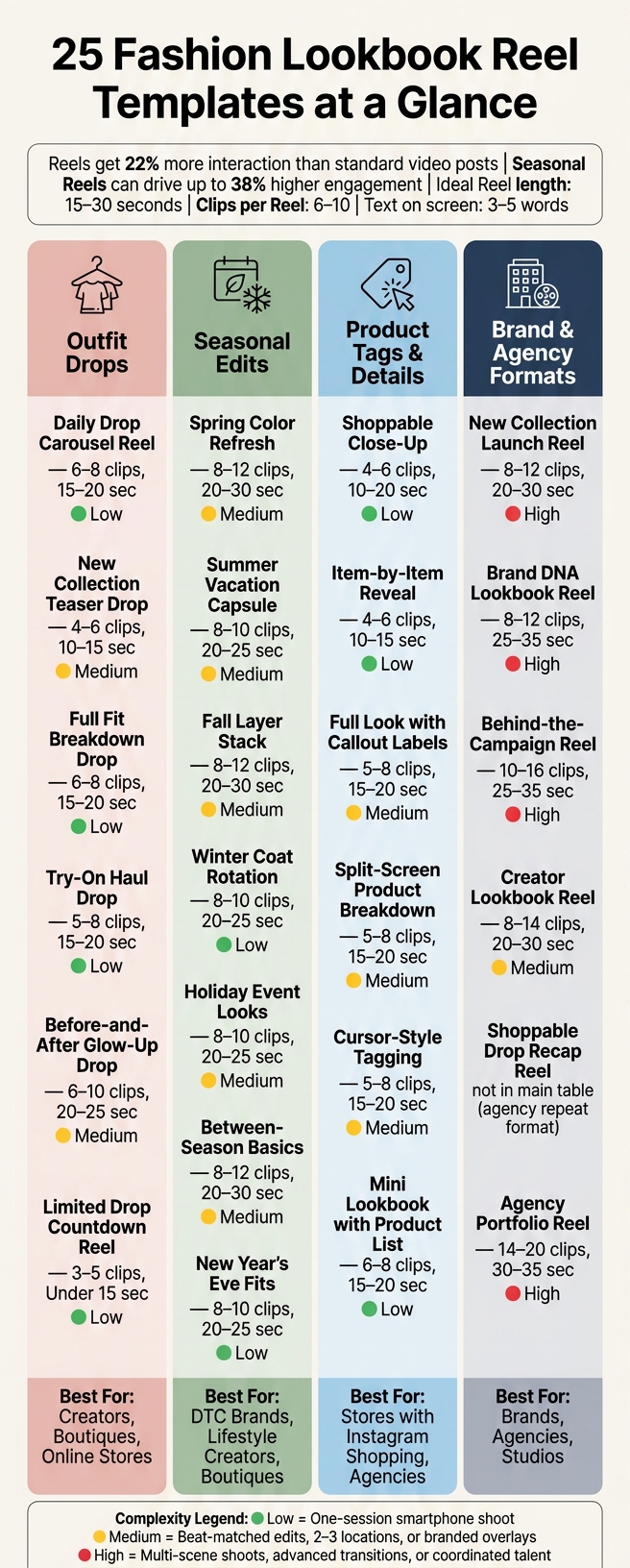
25 Fashion Lookbook Reel Templates: Quick Comparison Guide
After the detailed examples above, this table gives you a fast side-by-side view of all 25 templates. Find the row that lines up with your goal, account type, and how much you can shoot and edit.
Production complexity is simple on purpose:
- Low = one-session smartphone shoot
- Medium = beat-matched edits, 2–3 locations, or branded overlays
- High = multi-scene shoots, advanced transitions, or coordinated talent
| # | Template Name | Category | Primary Use Case | Ideal Account Type | Clip Count | Avg. Duration | Complexity |
|---|---|---|---|---|---|---|---|
| 1 | Daily Drop Carousel Reel | Outfit Drops | Multi-outfit weekly drop | Creator, Boutique | 6–8 | 15–20 seconds | Low |
| 2 | New Collection Teaser Drop | Outfit Drops | Pre-launch awareness | Brand, Agency | 4–6 | 10–15 seconds | Medium |
| 3 | Full Fit Breakdown Drop | Outfit Drops | Outfit detail and buying confidence | Boutique, Online Store | 6–8 | 15–20 seconds | Low |
| 4 | Try-On Haul Drop | Outfit Drops | Engagement-driven product discovery | Creator, Online Store | 5–8 | 15–20 seconds | Low |
| 5 | Before-and-After Glow-Up Drop | Outfit Drops | Styling transformation reveal | Stylist, Agency | 6–10 | 20–25 seconds | Medium |
| 6 | Limited Drop Countdown Reel | Outfit Drops | Urgency-driven limited release | Creator, Boutique | 3–5 | Under 15 seconds | Low |
| 7 | Capsule Wardrobe Drop | Outfit Drops | Capsule wardrobe demo | Stylist, Brand | 8–12 | 20–30 seconds | Medium |
| 8 | Spring Color Refresh | Seasonal Edits | Spring arrivals and new-season layering | Brand, Boutique | 8–12 | 20–30 seconds | Medium |
| 9 | Summer Vacation Capsule | Seasonal Edits | Travel and warm-weather outfit edit | Creator, Brand | 8–10 | 20–25 seconds | Medium |
| 10 | Fall Layer Stack | Seasonal Edits | Fall layering and back-to-season arrivals | Brand, Creator | 8–12 | 20–30 seconds | Medium |
| 11 | Winter Coat Rotation | Seasonal Edits | Winter outerwear showcase | Boutique, Brand | 8–10 | 20–25 seconds | Low |
| 12 | Holiday Event Looks | Seasonal Edits | Holiday party outfit edit | Boutique, Brand | 8–10 | 20–25 seconds | Medium |
| 13 | Between-Season Basics | Seasonal Edits | Transitional styling across weather changes | Creator, Agency | 8–12 | 20–30 seconds | Medium |
| 14 | New Year's Eve Fits | Seasonal Edits | New Year's Eve outfit reveal | Creator, Boutique | 8–10 | 20–25 seconds | Low |
| 15 | Shoppable Close-Up | Product Tags & Details | Single-item hero product spotlight | Boutique, Brand | 4–6 | 10–20 seconds | Low |
| 16 | Item-by-Item Reveal | Product Tags & Details | Styled set with 2–4 shoppable items | Creator, Online Store | 4–6 | 10–15 seconds | Low |
| 17 | Full Look with Callout Labels | Product Tags & Details | Full outfit with timed product callouts | Brand, Online Store | 5–8 | 15–20 seconds | Medium |
| 18 | Split-Screen Product Breakdown | Product Tags & Details | Multi-SKU catalog-style shoppable reel | Agency, Brand | 5–8 | 15–20 seconds | Medium |
| 19 | Cursor-Style Tagging | Product Tags & Details | Attention-directed item-by-item tagging | Boutique, Creator | 5–8 | 15–20 seconds | Medium |
| 20 | Mini Lookbook with Product List | Product Tags & Details | Full-look reel with end-card product list | Brand, Agency | 6–8 | 15–20 seconds | Low |
| 21 | New Collection Launch Reel | Brand & Agency Pages | Seasonal launch campaign | Brand, Agency | 8–12 | 20–30 seconds | High |
| 22 | Brand DNA Lookbook Reel | Brand & Agency Pages | Brand identity and editorial storytelling | Fashion Label, Agency | 8–12 | 25–35 seconds | High |
| 23 | Behind-the-Campaign Reel | Brand & Agency Pages | BTS and campaign process reveal | Brand, Agency | 10–16 | 25–35 seconds | High |
| 24 | Creator Lookbook Reel | Brand & Agency Pages | UGC compilation into one campaign reel | Brand, Agency | 8–14 | 20–30 seconds | Medium |
| 25 | Agency Portfolio Reel | Brand & Agency Pages | Multi-client range showcase for pitches | Agency, Studio | 14–20 | 30–35 seconds | High |
To choose the right row, start with Primary Use Case and look for the phrase that matches the post you want to make. Then check Complexity. That tells you, fast, whether the idea fits a simple shoot or needs more planning.
Clip Count and Avg. Duration set your target before you even open your editor. That matters more than most people think. If you know you need 6–8 clips for a 15–20 second reel, you can shoot with a clear plan instead of guessing your way through it.
A simple rule of thumb:
- Low works well for solo posting
- Medium fits repeatable brand content
- High is best for campaign work
Once you've picked a row, the next section shows how to scale and refine it with UpGrow.
Using UpGrow to Scale and Refine Fashion Reels
Use UpGrow to test which template works best for your audience. Start with the Viral Content Library to see how to go viral on Instagram by identifying which fashion Reel formats are already getting traction.
UpGrow's Viral Content Library helps you spot repeatable Reel patterns in fashion content. From there, pick the template that lines up with the hooks, clip lengths, and text styles driving reach and engagement in your niche right now. You can filter by interests like streetwear, luxury, or sustainable fashion to see which outfit drop formats, seasonal edit setups, and product-tag styles keep showing up in top-performing posts.
After you choose a template, test each version using the same targeting filters. Set filters by age, gender, location, language, and interest. Then publish different template types to the same audience and compare saves, shares, profile visits, and follower growth. The live dashboard tracks these metrics in real time, which makes it easier to spot a winning template fast and tweak the next post before the cycle resets. When Reels bring people to your profile, profile optimization can help turn those visits into follows.
For agencies, this same process works across client accounts. You can compare the same template from one dashboard - for example, how a Fall Layer Stack performs for a streetwear client versus a workwear client - then adjust clip pacing or text overlays for each account based on the data. Once targeting is set, use Boost™ on the strongest Reel.
Conclusion
The best template is the one that fits your goal, shoot setup, and posting rhythm. Pick the format that lines up with what you need most right now: sell new arrivals, build repeatable content, or grow a branded series. Think of the four groups as a toolbox, not a checklist to complete. Use outfit drops for inventory, seasonal edits for timely themes, product-tag templates for shopping, and brand formats when you want a series you can run again and again.
Once you choose a format, stick with it long enough to get a clean read. Start with two or three formats, run them for 30 days, and compare saves, shares, taps, and profile visits in Instagram Insights. Saves and shares now carry more weight than likes as signals for Reel distribution, so they deserve a central place in your reporting.
When one format starts working, give it a name, turn it into a weekly series, and post it on a set schedule. Change just one variable at a time - hook text, clip count, or CTA - so you can tell what’s moving the numbers. Start small, track the data, and keep the formats that steadily drive saves, taps, and follows.
FAQs
Which Reel template should I start with?
Start by matching the template’s hook to your goal. If you’re making educational content, problem-solution and step-by-step formats usually work best. For product demos, fast-fix and diagnostic hooks are often a better fit.
If you want ideas based on current trends, UpGrow’s Viral Content Library can help. It includes customizable templates for your niche, with formats like unboxings, testimonials, and lifestyle shots.
How many clips should a fashion lookbook Reel have?
A fashion lookbook Reel usually works best with 2–4 clips.
That keeps the sequence tight, so viewers can see the outfits fast and stay locked in. A simple setup like a before-and-after style contrast often does the job well.
This clip range fits transformation-style Reels in particular, where the goal is fast impact instead of a longer, more cinematic edit.
What metrics should I track for these Reels?
Track metrics based on your goal.
If attention is the goal, watch your 3-second view rate and retention. Those numbers tell you if your hook is doing its job or if people are scrolling past.
If you're aiming for engagement, focus on saves and shares. Those are strong signs that people didn’t just watch - they cared enough to keep it or pass it along.
For conversions, keep an eye on profile visits and clicks. UpGrow can help connect those performance signals to follower growth, so you can see which templates turn viewers into loyal followers.