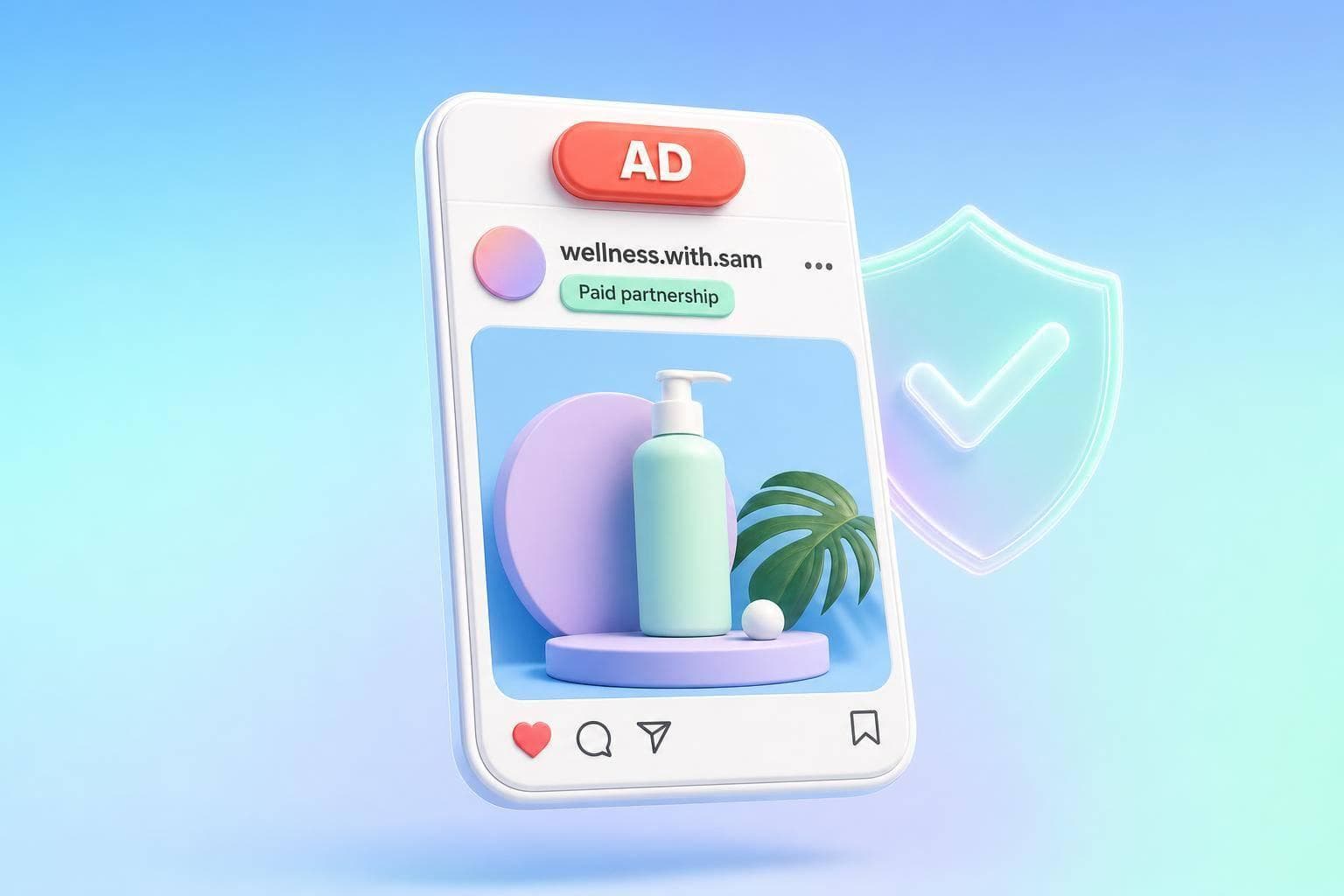
If you post sponsored Instagram content in the U.S., one rule matters most: disclose the relationship clearly and where people will see it right away. As of August 12, 2026, the FTC still expects plain labels like “Ad” or “Paid partnership with [Brand]”, and Instagram’s built-in paid partnership label does not cover the whole job by itself.
Here’s the short version:
- Disclose any material connection: payment, free products, affiliate commission, free trips, job ties, ownership, or family ties.
- Put disclosures upfront: in the first line of captions, before “See more,” and on-screen in Reels and Stories.
- Use direct words: “Ad,” “Sponsored,” or “Paid partnership with [Brand]”.
- Don’t rely only on Instagram tools: Meta’s label helps, but the FTC still wants plain-language disclosure people can spot fast.
- Brands, creators, and agencies all share risk: a contract alone won’t protect a brand.
- Claims need support: this is a bigger issue in health, fitness, food, finance, and other restricted areas.
- FTC pressure has stayed steady since 2023: warning letters, fake review rules, and civil penalty risk have kept this issue in focus.
- Research shows many creators still get this wrong while trying to grow their audience: one study found 76% put #ad in the middle of captions, while only 5% put it at the start.
- Disclosure does not automatically hurt performance: some research found no extra drop in engagement, and some tagged posts even saw more likes and comments.
A few points I’d keep top of mind before posting:
- If the content sounds like an endorsement and there’s a connection people may not expect, disclose it.
- If it’s a Story, Reel, or Live, don’t hide the disclosure in the caption alone.
- If content gets boosted as a Partnership Ad, FTC rules still apply, and Meta ad rules kick in too.
- If you’re in travel, fitness, food, or fashion, watch for gifted stays, free meals, affiliate links, and loaned products.
| Topic | What to do |
|---|---|
| Sponsored post | Add “Ad” or “Sponsored” at the start |
| Affiliate link | Say “I earn a commission if you buy” or “Affiliate link” |
| Gifted item or trip | Say the product, stay, or travel was provided |
| Reels/Stories | Add on-screen text; audio helps too |
| Live | Disclose at the start and repeat it |
| Paid Partnership tool | Use it, but don’t stop there |
| Brand review | Check claims, labels, and reposts before and after launch |
Bottom line: use both layers every time - FTC disclosure rules and Instagram’s branded-content tools. That’s the clearest way to cut down risk before a campaign goes live.
FTC Disclosures 101 for Social Media Influencers & Creators
sbb-itb-3c55afb
Core FTC Rules for Instagram Endorsements
The FTC's Endorsement Guides spell out what Instagram endorsements need to disclose. On Instagram, that can cover feed posts, carousels, Reels, Stories, Lives, and partnership ads when a creator recommends or endorses a product, service, or brand and has a material connection to it. In plain English: if a post sounds like an endorsement and leaves out a relationship that could matter to viewers, there's a problem. The first step is to decide whether the post is an endorsement. The next is to check whether a material connection needs to be disclosed.
Material Connections That Must Be Disclosed
A material connection is any relationship that could change how viewers judge the endorsement and that they would not normally expect. That includes:
- Cash payments
- Free or discounted products or services
- Affiliate commissions
- Free travel or event access
- Employment or ownership interests
- Personal or family ties, like promoting a spouse's or sibling's business
If an average viewer would not naturally assume the relationship exists, disclosure is usually required. That rule still applies even if the creator was never given a script. If there's compensation and a positive mention, the post can still count as an endorsement that needs disclosure.
Clear and Conspicuous Disclosure Standards
"Clear and conspicuous" means the disclosure must be easy to notice, easy to understand, and hard to miss. For feed posts and Reels captions, put "Ad", "Sponsored by [Brand]," or "Paid partnership with [Brand]" in the first line, before "See More" and before any hashtags. A disclosure tucked at the end of a long caption or buried in a hashtag pile does not meet the standard.
For Reels and Stories, use visible text on screen and, when it fits, an audio mention too. The text should be readable, high contrast, and stay up long enough for someone to catch it. In multi-frame Stories, the disclosure should appear on each frame with the endorsement or show up at regular intervals across the sequence, since viewers may jump in midway. For Live content, disclose at the start and repeat it from time to time for people who join late.
Those standards set the legal baseline. Instagram's labels and built-in tools are the next layer.
Disclosure Wording and Shared Liability
Use direct disclosure terms: "Ad", "Sponsored," and "Paid partnership with [Brand]." For affiliate deals, phrases like "Affiliate link" or "I earn a commission if you buy" make the money relationship plain. By contrast, vague labels like "Thanks [Brand]", "Partner", "Collab", "Ambassador," or brand-only hashtags do not clearly show that the relationship is paid.
Responsibility does not fall on just one side. Creators are responsible for what they post. Advertisers must instruct, monitor, and correct posts that miss the mark. Agencies and other middlemen can also face scrutiny if they run campaigns without solid compliance checks. A contract that dumps all responsibility on the creator does not shield the brand.
Next: map these FTC rules to Instagram's branded-content labels and ad tools.
How Instagram and Meta Policies Interact With FTC Requirements
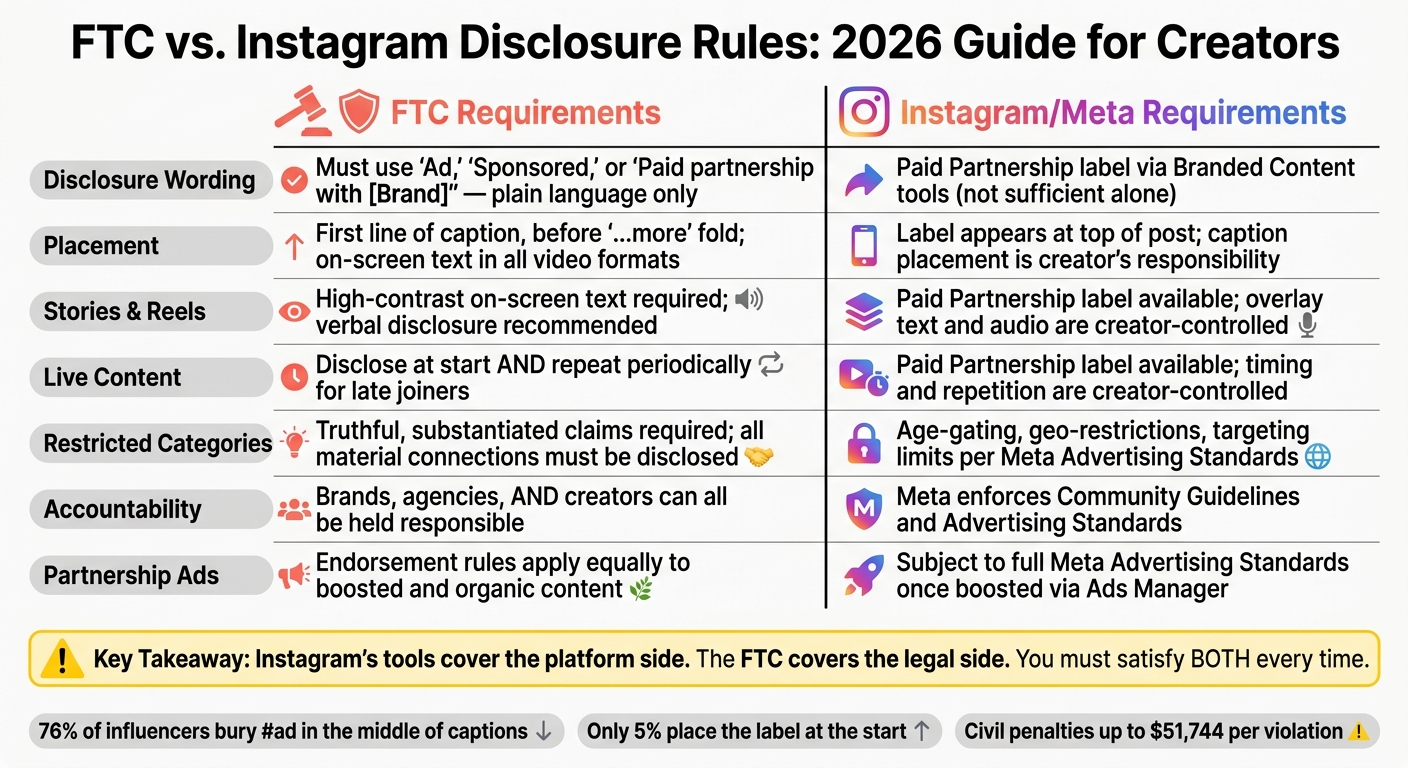
FTC vs. Instagram Disclosure Rules: What Every Creator Must Know in 2026
Instagram has built-in tools that make disclosures easier. That helps. But it doesn't remove FTC duties. Meta can set platform rules, while the FTC sets the legal standard. So the real issue is simple: do Instagram's tools cover both platform policy and FTC disclosure rules?
Paid Partnership Labels, Branded Content Tools, and Partnership Ads
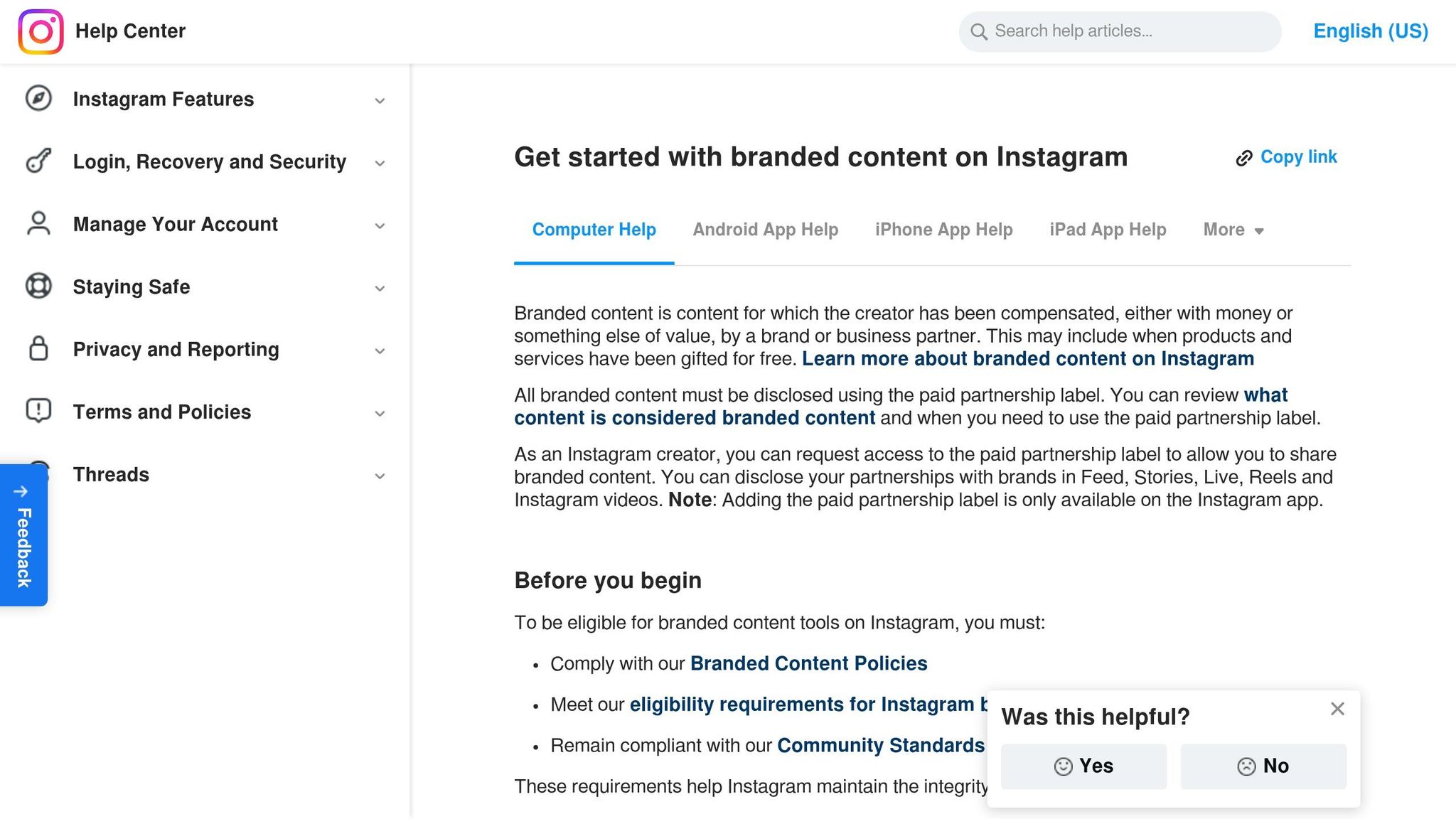
When a creator uses Instagram's Branded Content tools, a "Paid partnership with [Brand]" label appears at the top of eligible content across Feed, Stories, Live, Reels, and videos. Meta says that label is required when there's a commercial relationship with a brand.
That said, the label by itself is not enough for FTC compliance. Use the platform label and add a plain-language disclosure in the caption or on-screen. Think of it as a two-part setup: Meta wants the label, and the FTC wants people to notice and understand the disclosure.
Partnership Ads add another layer. These let advertisers boost creator content or run ads using the creator's handle and original content. Once that content becomes a Partnership Ad, it moves into Meta's paid ad system. At that point, it must follow the full Meta Advertising Standards, including rules on misleading claims, restricted categories, targeting, and community guidelines.
FTC endorsement rules still apply here too. If there's a material connection, it needs to be disclosed. And if the post makes claims, those claims need support. In regulated spaces, that two-layer setup gets tighter fast.
Sensitive Categories and Policy Restrictions
Meta places extra limits on alcohol, cosmetic/weight-loss, finance/insurance, subscription, and family-planning ads. These campaigns may need age-gating, geographic limits, or other targeting controls before they can run.
This is where people get tripped up. Getting through Meta review does not mean the FTC is satisfied. In restricted categories, risk goes up on both sides. The ad still needs clear disclosure, and claims still need to be truthful and backed up.
FTC vs. Instagram Requirement Mapping
| Requirement Type | FTC Expectation | Instagram/Meta Implementation |
|---|---|---|
| Disclosure wording | "Ad", "Sponsored", or "Paid partnership with [Brand]" | Paid Partnership label via Branded Content tools |
| Disclosure placement | First line of caption, before "…more" fold; on-screen in video | Label at top of post; caption placement is creator's responsibility |
| Stories and Reels | High-contrast on-screen text; verbal disclosure recommended | Paid Partnership label available; overlay text and audio are creator-controlled |
| Live content | Disclose at start and repeat periodically | Paid Partnership label available; timing and repetition are creator-controlled |
| Restricted categories | Truthful, substantiated claims; material connections disclosed | Age-gating, geo-restrictions, targeting limits, and claims rules per Meta Advertising Standards |
| Accountability | Brands, agencies, and creators can all be responsible | Meta enforces Community Guidelines and Advertising Standards |
| Partnership Ads | FTC endorsement rules apply to boosted and organic content equally | Subject to full Meta Advertising Standards once boosted through Ads Manager |
The clearest takeaway is this: Instagram's tools cover the platform side; the FTC covers the legal side. A post with the paid partnership label but no caption disclosure can still attract FTC attention. A post with a caption disclosure but no paid partnership label can still break Meta's Branded Content Policies. The safest move is to meet both sets of rules every time.
2023–2026 Enforcement Themes and Research Findings
FTC Enforcement and Public Guidance Trends
From 2023 through 2026, the FTC has kept its eye on the same Instagram slipups brands still make: hidden disclosures, fuzzy labels, and claims they can't back up. Since 2023, one point has come up again and again: whether a disclosure is easy to spot on a mobile screen.
In June 2023, the FTC updated its Endorsement Guides and made its position plain. Material connections must be disclosed, and endorsements can include social media tags, reposts, likes, and even simple brand mentions when a material connection exists. Then, in November 2023, the FTC sent warning letters to two trade associations and 12 health influencers and dietitians over Instagram and TikTok posts about aspartame and sugar products that did not include proper sponsorship disclosures. Those letters also included a Notice of Penalty Offenses, warning that future violations could bring civil penalties of up to $50,120 per violation.
In August 2024, the FTC finalized its rule on fake reviews and testimonials. That rule also goes after purchased followers, fake followers, and fake views, with civil penalties of about $51,744 per violation for deceptive review practices. On Instagram, fake engagement isn't just a marketing problem. It can become a legal one.
The FTC has also kept coming back to one very practical issue: placement. Disclosures buried after the "See more" cutoff, tucked into hashtag piles, or left in comments do not meet the clear and conspicuous standard. Put simply, if someone scrolling on a phone can miss it, it's too hidden.
That matters because Instagram compliance tends to break down in small, everyday choices, not just in big, obvious ones.
What Studies Show About Instagram Disclosure Compliance
The research lines up with the FTC's mobile-first view. An analysis of more than 20 million Instagram posts by affiliate network Awin found that 76% of influencers bury #ad disclosures in the middle of the caption, while only 5% put the label at the start.
Studies also point to a simple pattern: plain disclosure language works better than vague shorthand. In one experiment, "Paid Ad" led to much higher ad recognition than "Sponsored", "SP", or no label at all. Another study found that Instagram's "Paid partnership" label produced the highest ad recognition score, beating #paidad, a simple brand tag, and no cue. In plain English, short and direct labels are easier to spot and easier to understand.
A lot of brands still worry that disclosure will tank performance. The data doesn't support that broad claim. One large field study found that adding a disclosure did not further reduce engagement compared with undisclosed sponsored posts. HypeAuditor also reported that posts tagged #ad got more comments and likes on average than commercial posts without an ad-disclosure hashtag. So yes, disclosure is required, and no, it does not automatically hurt reach.
Niche Campaign Risks by Vertical
Some niches carry more risk because free products, affiliate deals, and sponsored access are easy to gloss over. With recent FTC attention, those misses can get expensive fast.
Here's how those problems tend to show up across verticals:
| Niche | Common Material Connections | Frequent Compliance Pitfalls |
|---|---|---|
| Travel | Gifted hotel stays, press trips, complimentary upgrades, hosted tours | Treating complimentary lodging as editorial coverage; hiding disclosure after "See more" or in hashtags |
| Fitness | Supplement sponsorships, affiliate commissions, free gear, performance-based pay | Results claims without support; vague or missing disclosure on Reels and Stories |
| Food | Complimentary meals, hosted tastings, restaurant-sponsored visits | Treating free meals or invited dining as an independent review; hiding disclosure in caption text |
| Fashion | Gifted products, loaned wardrobe items, affiliate links | Failing to label gifted or loaned items; affiliate links without clear sponsorship language |
Fitness and food draw the most pressure when claims about outcomes or ingredients enter the picture. That's why these issues are best caught before a campaign goes live, while teams can still review captions, labels, and claims.
Pre-Launch Compliance Review for Creators, Brands, and Agencies
Once you know the rules, the next move is simple: review the campaign before anything goes public. That step catches problems when they're still easy to fix.
Campaign Review Points Before Anything Goes Live
Start with a pre-launch checklist. First, confirm whether the post counts as an endorsement. Under FTC guidance, it does if a creator is paid, gets free products, earns affiliate benefits, or receives any other kind of value in exchange for posting. That applies to posts, reviews, affiliate links, discount codes, and brand tags. When planning these assets, using Instagram content ideas can help ensure variety while maintaining compliance.
Then map out every material connection tied to the campaign. That includes cash payments, gifted products, travel, discounts, affiliate commissions, ownership or employment links, and family relationships. Each one needs to be disclosed clearly and in plain view.
Claim review is where many teams slip up. In regulated spaces, every claim in a caption or video needs support the brand already has on hand. A creator's personal experience alone isn't enough. The FTC's 2023 warning letters to dietitian and health influencers made that point pretty clearly: health campaigns can draw fast scrutiny.
Disclosure testing also needs to happen format by format. What works in a feed caption can disappear in a Story or Reel. Use "Ad", "Sponsored", or "Paid partnership with [Brand]" at the start of captions, on-screen in Reels and Stories, and spoken aloud in Lives. If the content is reposted or reused, the disclosure needs to stay with it.
Tool Setup, Documentation, and Monitoring
After the disclosure and claim check, move to platform setup and documentation.
Instagram's Paid Partnership label adds another layer of transparency, but it does not replace FTC disclosure rules. Teams should make sure the label is turned on correctly, matches the actual brand relationship, and is visible in the final published asset, not just tucked away in backend settings.
Contracts and briefs should make a few things plain:
- who handles disclosure wording
- which claims are off-limits without substantiation
- whether the brand has to approve the final asset before it goes live
It also helps to keep copies of deliverables, screenshots of published posts, and a record of where disclosures appear in each format. For agencies, that paper trail matters. If questions come up later, written records showing who reviewed the campaign and when changes were made can save a lot of trouble.
Once the asset is approved, set up a simple plan to monitor live posts and reposts.
After content goes live, check that the disclosure still shows up clearly. Platform compression, caption edits, or Story reshares can break labeling that looked fine at launch. Monitoring tools should flag caption edits, Story reshares, and label loss after posting. That record makes it much easier to catch issues before they spread.
Key 2026 Takeaways
The main rule has not changed: material connections must be disclosed, and those disclosures must be easy to notice and understand. Instagram's branded content tools have gotten better, but they support FTC compliance rather than replace it. Since 2023, enforcement has kept focusing on weak, partial, or hidden transparency.
For fitness, food, travel, fashion, and other higher-risk campaigns, a documented pre-launch review is still the safest path. That review should cover the content type, material connections, claim substantiation, disclosure placement, platform setup, and a post-publication monitoring plan. That's the checklist that helps teams avoid the compliance gaps that keep drawing FTC attention.
FAQs
Do gifted products count as sponsorships?
Yes. Under FTC guidelines, a free product counts as a material connection, so you need to disclose it clearly.
That rule applies even if you weren't paid, weren't asked to post, and weren't told what to say. If you feature the product, make the brand relationship obvious with wording like Gifted by [Brand] or PR package from [Brand].
A simple brand tag isn't enough. And vague wording doesn't cut it either.
Is Instagram’s Paid Partnership label enough?
No. The Paid Partnership label by itself does not meet FTC rules.
Your disclosure needs to be clear and conspicuous. Think of the label as backup, not the whole job. It should show up right away, ideally at the very start of the caption.
Also, don’t hide the disclosure in links, hashtags, or menus. Use plain language people can spot fast, like Ad, Sponsored, or Gifted by [Brand]. That wording should appear across Feed, Stories, and Reels.
Who is liable for missing disclosures?
Liability is broad here: both influencers and brands are on the hook for compliance.
If an influencer fails to disclose a material connection or AI-generated content, fines can reach $43,792 per non-compliant post. That’s not a small slap on the wrist. It can add up fast, especially across a campaign with multiple posts.
Brands don’t get a pass, either. They’re fully accountable for their AI-generated content and campaigns. If disclosures aren’t clear and conspicuous, the fallout can include legal penalties, account suspensions, and lost audience trust.
In plain terms, this isn’t just the influencer’s problem. It’s the brand’s problem too.