
Influencer Rules in 16 Markets: Cheat Sheet
Clear rules for disclosing paid, gifted, or affiliate posts across 16 markets — where to label, when to file, and what to document.
Clear rules for disclosing paid, gifted, or affiliate posts across 16 markets — where to label, when to file, and what to document.
4.98 /5 - from 58k reviews
Trusted by 50,000+ creators — get real engagement delivered to your profile in minutes, not days.

If a creator gets paid, gifted a product, given a discount code, or earns affiliate income, I should treat the post as an ad and disclose it clearly. That is the core rule across all 16 markets in this guide. And the risk is not small: an EU review found that 97% of influencers posted commercial content, but only 20% disclosed it in a steady way.
Here’s the short version I’d use before posting:
This guide covers these 16 markets: United States, Canada, United Kingdom, European Union, Germany, France, Australia, India, Singapore, Japan, United Arab Emirates, Saudi Arabia, South Africa, Brazil, Mexico, and Russia.
A few local points stand out fast:
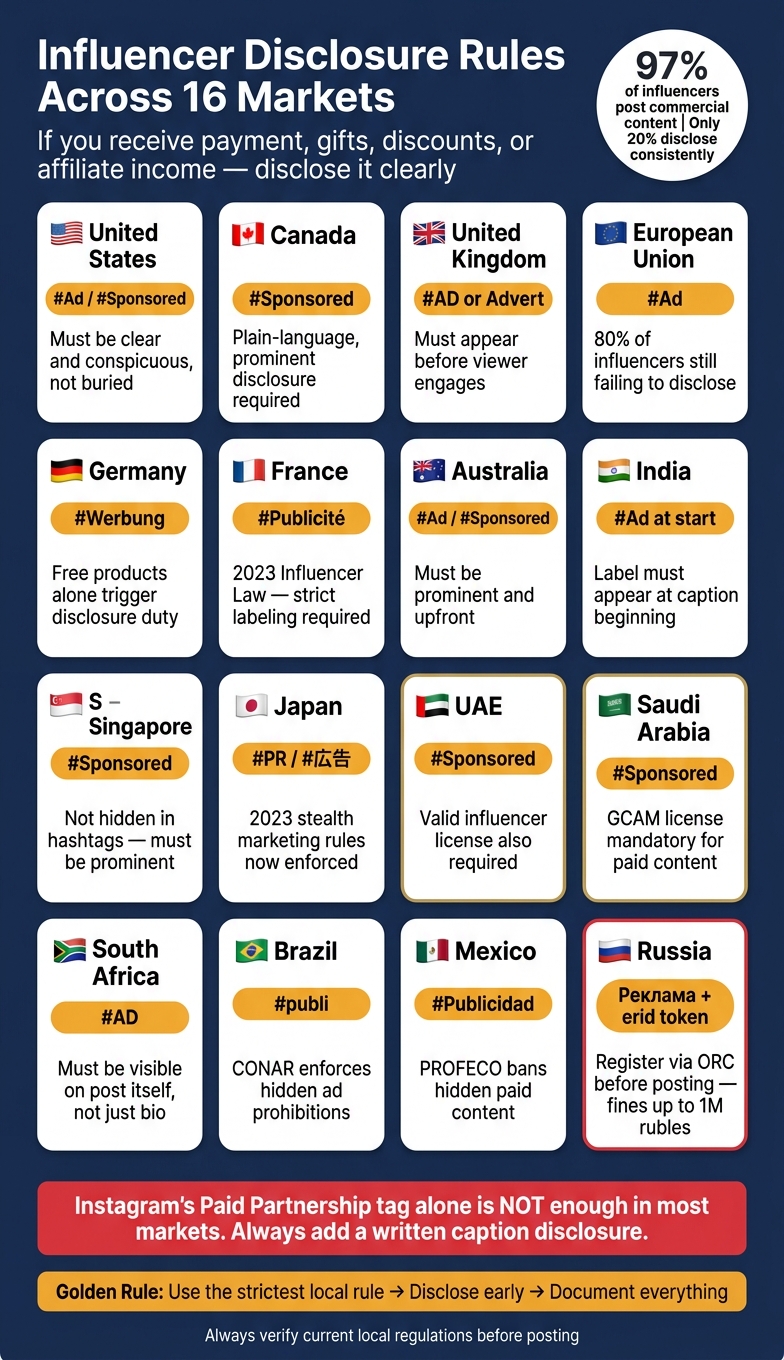
Influencer Disclosure Rules: 16-Market Cheat Sheet
| Market | Main point |
|---|---|
| United States | Clear, conspicuous disclosure of any material connection |
| Canada | Plain-language disclosure of paid relationships |
| United Kingdom | Ads must be obvious upfront, often with Ad or Advert |
| European Union | Disclosure gaps remain high despite broad ad-posting activity |
| Germany | Commercial intent can need disclosure even without cash payment |
| France | 2023 law requires clear labeling and limits some promotions |
| Australia | Disclosure must be plain and easy to notice |
| India | #Ad or #Sponsored should appear at the start |
| Singapore | Paid ties must be disclosed clearly, not buried |
| Japan | 2023 stealth marketing rules require ad relationship disclosure |
| United Arab Emirates | Sponsored content disclosure plus license rules |
| Saudi Arabia | Paid content disclosure plus license rules |
| South Africa | Terms like #AD must be easy to see on the post itself |
| Brazil | #publi or similar wording is commonly used |
| Mexico | Paid content must be clearly identified |
| Russia | “Реклама” + erid token + ad registration/reporting |
If I had to boil the full article down to one rule, it would be this: use the strictest local rule, disclose early, and document everything before the post goes live.
These baseline rules apply in most markets: disclose any material connection. Start here, then check the stricter local rule for each market.
Use plain labels like Ad, Advertisement, Sponsored, or Promotion. Put the label first in the caption, before any hashtags. That matters on Instagram because captions often collapse after the first two lines.
Stories and Reels need an on-screen disclosure. Video and Live content need a spoken disclosure at the start. If a campaign includes multiple posts, repeat the disclosure on every single post.
Instagram’s built-in Paid Partnership label can help, but it usually shouldn’t stand alone. Add a written disclosure too, unless local law says the tag by itself is enough.
Prize posts still count as advertising when a sponsor provides the prize or funds the promotion. So a giveaway isn’t “just a fun post” from a compliance point of view.
Giveaway posts must name the sponsor, explain the entry terms, and show the closing date plus key restrictions. They can also trigger local ad and prize rules, so check each market before anything goes live.
Use the table below as a quick scan, then read the market-by-market rules for the exact requirements.
| Market | Key compliance point |
|---|---|
| United States | Disclose any material connection clearly and conspicuously; FTC requires the label to be unavoidable, not buried in hashtags. |
| Canada | Disclose paid relationships clearly; ASC guidelines require prominent, plain-language labels. |
| United Kingdom | CAP Code requires ads to be obviously identifiable; "Ad" or "Advert" must appear before engagement. |
| European Union | 97% of influencers shared commercial content, but only 20% consistently disclosed it; about 80% failed to disclose properly. |
| Germany | Commercial intent must be disclosed even without payment; courts have ruled that free products alone trigger disclosure. |
| France | Influencer Law (2023) requires explicit labeling of commercial content and prohibits certain undisclosed promotions. |
| Australia | AANA Code requires clear and obvious disclosure; "Ad" or "Sponsored" must be prominent and upfront. |
| India | ASCI guidelines require "#Ad" or "#Sponsored" at the start of the caption; endorsers must have used the product. |
| Singapore | ASAS guidelines require clear disclosure of paid partnerships; labels must be prominent and not hidden in hashtags. |
| Japan | Stealth marketing regulations effective 2023 require clear disclosure of advertiser relationships. |
| United Arab Emirates | National Media Council rules require disclosure of sponsored content; influencers must hold a valid license. |
| Saudi Arabia | GCAM requires licensed influencers to disclose paid content clearly; unlicensed commercial activity is penalized. |
| South Africa | Clear terms like "#AD" or "#Sponsored" must be immediately visible. |
| Brazil | CONAR guidelines require "#publi" or equivalent disclosure; PROCON enforces consumer protection rules on hidden ads. |
| Mexico | PROFECO consumer protection rules require clear identification of paid content; hidden advertising is prohibited. |
| Russia | "Реклама" plus a unique "erid" token is required, and all internet advertising must be registered through an ORC before posting. |
The next section breaks down the rules market by market.
Below are the main local rules that go beyond the shared disclosure baseline. Start with the global rules above. Then check each market for any local twist.
The ASA and CMA require a clear disclosure on any paid or promo-related Instagram content. Use #AD or Paid Partnership.
The ARB applies Appendix K of the Code of Advertising Practice. Use #AD, #Advertisement, or #Sponsored. A July 2025 ruling against Superbalist made one point clear: a bio promo code does not replace disclosure on the post itself.
The FAS requires "Реклама" and an ORC-issued erid token before posting. Instagram's Paid Partnership label on its own does not meet the rule. You also need to file the post-publication report within 30 days.
Fines range from 10,000 to 500,000 rubles for individuals and up to 1,000,000 rubles for companies.
Use this checklist before every post to apply the market rules above.
First, confirm whether the creator received anything of value or has a prior relationship with the brand that could affect credibility. If the answer is yes, disclosure rules apply.
Once you've confirmed there is a material connection, go through these steps before publishing:
Platform tools can help people see the disclosure, but they don’t replace local law.
Instagram’s branded content tools is useful, but it does not replace local disclosure rules. The FTC says this clearly:
"Don't assume that using a platform's disclosure tool is sufficient... The ultimate responsibility for making clear disclosures is yours." - Federal Trade Commission (FTC)
If you’re running campaigns across more than one market, treat Instagram’s built-in tools as a backup layer, not the whole plan. Add a manual caption disclosure, confirm the label required in that market, and document the full approval workflow.
Across all 16 markets, the fastest way to stay compliant is pretty simple: if a post involves payment or a gift, disclose it clearly. Any material connection triggers that duty, and the label needs to be easy to see and placed where people can't miss or skip it.
Instagram's Paid Partnership tag can help, but it doesn't override local rules. Local disclosure rules still decide what counts. That means you should also add a written disclosure in the caption, check the exact label required in that market, and keep a record of the approval workflow.
Giveaways call for the same level of care. Make the sponsor's identity clear, spell out the terms, confirm who is eligible, and check local prize laws before anything goes live.
If there's any doubt, use the strictest local rule as your starting point.
A post counts as an ad when there’s a material connection between the creator and a brand. That can mean payment, free products, discounts, or any other perk given in exchange for promoting or reviewing a product or service.
It can still count as an ad even without a formal contract. Gifted products, for example, may fall into that category if the post is promotional. And if the brand has any control over the content, such as asking for a positive review or telling the creator what tone to use, the post is also an ad.
No. Instagram’s Paid Partnership tag can help label branded content, but it shouldn’t take the place of a clear disclosure right in the post.
In many markets, including the United States, disclosures need to be easy to spot and easy to understand. If you rely on the platform tag alone, that may not satisfy local legal rules. It’s smart to check local ad laws and make sure your disclosure is clear and prominent.
Russia has an extra compliance step for internet ads, and that includes influencer marketing.
If a post is paid for - or exchanged through barter - it must be registered through an authorized Operator of Advertising Data to get an erid token. That token then needs to appear in the post. After the post goes live, post-publication reporting is also required.
Spain has its own registry rule. Influencers who are classed as users of special relevance must register in the State Registry of Providers of Audiovisual Communication Services.


