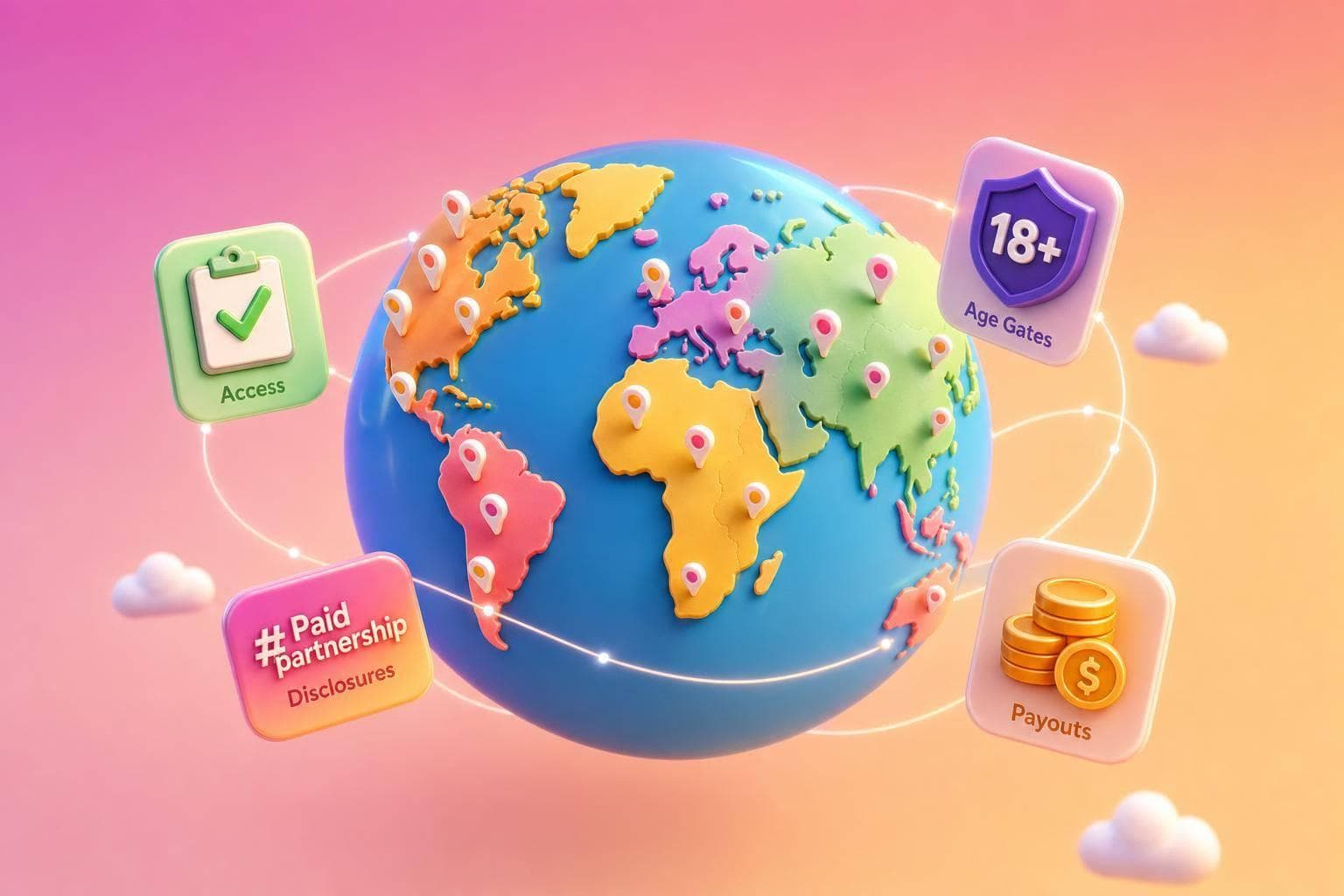
Instagram branded content is not one-rule-fits-all. If I run a campaign in the U.S. and another market, I need to check four things before launch: country access, product limits, age gates, and disclosure wording.
Here’s the short version:
- Meta’s base policy applies everywhere
- Country access still changes by market
- Some products are banned worldwide
- Some categories need 18+ or 21+ targeting, local licenses, or Meta approval
- The Paid Partnership label alone is not enough
- Live has a big gap: no age or location gating
- Both the brand and creator must be in eligible places for some tools and payouts
A few facts stand out:
- Alcohol rules can shift from 21+ in the U.S. to 25+ in Sweden
- Some places are a hard stop, including Russia, Cuba, Iran, North Korea, Syria, and Crimea
- Monetization access can be full, limited, or unavailable depending on the tool and market
If I were planning a cross-border Instagram deal, I’d keep the checklist simple:
- Check account eligibility
- Check the product category
- Set age and location limits
- Use the Paid Partnership label
- Add a plain disclosure like
#ad - Confirm local-language wording
- Recheck tools and payout status before launch
Bottom line: Instagram branded content compliance is less about one global approval and more about country-by-country setup.
| Check | What I need to verify |
|---|---|
| Access | Are branded content tools, ads, and payouts live in that market? |
| Category | Is the product banned, restricted, or approval-based? |
| Age rules | Does the campaign need 18+, 21+, or a local minimum? |
| Disclosure | Do I need the label, #ad, and local-language wording? |
| Format | Is it a Feed post, Reel, Story, or Live? |
| Ads | If boosted, are restrictions reset in Meta Ads Manager? |
If I get those six checks right, I cut the risk of takedowns, blocked ads, and broken campaign terms.
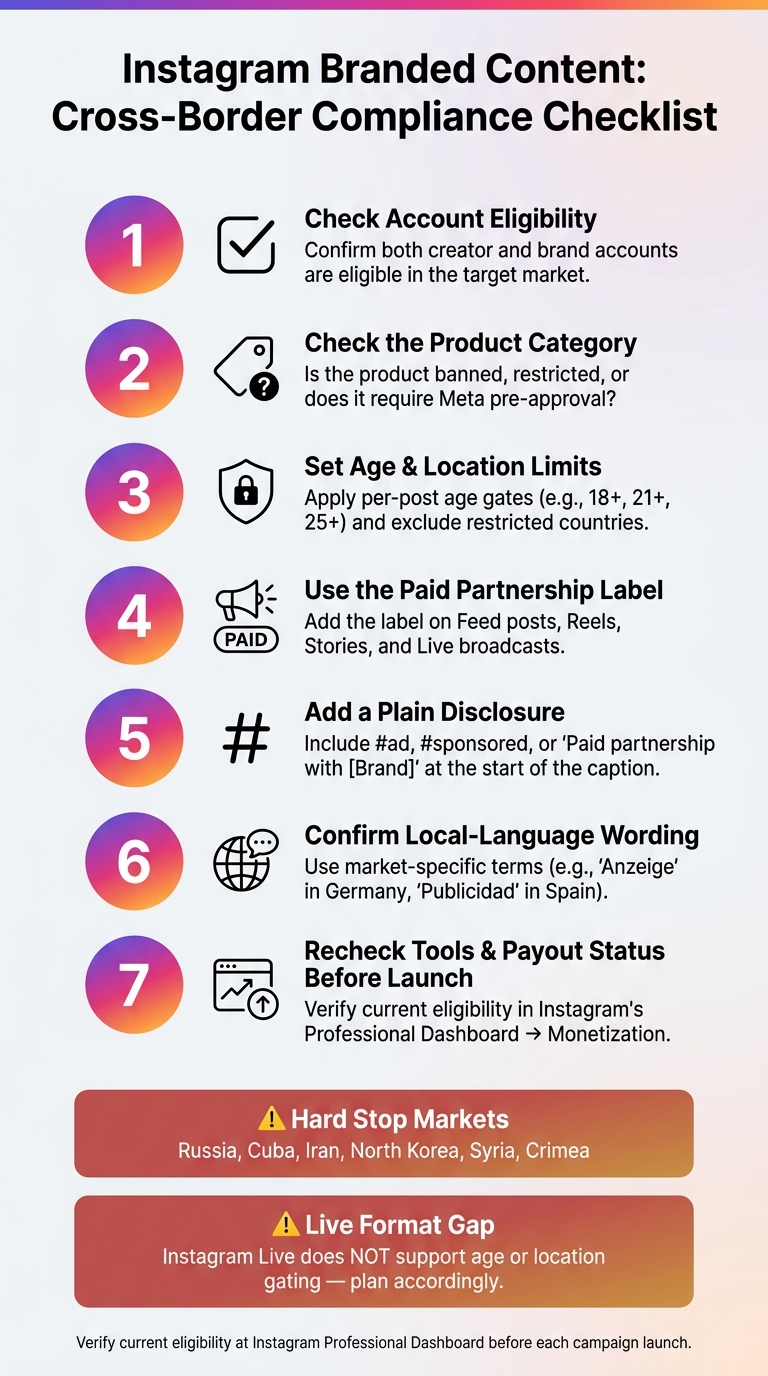
Instagram Branded Content Compliance Checklist: 7 Steps for Cross-Border Campaigns
Instagram branded content policy: the basics
Before you look at regional availability, get the ground rules straight.
Branded content is content from a creator or publisher made in exchange for value from a business partner. Brands often use an influencer pricing calculator to determine fair market rates for these exchanges. That value can include money, gifts, discounts, travel, free products, or services. For example, if a U.S. fitness creator gets free supplements and posts a Reel about them with a discount code, that counts as branded content. Access to branded content tools also changes by market, so these base rules apply first.
Branded content comes in two formats: organic posts and Partnership Ads.
Organic branded content is a creator's post published on the creator's profile and tagged with the brand using the Paid Partnership label. Partnership Ads use that same post as a paid ad through Meta Ads Manager, with the Paid partnership with [Brand] label still shown. Organic posts must follow Meta's Community Guidelines and branded content rules. Partnership Ads must also follow Meta's full advertising policies, along with any regional ad rules.
Once that's clear, the next step is figuring out who can use the tools.
Who can use branded content tools
Only Creator or Business accounts can use Instagram's branded content tools, and brands need a Business account to run Partnership Ads. Personal profiles can't use these tools.
Accounts also need to stay clear of major policy violations. That includes repeated breaches of Meta's Community Guidelines. If an account runs into those issues, it can lose access to branded content tools or face suspension.
Restricted and prohibited content categories
Not every product or service can be promoted through branded content. Some categories are banned outright. Others are allowed only if age limits, location controls, or Meta approval are in place.
Fully prohibited categories include illegal products and services, tobacco and vaping products, illicit drugs, unsafe supplements, weapons and ammunition, and certain adult products and services, including explicit sexual content. These rules apply worldwide. So if a U.S. fitness brand wants to pay a creator to promote banned steroids, that still isn't allowed as branded content, even if those products are legal in some other place. Meta's global rules still control the situation.
Restricted categories can appear in branded content, but only when the right controls are set up. Here's how the main ones work:
| Category | Restriction Type | What's Required |
|---|---|---|
| Alcohol | Age + geography controls | Target users above the legal drinking age; some markets are excluded |
| Financial and insurance products and services | Age controls + compliance | Not targeted to minors; some subcategories, such as crypto, require Meta pre-approval |
| Cosmetic procedures & weight-loss products | Age controls | Age-appropriate targeting; no unsafe or exaggerated claims |
| Gambling with real money | Meta pre-approval required | Must be licensed; prior written approval before any campaign |
| Prescription medications & pharmacies | Meta pre-approval required | Licensed operators only; approval required before promotion |
| Family planning & contraception | Age controls | Target adult audiences appropriately |
If a post in a restricted category gets turned into a Partnership Ad, the age and geography restrictions need to be set again in Meta Ads Manager. It's not enough to apply them only at the organic post level.
These are the baseline rules; next comes which markets support the tools and monetization features.
sbb-itb-3c55afb
Which countries and regions can access branded content and monetization
Core branded content tools are available in most places where Meta ads run. But monetization is a different story. Access to payouts adds one more account-level check on top of feature access.
There’s also a two-sided rule here: both the creator and the brand must be in eligible countries. If an account is moved to a non-eligible country, access can disappear. And monetization features - Creator Marketplace, Gifts, Subscriptions, and Reels monetization - don’t go live the same way in every market.
Use the table below to separate broad branded content access from places where monetization or payouts may be limited.
Country availability table for core access versus limited access
Before you get sponsored on Instagram, verify what’s live for that account in Instagram’s Professional Dashboard → Monetization.
| Country / Region | Branded Content Tool | Partnership Ads | Creator Marketplace | Gifts | Subscriptions | Reels Monetization | Payout Availability |
|---|---|---|---|---|---|---|---|
| United States | Full | Full | Full | Full | Full | Full | Check current eligibility |
| Canada | Full | Full | Full | Check current eligibility | Full | Full | Check current eligibility |
| United Kingdom | Full | Full | Full | Check current eligibility | Full | Full | Check current eligibility |
| Germany | Full | Full | Full | Full | Full | Full | Check current eligibility |
| France | Full | Full | Full | Check current eligibility | Full | Full | Check current eligibility |
| Australia | Full | Full | Full | Check current eligibility | Full | Full | Check current eligibility |
| Japan | Full | Full | Full | Full | Full | Check current eligibility | Check current eligibility |
| Brazil | Full | Full | Full | Check current eligibility | Full | Full | Check current eligibility |
| Mexico | Full | Full | Full | Check current eligibility | Full | Full | Check current eligibility |
| India | Full | Full | Full | Check current eligibility | Full | Full | Check current eligibility |
| Indonesia | Full | Full | Full | Full | Full | Full | Check current eligibility |
| South Korea | Full | Full | Full | Full | Full | Check current eligibility | Check current eligibility |
| UAE | Full | Full | Full | Limited | Limited | Limited | Check current eligibility |
| Saudi Arabia | Full | Full | Full | Limited | Limited | Limited | Check current eligibility |
| South Africa | Full | Full | Full | Limited | Limited | Limited | Check current eligibility |
| Russia | Not available | Not available | Not available | Not available | Not available | Not available | Not available |
| Crimea / Cuba / Iran / North Korea / Syria | Not available | Not available | Not available | Not available | Not available | Not available | Not available |
Markets with limitations or exclusions
Creator Marketplace is available wherever Meta ads run, except in Crimea, Cuba, Iran, North Korea, Syria, and Russia. If a deal depends on monetization or paid distribution, those sanctioned or restricted territories are a hard stop.
Outside those markets, limits can still show up for simpler reasons. A feature may not have launched there yet. Local payment rules may block it. Or the account may not have payout support set up. Payout access depends on using a supported payout account in an eligible country.
That’s why both the creator and the brand should check current status in Instagram’s Professional Dashboard or Meta Business Suite, then keep a record of that result for the campaign file.
Next, check age limits and disclosure rules, which can change by market and category.
Age limits, disclosure rules, and local compliance
Once you’ve confirmed a market is allowed, check the age gate and disclosure setup before anything goes live. If those settings are off, Instagram can hide the post or take it down.
Age restrictions by category and market
Instagram allows business and creator accounts to set per-post age gates, including country-specific minimum ages. That setting applies post by post, so it resets with each new campaign.
Some categories usually need 18+ targeting at a minimum, along with any stricter local legal age rules.
Alcohol is the clearest case for why a single global rule doesn’t work. In the U.S., the minimum is 21+. In Sweden, it’s 25+. And in some countries, Meta doesn’t allow alcohol ads at all.
Real-money gambling comes with even tighter rules. Brands need Meta pre-approval, valid licenses in each target jurisdiction, and 18+ targeting before launch.
Instagram may also hide posts about diet products or cosmetic procedures from people under 18. If the post makes claims that break policy, it can be removed.
How to apply the Paid Partnership label correctly
Use the Paid Partnership label on feed posts, Reels, Stories, and Live. Add it while publishing, tag the brand, and switch on Partnership Ads only if paid promotion is part of the plan.
That label does not replace a plain-language disclosure. You still need #ad, #sponsored, or "Paid partnership with [Brand]" at the very start of the caption, before the caption gets cut off.
Format matters here:
- Reels: use a text or verbal disclosure
- Stories: add a clear overlay people can see on screen
- Live: give a verbal disclosure at the start, then repeat it during longer broadcasts
One catch: Instagram Live branded content does not support age or location gating.
Outside the U.S., use a disclosure in the local language that makes the sponsorship plain. For example, Anzeige in Germany or Publicidad in Spain. Put it at the start of the caption or use a visible overlay.
For cross-border campaigns, localized disclosure templates and local Instagram influencer search tools help keep creators on the same page with the right wording in each country.
Disclosure and restriction table by content type
The table below shows how disclosure and age gating shift by format.
| Format | Paid Partnership label placement | On-screen disclosure recommended | Age gating available | Extra compliance notes |
|---|---|---|---|---|
| Feed post | Under creator's username | No, but caption disclosure should appear in the first line | Yes | Add #ad or Paid partnership with [Brand] before the caption folds |
| Reels | Under creator's username | Yes - text overlay or verbal disclosure in the first few seconds | Yes | Pair the label with a clear caption disclosure above the fold |
| Stories | On the Story frame | Yes - readable overlay across the full frame | Yes | Keep the disclosure visible for the whole Story frame |
| Live | Shown during broadcast | Yes - verbal disclosure at the start and periodically | No | Pinned comments are not sufficient; age gating isn't available for Live |
Use these rules to build market-by-market campaign checks.
How brands can plan cross-border Instagram campaigns
Cross-border campaigns need a market-by-market compliance check. Once you know the policy basics, apply them separately in each country you plan to target.
A region-by-region campaign checklist
Use the same rules across markets, but verify them one country at a time.
-
Confirm country eligibility
Make sure both accounts are eligible in the target market before contracts are signed and then check again before launch. -
Review category restrictions and set age gates
Set age gates and location exclusions based on each market’s local rules, especially for regulated categories. -
Prepare required disclosures and approvals for each market
Your contracts should state which disclosure format applies in each country and what happens if a post goes live without the right label.
Use location and audience data to plan safer campaigns
Use Instagram Insights to see where the creator’s audience is concentrated before you lock in market restrictions. This step matters. If a creator’s audience leans toward a country with tighter rules, you may need stricter location limits or a different content format.
Key rules to check before any regional brand deal
Before launch, confirm account eligibility, disclosures, and any needed age or location limits. U.S. law can also apply to posts made outside the United States if it is reasonably foreseeable that U.S. consumers will see them. Check the latest Instagram and Meta eligibility docs before launch.
FAQs
Do both the brand and creator need to be in eligible countries?
Yes, often they do. The exact rules can change based on the feature, but in most cases, a business needs to operate in a supported market to use monetization tools like shopping.
It also helps to check where the creator’s audience is based. If your product is sold in the United States, the creator should have an audience that lines up with that. For U.S.-focused campaigns, it’s recommended that 70% to 80% of the creator’s audience be U.S.-based.
What happens if I boost a branded post into a Partnership Ad?
Boosting a branded post into a Partnership Ad turns it into a paid ad that runs under the creator’s handle while keeping the required disclosure. That means the post can go far beyond the people who would’ve seen it on its own.
To make that happen, the creator needs to add the Paid Partnership label and switch on Allow brand partner to boost. That gives the brand permission to promote the post.
Is the Paid Partnership label enough by itself?
No. The Paid Partnership label by itself is not enough. Instagram’s label can help support your disclosure, but it shouldn’t replace a clear and conspicuous disclosure.
If you want to stay compliant and keep trust intact, the disclosure needs to be easy to spot, visible right away, and not tucked away in hashtags, links, or menus.