Table of contents
- How to Build Fail-Proof Influencer Contracts
- What This 10-Clause Template Covers
- 1. Parties and Campaign Scope
- 2. Content Deliverables
- 3. Posting Schedule and Deadlines
- 4. Payment Terms and Compensation
- 5. Content Rights and Intellectual Property
- 6. Approval Process and Revisions
- 7. Usage Rights and Exclusivity
- 8. FTC Disclosure and Legal Compliance
- 9. Cancellation, Termination, and Force Majeure
- 10. Dispute Resolution and Governing Law
- How the Same Contract Template Changes by Niche
- Contract Red Flags to Catch Before Signing
- Tools for Managing Instagram Collaborations
- Conclusion
- FAQs
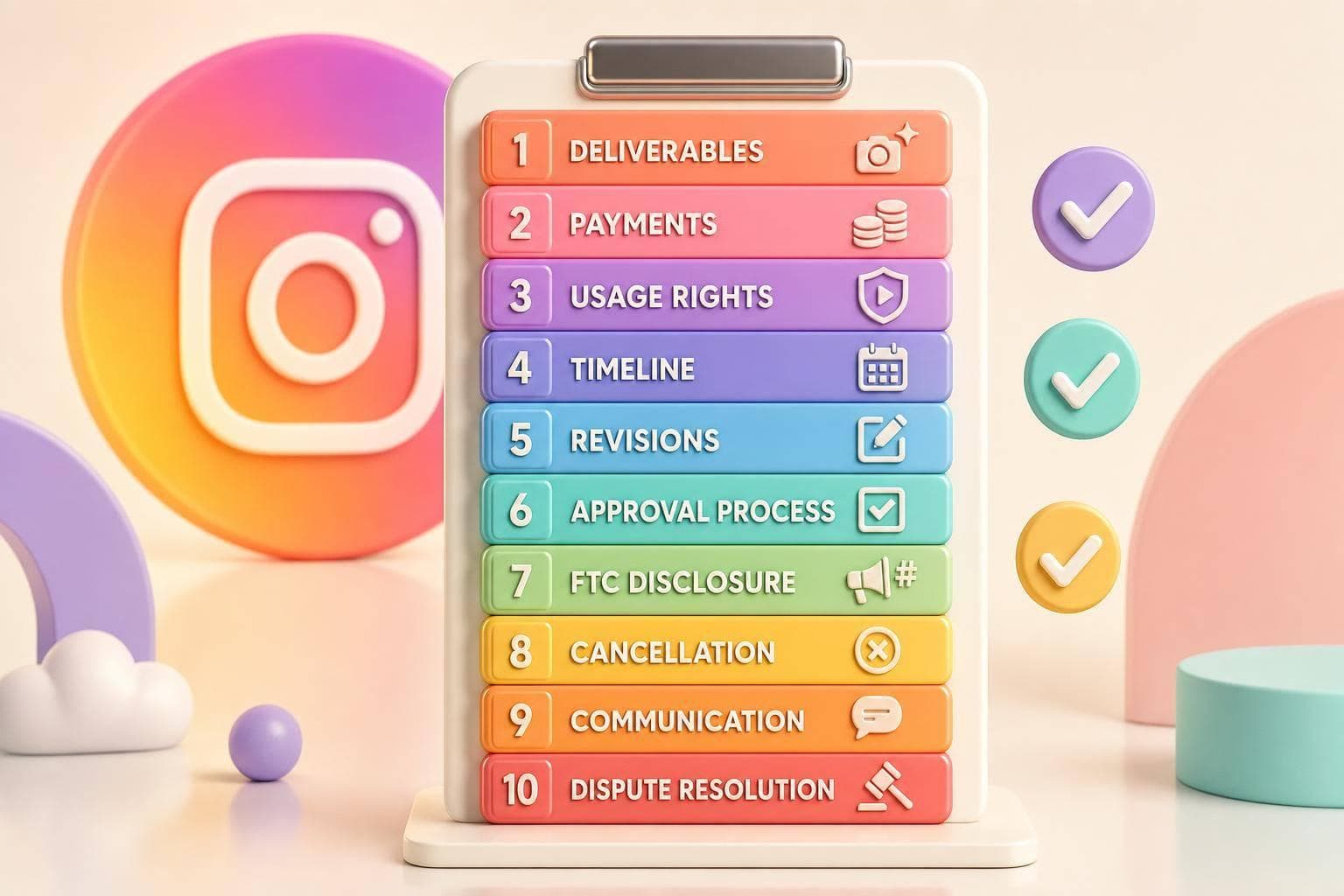
If your Instagram deal is not in writing, you are leaving payment, posting dates, content rights, and FTC disclosures open to argument. This guide boils the contract down to 10 core clauses so I can lock in who does what, when content goes live, how much gets paid, who can reuse the post, and what happens if the deal falls apart.
Here’s the short version:
- I need the contract to name the parties and the campaign scope
- I need each deliverable listed in plain terms
- I need posting dates, review windows, and live-period rules
- I need payment terms in USD, including triggers and due dates like Net 15 or Net 30
- I need content ownership and usage rights spelled out
- I need revision limits and approval deadlines
- I need FTC disclosure rules written into the deal
- I need cancellation, breach, and force majeure terms
- I need a dispute process and governing law
- I need niche-specific edits for fitness, fashion, food, and travel
One stat says a lot: Instagram influencer marketing spend hit about $2.21 billion in 2024. And under FTC rules, if money, gifts, trips, or affiliate pay are involved, that relationship must be disclosed clearly in sponsored content. That should be in the contract, not buried in a DM thread.
A quick way to think about it: this template is built to stop the most common problems before they start - scope creep, late approvals, missed payments, rights grabs, and weak disclosure terms.
| Clause | What it covers |
|---|---|
| 1. Parties & scope | Who is in the deal and what the campaign includes |
| 2. Deliverables | Posts, Stories, Reels, captions, tags, links, and reports |
| 3. Schedule | Draft dates, review windows, post dates, and time zone |
| 4. Payment | Fee, trigger, due date, method, late fees, and in-kind value |
| 5. IP rights | Who owns the content and what license the brand gets |
| 6. Approval | Review flow, revision rounds, and turnaround times |
| 7. Usage & exclusivity | Reposts, ads, whitelisting, territory, term, and competitor limits |
| 8. FTC compliance | Disclosure placement, claim limits, and fix process |
| 9. Exit terms | Cancellation, breach, kill fees, and force majeure |
| 10. Disputes | Notice, negotiation, mediation, arbitration, and state law |
If I were using this article as a starting point, I’d treat it as a plain-language checklist: get the core 10 clauses in place, then tweak them for the type of brand deal at hand.
How to Build Fail-Proof Influencer Contracts
sbb-itb-3c55afb
What This 10-Clause Template Covers
This template takes broad collab needs and turns them into clear contract terms that can fit pretty much any Instagram deal, no matter the niche. Below is a quick look at what each clause should handle.
The opening clauses cover the nuts and bolts: deliverables, formats, posting windows, and payment triggers. That includes the fee in USD, what event triggers payment, and when payment is due, such as Net 15 or Net 30 after the publish date.
The middle clauses deal with content rights and approval terms. It helps to keep content rights and exclusivity separate, because ownership, paid reuse, and competitor limits are not the same thing. The approval clause should also set a clear review window, such as 2 business days, so approvals don’t drag out.
The compliance clause makes FTC disclosure requirements a contract duty. That matters a lot in fitness and food campaigns, where claims and product details often need closer review.
The final clauses deal with risk and disputes. Cancellation, termination, and force majeure language covers things like budget cuts, illness, or travel disruptions. Dispute resolution lays out the process and names the governing state law.
Use this quick map to build the agreement.
| Clause Area | What It Defines |
|---|---|
| Deliverables | Content type, format, quantity, and caption requirements |
| Posting Schedule | Dates, windows, and time zone (e.g., Pacific Time) |
| Payment | Fee in USD, payment trigger, and due date |
| Content Rights | Ownership, licensing, and reuse permissions |
| Usage & Exclusivity | Ad use, duration, territory, and competitor restrictions |
| Approval & Revisions | Review timeline and revision cap |
| FTC Disclosure | Required labels, placement, and compliance language |
| Cancellation | Kill fees, deposits, and early termination conditions |
| Force Majeure | Delays outside either party's control |
| Dispute Resolution | Process steps and governing state law |
The clause structure stays the same across fitness, fashion, food, and travel. Next: the 10 clauses, starting with parties and campaign scope.
1. Parties and Campaign Scope
Start with the basics: who's actually signing the agreement. For each party, include the legal name, entity type, mailing address, email, and phone number. If there's an agency, talent manager, or other rep in the mix, name that party too. Then spell out who has the power to give instructions, approve content, and change the deal. This part matters more than people think. It keeps last-minute confusion from turning into a mess.
Make it clear that the creator is an independent contractor, not an employee. That one line can save a lot of trouble later.
Next, define the campaign in one plain-English sentence:
"The parties will promote [Product] to [Target Audience] through [Content Types] during [Campaign Period]."
After that, narrow the scope. Is this for Instagram only? Does it include cross-posting to TikTok, YouTube, or Pinterest? Is it a one-off post, a multi-post campaign, or a long-term ambassadorship? Say it outright. If you leave this fuzzy, you're asking for back-and-forth later.
Then shape the scope around the niche:
- Fitness: Note whether the content includes workouts, tutorials, or product demos. Also set limits on health claims so the creator doesn't drift into risky territory.
- Fashion: State whether the deal covers seasonal drops, capsule collections, styling content, or a longer partner setup.
- Food: Include the filming location and any allergen or food-safety disclosures that need to appear.
- Travel: Name the destination, hotel, or booked experience, and state whether flights or lodging are part of the deal.
Once the scope is locked in, move to the deliverables.
2. Content Deliverables
Parties and scope set the deal. Deliverables spell out the actual work. And this is where contracts often go sideways: the terms sound fine, but the deliverables are too loose.
Once the campaign scope is set, pin down the exact deliverables. Be specific about the format, quantity, platform, account, caption rules, file type, revision cap, and whether the posts must stay live. If that detail isn’t written down, it’s easy for both sides to walk away with different expectations.
Required post elements should also be spelled out. That usually includes:
- the brand tag
- the campaign hashtag
- FTC disclosure such as #ad or Paid partnership with [Brand]
- any link requirement, such as link-in-bio or a link sticker
Technical specs matter too. If the campaign calls for Reels or Stories, note the 9:16 vertical format, HD resolution, any minimum video length, and the needed file format. It may sound small, but these details save a lot of back-and-forth later.
Deadlines belong here as well. Set the draft delivery date, the asset delivery deadline, and the time zone. Then define the exact live period. If the brand wants Instagram Insights screenshots or other reporting, say so up front and name the metrics to track, such as engagement rate, sends per reach, saves, and DM inquiries. Once the deliverables are locked, set the posting dates and final deadlines.
Some deals need deliverables that fit the niche. A fitness campaign might need a workout demo or limits around health claims. Fashion may call for a try-on or a styling angle. Food content may need an allergen disclosure. Travel content may need a named destination and property.
Anything not listed is extra and needs written approval.
3. Posting Schedule and Deadlines
Set the schedule after deliverables are locked. First, choose the campaign start and end dates. Then give each deliverable its own draft date, approval date, and go-live date. After that, lock the exact publishing window for every post.
For each post, include:
- the platform
- the format
- a specific posting window
- one U.S. time zone used across the full campaign
Next, build the review loop around those dates. A simple setup works well: send the draft 7 to 10 days before go-live, allow 2 to 3 business days for brand feedback, and deliver the final version within 2 business days. If the brand misses its review window, push the go-live date by the same number of late days.
The contract should also spell out how long content stays up. Feed posts and Reels should remain live for 30 to 90 days, while Stories should stay live for at least 24 hours. And if the brand misses the review window, treat the content as approved.
When dates slide, the contract needs to say what happens next. For example, you might require a make-good Story if a Reel goes up more than 24 hours late, or apply a partial fee reduction after 7 days. Also attach a campaign calendar exhibit that lists every deliverable and date.
4. Payment Terms and Compensation
Once the deliverables and deadlines are locked in, payment needs to be just as clear. This clause should answer one simple question: who pays, how much, and when.
Start with the total fee in U.S. dollars and spell out what that fee includes.
"Brand will pay Creator a flat fee of $2,000 for 2 Reels and 1 carousel post, including 6 months of organic usage on Brand's owned social channels."
Then separate the base fee from any paid add-ons. That way, there’s no confusion about what’s included and what costs extra.
A few payment setups show up again and again:
- 50% at signing and 50% after the final post
- Milestone payments tied to approval, posting, and final reporting
It also helps to name the payment method up front: ACH transfer, wire, or PayPal. And don’t leave out processing fees. Someone has to absorb them, so the contract should say who.
Late payment terms matter too. A 1%–1.5% monthly fee on overdue balances, where allowed by law, is a common way for creators to protect themselves.
Non-cash pay needs its own line item. Say a travel brand covers flights and a three-night hotel stay worth about $1,200. That amount should appear in writing, along with whether it replaces part of the cash fee or sits on top of it. The same goes for gifted products. List their value and say plainly whether posting is required.
Tax handling should also be stated. If total payments hit $600 or more in a calendar year, the brand will generally issue a Form 1099-NEC to a U.S.-based creator. Brands do not withhold payroll taxes for U.S. independent contractors. For international creators, collect a W-8BEN before payment.
| Compensation Format | Key Clause Details |
|---|---|
| Flat fee | Exact USD amount, deliverables covered, usage rights included or excluded |
| Affiliate/commission | Commission rate (e.g., 15% of net sales), tracking method, payment frequency |
| Performance bonus | Measurable trigger (e.g., 200 tracked sales), data source, measurement window |
| Gifted/in-kind only | Fair-market value listed, posting obligation stated, no cash payment confirmed |
Once payment is fixed, the next clause should spell out who owns the content and how it can be used.
5. Content Rights and Intellectual Property
Once payment is settled, the next thing to lock down is who owns the content and how it can be used.
Here’s the part many brands miss: the creator owns the photos, videos, and captions by default, even if the brand paid for the campaign. Payment by itself does not move copyright to the brand. If a brand wants to use the content, the contract needs to spell out those rights in plain English.
In most cases, the better move is to use a license instead of a full transfer of ownership. Unless the agreement says ownership shifts to the brand, the creator keeps it. The contract should clearly define:
- where the content can appear
- how long the brand can use it
- which countries or regions the rights cover
- whether the brand can edit it
- whether the creator must be credited
- whether unused or unposted assets are part of the deal
A sample ownership clause might read:
Creator retains all right, title, and interest in and to the Content. Creator hereby grants Brand a non-exclusive, worldwide license to use, reproduce, display, and distribute the Content on Brand's owned social media channels and website for a period of twelve (12) months from first publication.
Paid usage through the creator’s account should be priced and approved separately. That part needs its own terms. The contract should say which ad accounts get access, how long the ads can run, and whether the creator has the right to reject certain ads. Organic usage rights do not automatically include paid ads.
Edits need rules too. Who can approve changes? Can the brand crop, reformat, or tweak the asset, or does that need the creator’s sign-off? It’s much better to sort that out now than argue over a recut later.
The creator should also warrant non-infringement and provide model and property releases for any identifiable people or private locations. This comes up a lot in fitness, food, and travel collabs, where extra people, logos, or private spaces often end up in the frame. A smart contract assigns clearance duty to the party that supplied the asset.
| Rights Area | What to Define |
|---|---|
| Ownership | Creator retains copyright vs. full assignment to brand |
| License scope | Platforms, duration, territory, organic vs. paid |
| Creator account ads | Ad account access, run time, creator approval rights |
| Derivative works | Editing, cropping, reformatting - allowed or requires approval |
| Third-party IP | Music, logos, likeness releases - who is responsible |
6. Approval Process and Revisions
Once usage rights are set, the next step is simple: decide who approves the content, how many revision rounds are included, and how fast each step needs to move. This governs the edit process, not the usage rights.
A solid approval clause lays out the workflow step by step. The concept or outline should be due 7–10 business days before posting. The final draft should be due 3–5 business days before posting. Brand feedback should come back within 2–3 business days, ideally in one message instead of scattered notes. Include 1–2 revision rounds in the scope, and require the creator to resubmit within 1–2 business days. If the brand sends feedback late, that should count as a change request rather than part of the original process.
That split between minor and major edits matters more than people think. Minor edits usually mean fixing typos, adjusting hashtags, or making small caption updates. Major changes, like a reshoot or a new concept, are outside the original scope and should come with new pricing.
There’s also a legal line here. Brand-requested edits can’t force false or misleading claims under FTC rules. The creator should be able to reject edits that break platform rules or the law. And throughout revisions, #ad and Paid partnership labels need to stay in place.
| Approval Step | Recommended Timeline |
|---|---|
| Concept/outline submission | 7–10 business days before posting |
| Final draft submission | 3–5 business days before posting |
| Brand review and feedback | 2–3 business days after receipt |
| Creator revision and resubmission | 1–2 business days after feedback |
| Final written approval | Before the scheduled post date and time |
Review limits can also shift by niche. In fitness, the review should verify health claims. In fashion, it should check logo placement and product tags. In food, it should confirm allergen and ingredient wording. In travel, it should fact-check prices, hours, and safety notices.
Once approval is locked, define how the brand can use the finished content.
7. Usage Rights and Exclusivity
Once the content is approved, the next step is to spell out how the brand can use it, for how long, and with what limits.
Be clear on whether the brand receives a license or a full assignment. Then define the channels, term, and territory. In plain English, the contract should say exactly where the content may appear, how long that permission lasts, and which geographic area it covers. That can include places like the Instagram feed, the brand website, email newsletters, or paid ads, along with territory limits such as the U.S., North America, or worldwide.
It also helps to split organic reposting from paid advertising. They are not the same thing, and they should not be priced the same way. If a brand wants to run a creator's Reel as a Meta ad or whitelist it through the creator's handle, that needs its own time period and fee. A common setup is:
- Organic reposting rights for 6–12 months
- Paid ad rights for 30–90 days, with a separate buyout fee
Exclusivity should sit in its own lane. It is separate from usage rights because it controls which competing brands the creator can work with during a set period. The best version is narrow and tied to a clear time window. For example, a contract might bar work with other direct-to-consumer supplement brands in the U.S. for 60 days after the final post date. That is much more reasonable than a broad ban on all “lifestyle” work. Keep exclusivity limited to direct competitors.
The clause should also deal with the creator's name, image, and likeness. If the brand wants to use the creator's name, image, or social handle in paid ads, that needs explicit written permission in this section. And if you want to avoid future headaches, say so plainly: no AI training, synthetic likenesses, or other reuse unless there is separate written approval.
8. FTC Disclosure and Legal Compliance
Once usage rights and approvals are set, the next step is compliance. For any U.S.-based Instagram collab, this part of the contract needs to be locked down. If there’s any material connection - payment, free products, affiliate commissions, or even a personal relationship - it must be disclosed clearly and conspicuously.
The contract should spell out what that looks like for each content format:
- Feed posts: put the disclosure at the beginning of the caption
- Stories: include the disclosure on every frame that shows or mentions the product, with high-contrast text
- Reels/video: show the disclosure on screen and say it out loud in the opening seconds
Instagram’s native Paid Partnership tag helps, but it does not replace a plain disclosure in the content itself, even if you use an Instagram post optimizer to refine your captions. That rule works the same way across fitness, food, fashion, and travel deals. The format may shift, but the standard does not.
There’s another piece here too: disclosure by itself isn’t enough. The contract should also cover claim accuracy. The brand provides substantiated claims, and the creator can’t add unapproved health, performance, or nutrition claims.
If a post goes live with a defect, the agreement should say exactly who handles the fix and who covers the cost. The creator must correct any non-compliant post promptly, whether that means editing the caption, adding an overlay, or taking it down and reposting it. The brand can withhold the disputed payment until the problem is fixed, and both sides need to work together if the FTC or Instagram flags an issue. The brand is responsible for claim accuracy. The creator is responsible for disclosure placement and truthful personal commentary.
9. Cancellation, Termination, and Force Majeure
This part of the contract should split exits into three separate buckets: cancellation for convenience, termination for breach, and force majeure. Each one needs its own notice rule and its own payment result. That way, if the deal falls apart, nobody is left guessing what happens next.
For cancellation for convenience, require written notice. A single-post deal will often use 7 days. A multi-month ambassadorship usually needs 30 to 60 days. Simple enough: if one side wants out for no fault-based reason, they need to say so in writing and give the agreed notice period.
For termination for breach, cover material problems such as missed deadlines, disclosure failures, unapproved claims, platform-rule violations, or account suspension. If the issue can be fixed, give a cure period of 3 to 5 business days. But some problems should trigger immediate termination, especially disclosure failures, illegal claims, or platform-rule violations.
Force majeure should cover events outside either party’s control, like natural disasters, government advertising restrictions, or long platform outages. But don’t let this clause turn into a catch-all excuse. Ordinary delays do not count as force majeure.
Once you define the exit type, spell out the money side. On early exit, the contract should say:
- whether completed work gets paid
- whether prepayments are refundable
- whether a kill fee applies
Then deal with the content itself. If the partnership ends, what happens to approved content that already exists? The contract should say which approved or already-posted assets, if any, can stay in use after termination, and for how long.
Some niches need a few extra trigger points, but the setup stays the same:
- Fitness: Immediate termination for unsafe or unsupported health claims.
- Fashion: Rescheduling if samples arrive late or in the wrong size.
- Food: Coverage for ingredient shortages, kitchen closures, and safety issues.
- Travel: Rescheduling for flight cancellations or destination closures.
If termination turns into a conflict, send that dispute through the process named in section 10. The next clause should also state the governing state law.
10. Dispute Resolution and Governing Law
After the termination section, spell out how unresolved disputes will be handled. This clause lays out the process for fights over payment, posting, usage rights, and similar issues.
State the governing law and venue as separate points. They don't always match. Once you name the forum, make the dispute process clear from start to finish.
A simple tiered path usually works best:
- written notice
- a short negotiation period
- mediation
- binding arbitration
- court only for emergency relief
Keep this process tied to the deal's most common trouble spots: late payment, missed posting, unauthorized reposting, and compliance failures.
Two points tend to drive the back-and-forth here: where a dispute will be heard and who pays attorneys' fees and costs.
This same clause should also explain what happens when compliance slips. If a creator misses disclosure rules, advertising rules, or brand safety rules, say whether that counts as a material breach, how fast it must be fixed, and whether repeated failures lead to fast correction or termination.
How the Same Contract Template Changes by Niche
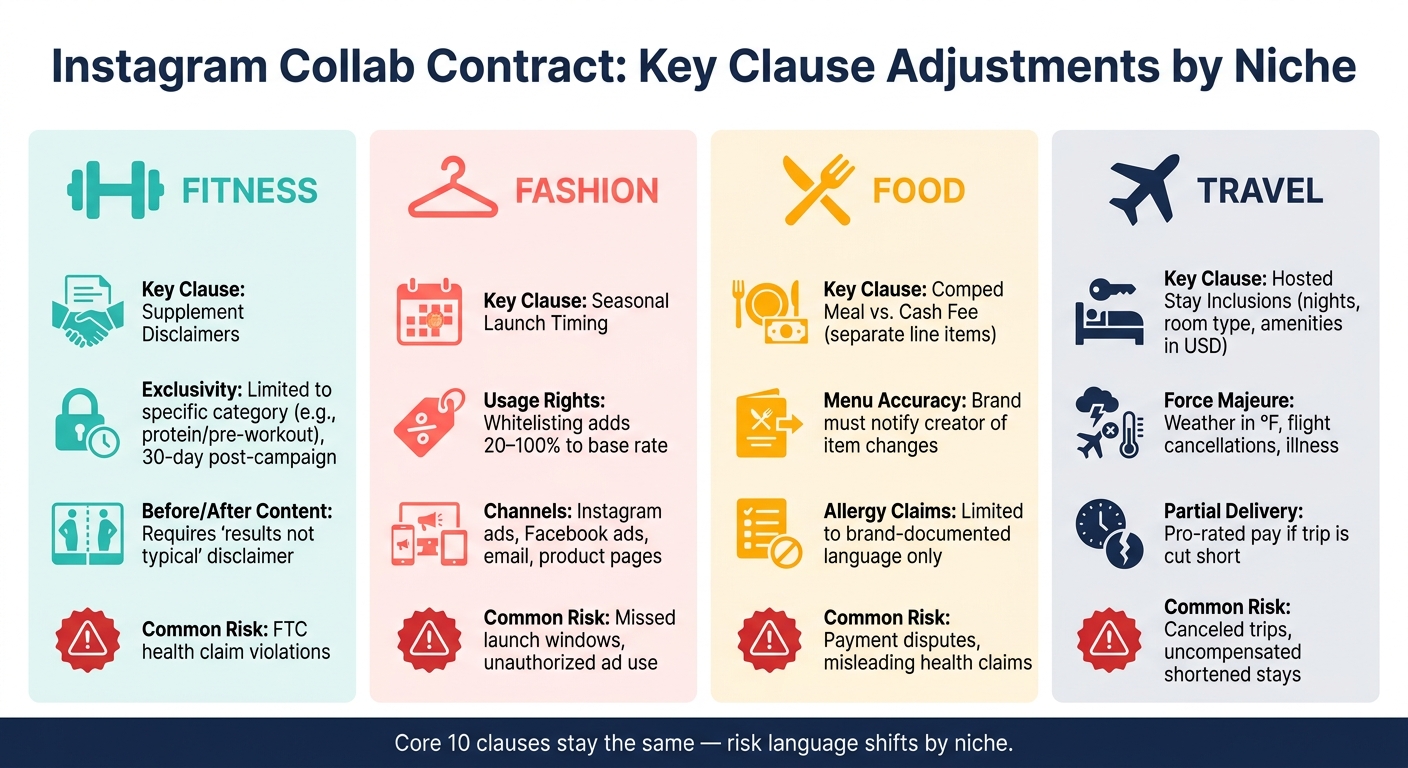
Instagram Collab Contract: 10 Essential Clauses by Niche
The core 10 clauses stay the same. But the risk language should shift based on the niche.
A fitness deal doesn't carry the same risk as a fashion drop. A food collab has its own pain points. Travel? That's a whole different beast. Claims, timing, payment, and cancellation terms all need to match what could actually go wrong in that campaign.
Use these clause tweaks to match the biggest risk in each niche.
Fitness Collab Terms
Fitness collabs need tight claim language. Why? Supplement and health claims must be backed up, and overblown weight-loss or medical claims can trigger enforcement.
The deliverables clause should say exactly what the creator is promoting, such as protein powder, a gym membership, or a workout app. The approval clause should also require brand sign-off before anything goes live.
Exclusivity needs a narrow definition here. Don't use a blanket ban on all competing brands. Limit it to a specific category instead, like other protein powder or pre-workout supplements, for 30 days after the final post date. If the deal involves gyms or equipment, name rival chains or product lines directly.
Before-and-after content needs clear rules too. The contract should say how transformation images can be captured, edited, and reused. It should also require a disclaimer when results are not typical. For outdoor workout content, use U.S. units across the board: miles for distance, pounds for weight, and °F for temperature.
Fashion Collab Terms
Fashion deals live and die by timing.
The posting schedule clause should point to the exact U.S. collection launch window. For example, one Reel and two feed posts published between 11/01/YYYY and 11/07/YYYY to support the Black Friday drop. Use MM/DD/YYYY dates and tie the posting window to audience peak times.
Fashion contracts should also price whitelisting and extended reuse separately. Agencies report that whitelisting and extended usage rights for creator content can add 20–100% to the base rate. The contract should list every channel where the brand can reuse images, including:
- Instagram ads
- Facebook Ads
- Email newsletters
- Product pages on the brand's U.S. website
Set a clear duration, such as up to 12 months, and a clear territory, such as United States only. Also state whether resizing or cropping is allowed.
Food Collab Terms
The most common source of disputes in food collabs is the line between a comped meal and a paid deliverable. That's where deals often get messy.
Treat the comp and the cash fee as separate line items. The payment clause should state the exact cash amount owed for content creation. Then list, separately, what the comp covers: number of guests, courses, beverages, tax, tip, and a maximum dollar value in U.S. dollars.
Menu accuracy should also be written into the contract. Dishes change. Prices shift. Seasonal items disappear. The contract should require the brand to notify the creator if a featured item is no longer available, and it should allow caption edits so the post matches what was actually served.
Any health or allergy claims, such as gluten-free, dairy-free, or nut-free, should be limited to language the brand has documented and approved. The repost rights clause should also draw a line between organic reposts, which are often included, and paid ad use, which should be negotiated on its own.
Travel Collab Terms
Travel contracts need the most day-to-day detail because so much can go wrong before a single frame is shot.
The scope clause should list every inclusion: number of nights, room type, resort fees, and any amenities like spa credits or guided tours. If there's a dollar amount attached, state it in U.S. dollars. Transportation reimbursement should also be spelled out. Say whether flights, rail, or driving mileage is covered, and explain how per-mile reimbursement is calculated using miles, not kilometers.
Travel contracts also need detailed cancellation and force majeure terms. The clause should address weather extremes in °F that make shooting unsafe, and connect those conditions to either a rescheduling option or a proportional cut in deliverables. For higher-risk activities like hiking or water sports, include a waiver that lets the creator decline unsafe setups without breaching the contract.
If a trip gets cut short due to airline delays or illness, the contract should say how partial content, say, one Reel instead of two, will be reviewed and paid.
Use this at-a-glance map to spot the main clause risk by niche.
| Niche | Key Clause Focus | Common Risk |
|---|---|---|
| Fitness | Supplement disclaimers, exclusivity by category, before/after limits | FTC health claim violations |
| Fashion | Seasonal timing, multi-channel usage rights, whitelisting fees | Missed launch windows, unauthorized ad use |
| Food | Comped meals vs. cash payment, menu accuracy, allergy claims | Payment disputes, misleading health claims |
| Travel | Hosted stay inclusions, itinerary changes, weather/force majeure | Canceled trips, uncompensated shortened stays |
Contract Red Flags to Catch Before Signing
Once you’ve drafted the 10 clauses, do one more pass. This is where small words can cause big problems. Look for terms that quietly expand usage rights, slow down payment, or water down disclosure rules.
Rights Clauses That Go Too Far
Watch for rights language that gives away too much for too little. If a clause includes terms like perpetual, irrevocable, worldwide, royalty-free, transferable, or rights for all current and future media tied to a low fee, stop there.
That kind of wording gives the brand far more than a basic campaign license. Set clear limits instead:
- a fixed term
- a defined territory
- a list of channels where the content can appear
If the brand wants more than that, charge a separate fee.
Also review any clause that allows the brand to transfer or sublicense your content to third parties without your approval. That’s another red flag. If the rights grant is broader than the fee, renegotiate it before you even get to the payment terms.
Missing Details That Cause Payment Disputes
Vague payment language is where many disputes start. The contract should spell out the exact fee in U.S. dollars, the net payment window, what starts that clock, and any reimbursement rules with clear dollar caps.
Be careful with phrases like “standard net terms” and “bonus at brand’s discretion.” They sound harmless, but they leave timing and amounts open-ended.
If there’s a performance bonus, the deal should state:
- the metric
- the dollar amount
- the measurement window
No guesswork. No side conversations later.
The contract should also give you the right to pause future work until overdue invoices are paid.
Approval and Revision Terms Left Open-Ended
A clause that says content needs brand approval - but doesn’t include a response deadline or a cap on revisions - is trouble waiting to happen.
Why? Because endless edits can drag out the approval process, and that often delays the payment tied to approval. A better clause sets a response window, limits the number of revision rounds, and draws a clean line between a minor edit and a full concept change.
That distinction matters. A full concept switch after the shoot isn’t a revision. It’s new work.
And if the brand misses the approval deadline, the contract should say the content is deemed approved.
Compliance and Termination Problems
No FTC disclosure clause is a red flag on its own. The brand should never ask the creator to hide or remove a required disclosure.
Termination language needs a close read too. Be careful with one-sided clauses that let the brand walk away at any time without paying for work already completed. If a clause allows the brand to exit after work has started and avoid paying for completed work, cut it.
Add terms that protect you instead, like a kill fee and a cure period.
Use a workflow tool to track approvals, payment dates, and usage windows. Once the contract is cleaned up, keep the details in a workflow and date log.
Tools for Managing Instagram Collaborations
Once the contract is signed, the work shifts from paperwork to execution. Now you need one place to track drafts, approvals, deadlines, invoices, and results. A simple rule helps here: use the same clause names from the contract as your tracking labels. That keeps the legal side and the day-to-day work in sync.
Use Contract Workflows and Tracking Together
Use four tools side by side: a contract management system, a shared calendar, an approval log, and a payment tracker.
Build the shared calendar from the dates already listed in the contract so both sides are working from the same timeline. The approval log should record the reviewer, feedback, and sign-off date. The payment tracker should link each invoice to the matching deliverable and clause, with columns for amount in U.S. dollars, due date, and payment status. Update the status when the post goes live, then close it out when payment clears.
For reporting, track the same metrics in every deal:
- reach
- impressions
- engagement rate
- clicks
- saves
- conversions
That makes it much easier to compare creators across campaigns. It also gives you a stronger case when you negotiate future rates or ask for usage extensions.
Audience Growth and Analytics Support
For growth support, use AI-driven Instagram marketing strategies that match the goals of the campaign. UpGrow can support organic Instagram growth and campaign analysis with AI targeting, a live dashboard, and performance tracking tied to your campaign goals. You can then use that dashboard data to shape future briefs, fees, and usage terms.
Conclusion
A strong Instagram collab contract turns assumptions into clear terms. Payment, deliverables, rights, timing, compliance, cancellation, and disputes all need to be spelled out. The basic structure can stay the same, but the risk language should shift based on the deal.
Keep the framework in place, then adjust the details for the niche. For example, fitness deals may need tighter language around health claims, while travel deals may need a force majeure clause that covers delays, weather, or canceled bookings. Once you lock in the clause set, turn it into a template you can use again and again.
Save a master version in Google Docs, Word, or an e-sign tool. Then make copies for each niche. Use U.S. dollars and dates in MM/DD/YYYY format. It also helps to have a U.S. influencer law attorney review the FTC, IP, and dispute clauses one time. That way, your terms stay consistent across campaigns.
Clear contracts protect both sides and make repeat collaborations much easier.
FAQs
Do I need a lawyer for an Instagram collab contract?
Not necessarily. A lawyer can help make sure your Instagram collab contract covers legal and compliance issues, but you don’t need one for the agreement to be valid.
A clear template can do the job well if it spells out the key terms, like:
- Deliverables: what each person or brand will provide
- Payment terms: how much is being paid, when, and under what conditions
- Usage rights: who can use the content, where, and for how long
- Disclosure requirements: how sponsored content will be labeled
With or without legal counsel, the contract should match your goals and follow the rules that apply to the deal.
What should I do if a brand wants perpetual usage rights?
Treat perpetual usage rights as separate from a standard license, and price them higher.
Why? Because the brand can use your content forever, across all channels. That goes well beyond a basic usage deal.
A simple rule of thumb: charge a 100% to 200% premium on top of your base fee.
Your contract should also draw a clear line between perpetual licensing and a full content buyout. They are not the same, and the pricing shouldn't be either.
Be specific about:
- where the content can be used
- whether paid amplification is allowed
- the separate fee for perpetual usage rights
That last part matters more than people think. Listing this fee on its own makes the scope of the deal much easier to see at a glance.
How should I price paid ad usage or whitelisting?
Treat paid ad usage and whitelisting as separate add-ons. They shouldn't be folded into your base content fee, because that fee covers creation only.
A common benchmark for whitelisting is 30% to 50% of your base fee per 30-day period.
In the contract, spell out the details:
- the platform
- the duration
- any geographic limits
- any limits on caption or call-to-action testing
Also, keep these rights separate from organic licensing.