
How Much Do Instagram Influencers Make in 2026? Earnings by Follower Tier
Follower count sets the range, but engagement, format, niche and contract terms determine what Instagram influencers actually earn.
Follower count sets the range, but engagement, format, niche and contract terms determine what Instagram influencers actually earn.
4.98 /5 - from 58k reviews
Trusted by 50,000+ creators — get real engagement delivered to your profile in minutes, not days.

Instagram post rates in 2026 range from about $10 to $500,000+ per deal. If I had to boil this down to one point, it’s this: follower count sets the rough range, but engagement, format, niche, and deal terms decide the final price.
If you want the fast answer, here it is:
But those numbers shift fast.
A Reel can cost 1.5x to 3x more than a static post. A Story set often lands at 30%–50% of a feed post rate. And extras like usage rights, whitelisting, exclusivity, rush delivery, and extra revisions can add a lot to the fee.
There’s also a simple pricing rule many people still use: $0.01–$0.03 per follower for a basic feed post. So if you have 50,000 followers, a rough post estimate is about $500–$1,500. Still, that rule is only a starting point. A smaller account with high engagement, strong shares and saves, and a tight niche can out-earn a larger account with weak audience action.
A few points matter most:
| Tier | Followers | Typical Post Range |
|---|---|---|
| Nano | 1K–10K | $10–$500 |
| Micro | 10K–100K | $100–$5,000 |
| Mid-tier | 100K–500K | $500–$25,000 |
| Macro | 500K–1M | $2,500–$50,000 |
| Mega | 1M+ | $10,000–$500,000+ |
Bottom line: if you want to estimate what an Instagram influencer can make in 2026, I’d start with follower tier, then adjust for engagement rate, content type, niche, audience location, and contract terms. That gives you a much better number than follower count alone.
Instagram Influencer Earnings by Follower Tier & Content Type (2026)
Instagram doesn't have an official rate card. What a creator charges depends on the niche, engagement rate, content format, and usage rights. So the smart move is simple: start with published benchmarks, then adjust based on the account, the deliverable, and how the brand plans to use the content.
The table below pulls from overlapping published benchmarks. Use these numbers as a baseline, not a fixed price sheet, because each source uses slightly different tier cutoffs.
| Tier | Follower Range | Typical Feed Post Range | Source(s) |
|---|---|---|---|
| Nano | 1K–10K | $25–$500 | Influee, Shopify, Creator Lane |
| Micro | 10K–100K | $150–$5,000 | Nowadays, Influee, Shopify |
| Mid-Tier | 100K–500K | $500–$25,000 | Multiple published benchmarks |
| Macro | 500K–1M | $2,500–$50,000 | Multiple published benchmarks |
| Mega | 1M+ | $10,000–$500,000+ | Multiple published benchmarks |
Those wide ranges aren't random. They reflect big differences in niche, engagement, and deal terms. For example, a creator with 30K followers and 8% engagement can earn more than a creator with 150K followers and 1.2% engagement. That's why these feed-post ranges work best as a starting point before you factor in format and usage rights.
The 10K–100K tier tends to be the industry's sweet spot. Across 2025-2026 benchmarks, micro-influencers usually charge $150 to $5,000 per static feed post.
But pricing inside that range can swing a lot. Two creators with the same follower count may quote very different rates if one has a tighter audience match, stronger niche authority, or better engagement. In plain English: follower count gets you in the ballpark, but audience fit often decides the final number. And once you switch from a static post to another format, the quote can change fast.
On a cost-per-follower basis, nano accounts often beat larger creators because their engagement tends to be higher. Nano-influencers average a 2.19% engagement rate, while macro accounts often fall below 1%.
Audience quality is the pricing lever. A tightly focused niche account can charge more per post than a broader account with a similar follower count because that audience may be worth more to a certain brand. If you want a rough estimate, use UpGrow's Instagram influencer pricing calculator to see how engagement rate and niche can shift your rate. That difference often gets even bigger when Reels, Stories, and bundles are part of the deal.
Once you know the base rate for each creator tier, format becomes the next big pricing lever. And it can change the quote fast.
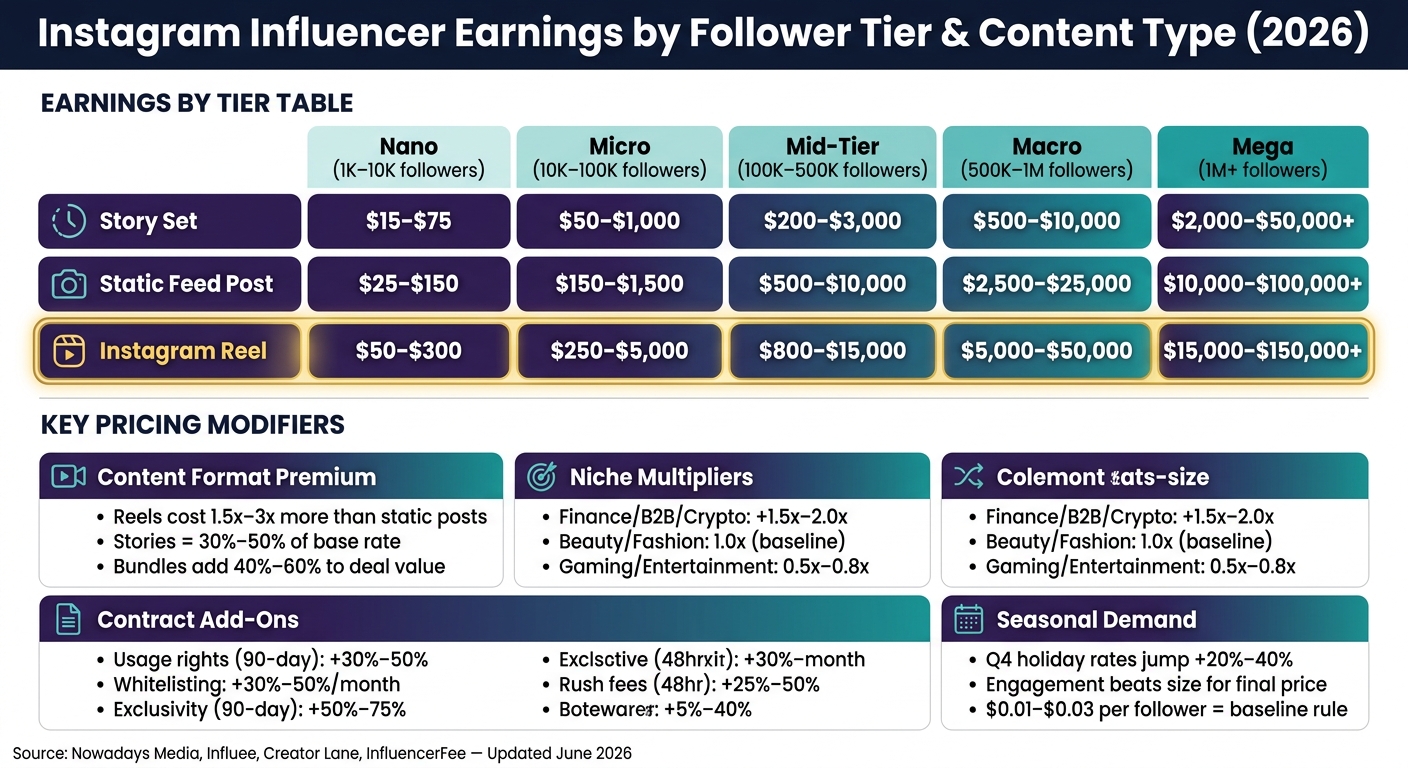
Based on 2026 benchmarks from Nowadays Media, Influee, Creator Lane, and InfluencerFee, Reels usually cost 1.5x to 3x more than a static feed post because they take more work to make and tend to get an algorithm bump. Stories usually land at 30%–50% of that base rate.
| Content Type | Nano (1K–10K) | Micro (10K–100K) | Mid-Tier (100K–500K) | Macro (500K–1M) | Mega (1M+) |
|---|---|---|---|---|---|
| Story set | $15–$75 | $50–$1,000 | $200–$3,000 | $500–$10,000 | $2,000–$50,000+ |
| Static feed post | $25–$150 | $150–$1,500 | $500–$10,000 | $2,500–$25,000 | $10,000–$100,000+ |
| Instagram Reel | $50–$300 | $250–$5,000 | $800–$15,000 | $5,000–$50,000 | $15,000–$150,000+ |
Sources: Nowadays Media, InfluencerFee, Influee, Creator Lane, and 2026 premium benchmarks
The gap gets bigger when brands buy more than one asset. Bundles can increase total deal value by 40%–60%. Stories cost less because they disappear after 24 hours, which gives them less staying power than feed posts or Reels.
The $0.01–$0.03 per follower rule is still the most common starting point in influencer pricing. Say a creator has 50,000 followers and uses $0.02 per follower. That puts a static post at about $1,000. Add a 1.5x Reel premium, and the quote moves to about $1,500.
That said, the rule gets shaky at both ends.
A mega-influencer with 2 million followers would land at $20,000–$60,000 under this formula, but actual Reel rates at that level often go higher because of name recognition outside Instagram and custom deal terms. On the flip side, nano-creators can sometimes charge more per follower than the formula suggests. Why? A small, tightly focused audience can be worth a lot to the right brand.
So think of this rule as a gut check, not a cap. Niche, usage rights, and exclusivity can all push a quote up.
The rate tables above are just a starting point. In practice, the final quote can swing up or down based on a few things that matter more than raw follower count.
Follower count matters less than essential Instagram metrics like engagement, saves, shares, and niche fit. A smaller account with stronger engagement can earn more than a larger account with weak engagement. Saves and shares stand out because they signal stronger purchase intent and longer-term content value. The biggest rate shifts usually come from niche, usage rights, exclusivity, and audience quality.
Niche can change pricing a lot, even when two creators have the same follower count.
| Niche | Indicative Multiplier vs. Baseline | Key Driver | Source |
|---|---|---|---|
| Finance / FinTech / Crypto | 1.5x – 2.0x | High-value customers; high LTV | |
| B2B / SaaS | 1.5x – 2.0x | Expensive-to-acquire customers | |
| Medical / Legal / Regulated | 1.4x – 1.6x | High trust requirement; licensed or qualified creators | |
| Tech / Productivity / Gadgets | 1.3x – 1.6x | High-LTV brand verticals | |
| Beauty / Fashion / Lifestyle | 1.0x (Baseline) | High creator supply; competitive market | |
| Parenting / Family | 1.1x – 1.5x | Trusted advisor dynamic; strong purchase intent | |
| Gaming / Entertainment | 0.5x – 0.8x | Large reach but lower buyer intent |
Gaming and entertainment creators often have big reach, but weaker buyer intent keeps rates below baseline. Finance, B2B, and other high-intent niches sit on the other end of the spectrum: smaller audiences, but much more pricing power.
Even in the same niche, contract terms can change the final price fast.
Usage rights are usually the biggest lever. Standard 30-day paid social usage often adds 15%–25% to the base rate. A 90-day multi-platform license can add 30%–50%. Perpetual rights can add 100%–200%. Whitelisting - where a brand runs ads directly from the creator's handle - usually adds another 30%–50% per month on top of that.
Exclusivity is another major cost driver. A 30-day category exclusivity clause often adds 20%–35% to the base fee, while a 90-day window can add 50%–75%. The wording matters here. A narrow clause like "facial serums" is a lot easier on budget than a broad one like "beauty."
Other terms can push rates higher too:
Rush fees usually add a 25%–50% surcharge for content needed within 48 hours. Extra revision rounds can cost $200–$500 each. Audience geography matters too. Creators with followers concentrated in the U.S., UK, or Canada often command higher rates than creators whose audiences are mostly in lower-CPM markets.
Audience quality also plays a direct role. Brands use third-party tools to check for bot traffic and confirm that audience demographics match the target customer. If a creator has inflated follower numbers but weak engagement, it becomes much harder to defend a premium rate. That’s why genuine reach and strong engagement still sit at the center of any rate negotiation.
Use the table above as your starting point. Begin with follower tier, then adjust for content format, niche, engagement, and deal terms.
From there, the biggest pricing levers are content format - Reels often cost 1.5x–3x more than a static post - plus niche, where finance and B2B often price higher than lifestyle and fashion, engagement quality, and contract terms. In plain English: a smaller account with strong engagement can earn more than a bigger account with weak engagement. Brands pay for likely results, not follower count by itself.
Timing matters too. Rates often climb in Q4, with holiday demand pushing prices up by 20%–40%.
If you want a broader income picture, check out how much money can you make on Instagram or try the Instagram influencer pricing calculator to estimate your rate.
Rates come down to real reach and engagement, and UpGrow helps creators build the kind of audience brands want to pay for.
Last updated: June 2026
An influencer with 10,000 followers will often charge $150 to $1,500 for a feed post. The exact price depends on things like engagement rate and niche.
That range can feel a little all over the place, and there’s a simple reason for that: 10K followers sits in the middle ground between nano and micro creators. So pricing isn’t fixed.
Reels tend to cost more than feed posts, usually landing around $250 to $2,500 per video. And if the creator is in a high-value niche like finance or SaaS, rates can go past those baseline ranges.
Instagram rates can swing a lot in 2026. In most cases, pricing moves with follower count, engagement, niche, and usage rights.
A static feed post might cost $25–$150 for nano-influencers, $150–$2,000 for micro-influencers, and $50,000+ for mega-influencers.
Reels usually cost 30%–50% more than static posts. Stories tend to be 40%–60% less.
On top of that, things like usage rights, exclusivity, and bundled deliverables can push the final rate up or down. A simple one-off post is one thing. A package with extra rights and added assets is a different ball game.
There’s no strict minimum follower count to get paid on Instagram. Nano-influencers are often defined as creators with 1,000 to 10,000 followers, but even people with fewer than 1,000 can still make money through product gifting, affiliate partnerships, or small collaboration deals.
A lot of brands care more about engagement and audience quality than raw follower numbers. So even a small account can land paid work if it drives honest results.
Yes. Reels usually bring in more than static feed posts, with a typical premium of 30% to 50%. In many cases, creators charge 1.5 to 3 times more for a Reel than for a static photo.
That price jump comes from the extra scripting, filming, and editing Reels take on, plus their stronger reach and longer shelf life. Stories are usually the lowest-priced format.


