Instagram PR Package Disclosure: 9 Rules
Make brand ties obvious: clear, front-loaded Instagram disclosures for gifts, affiliates, tags, giveaways, and every format.
Make brand ties obvious: clear, front-loaded Instagram disclosures for gifts, affiliates, tags, giveaways, and every format.
4.98 /5 - from 58k reviews
Trusted by 50,000+ creators — get real engagement delivered to your profile in minutes, not days.
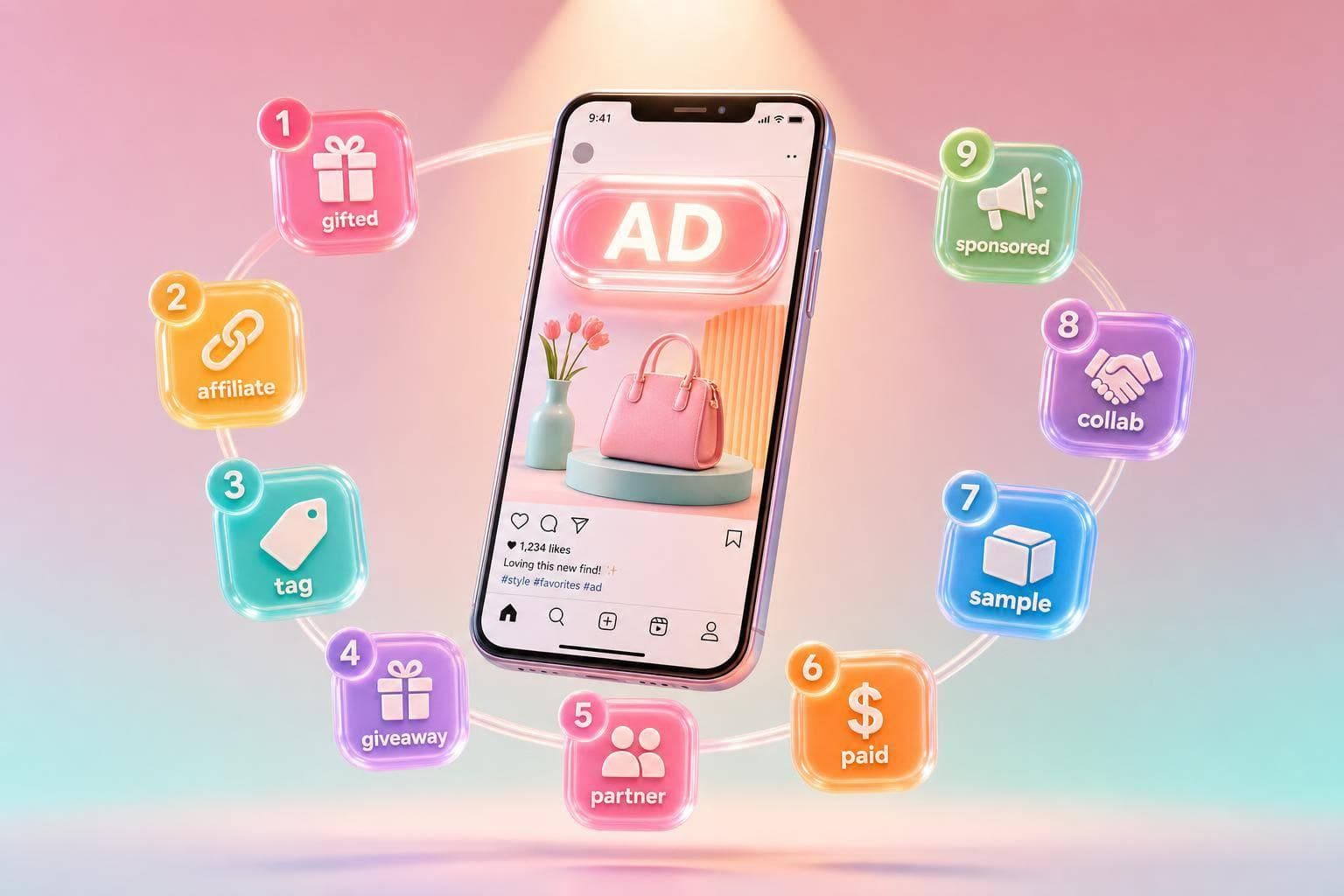
If a brand gives you something and you post about it, disclose it. That includes free products, affiliate codes, event invites, trips, and paid deals. Under FTC rules, there is no minimum dollar amount, and both creators and brands can be on the hook.
Here’s the short version:
A simple test I’d use: if someone would view the post differently after learning about the brand tie, I’d disclose it right away.
| Rule | What I’d do |
|---|---|
| Branded content label | Turn on Paid Partnership when the post has a brand tie |
| Caption disclosure | Put Ad, Sponsored, or Gifted by [Brand] first |
| First-line placement | Keep the disclosure above the “more” cut-off |
| Gifted products | State that the item was free and name the brand |
| Affiliate links/codes | Say I earn a commission or other perk |
| Tags/mentions/reshares | Add disclosure to the post my audience sees |
| Giveaways | State the brand tie and prize source up front |
| Clear wording | Skip vague tags like #sp or #collab |
| Every format | Repeat it on Feed, Story frames, Reels, and Live |
This article is a posting checklist in plain English. It shows how I’d handle disclosures so people see them fast and understand them on the spot.
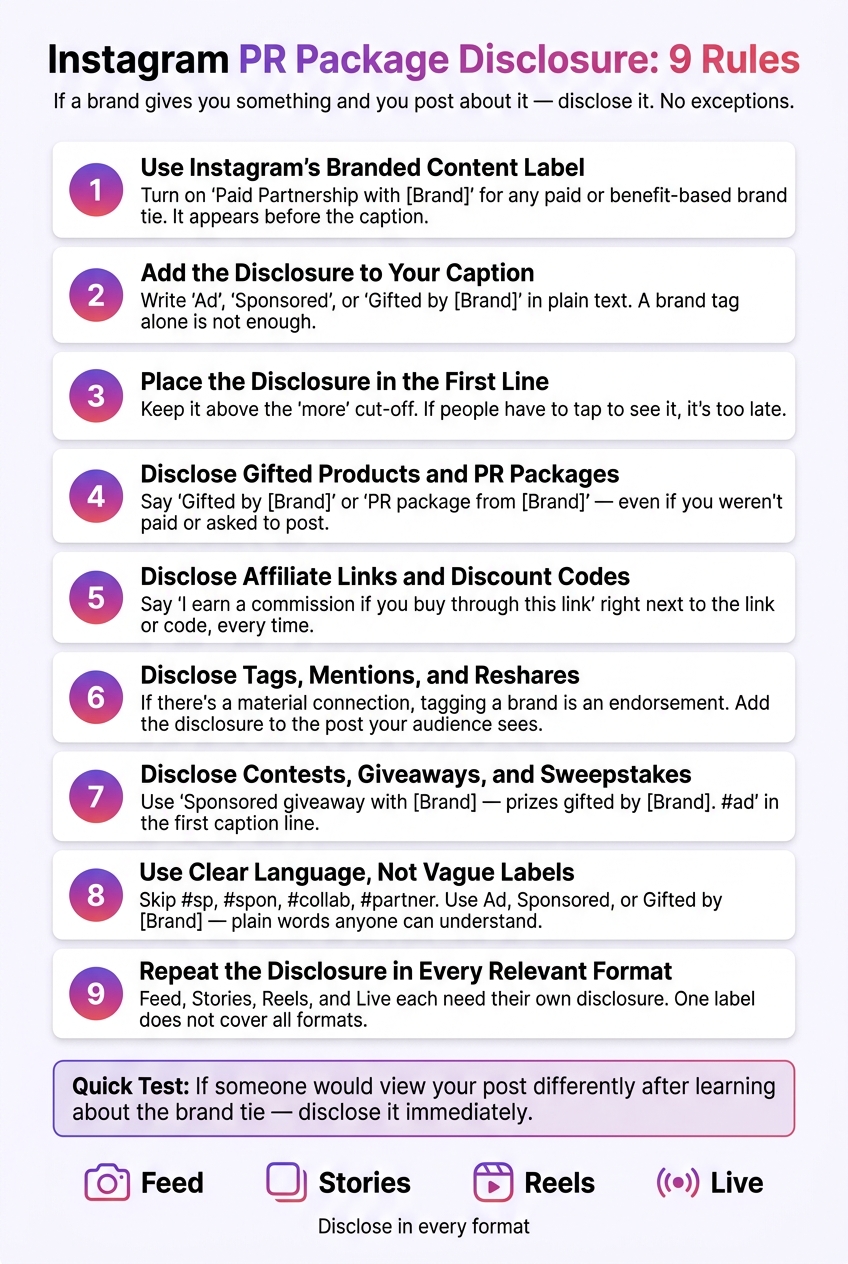
Instagram PR Disclosure: 9 Rules Every Creator Must Follow
A material connection is any relationship that could shape how followers view an endorsement - and one they would not reasonably expect to know about.
This covers more than paid sponsorships. Free PR mailers, gifted products, hotel stays, trips, event invites, early access, affiliate commissions, and commission-based promo or discount codes all count.
It also includes personal and business ties. If you're an employee, contractor, relative, close friend, investor, or ambassador for a brand, that can be a material connection too. If people don't know you have a personal or financial stake, they can't properly judge your recommendation.
Even unsolicited gifts can count. Say a brand sends you a PR package out of the blue and you post about it. That free product still creates a material connection. You do not need a contract or a direct requirement to post for the disclosure rule to apply.
A simple rule of thumb: if your followers would be surprised to learn about the connection, disclose it. In many cases, that starts with Instagram's branded content label.
Once you know what counts as a material connection, the next step is labeling the content correctly.
Use Instagram's branded content label for any paid or benefit-based brand partnership. If there's a material connection, this label should be the first disclosure people see.
It shows up before the caption, which matters. Viewers can spot the partnership right away instead of having to hunt for it. When you turn it on, Instagram displays "Paid Partnership with [Brand]" at the top of the post or Story frame. You enable it through Instagram's branded content tool, and the brand has to approve the partner tag before the label goes live.
This also works for Lives. In that format, the label appears at the top of the live interface.
That said, the label on its own isn't enough. FTC guidance still expects a plain-language disclosure inside the content itself, whether that's in the caption, shown on-screen in a Story, or said out loud in a Reel or Live. Next, add the disclosure in the caption.
The branded content label helps, but it doesn't finish the job. Your caption still needs a plain-language disclosure. If there's any material connection, you need to say that in the caption too. Just tagging @brandname isn't enough, because that doesn't tell people whether you got paid or received a free product.
Put the disclosure at the VERY start of the caption, before the more cut-off. The FTC has said that disclosures shown only after someone clicks are unlikely to be clear and conspicuous.
Use direct wording people can understand right away, such as Ad, Sponsored, Gifted by [Brand], or PR package from [Brand]. For affiliate posts, a short line like Ad: I earn a commission from links/codes in this post also works. The words matter, but the spot matters just as much to optimize your Instagram posts.
Treat #ad like a disclosure, not just another hashtag. Skip vague shorthand like #sp, #spon, or #collab, and don't hide #ad at the end of a long caption or inside a pile of hashtags.
A simple gut check helps here: if someone scrolling past your post can't spot the disclosure right away, move it higher.
A disclosure can be correct and still miss the mark if people don't see it. On Instagram, the feed often shows only the first two or three lines of a caption before someone has to tap "See More." So the safest move is simple: put the disclosure in the first line.
FTC guidance says that if an endorsement appears at the beginning of a post description, the required disclosure should be visible without requiring users to click "more." In plain English, the disclosure should show up before the caption gets cut off.
The best opener is short and obvious. Terms like "Ad", "Sponsored," or "Gifted by [Brand]" are clear and easy to spot. If the post includes both a gifted PR package and affiliate links, use one direct line like "Ad – gifted PR package + affiliate links" so readers get the full picture right away.
Don’t hide #ad at the end of the caption or tuck it into a pile of hashtags. And yes, you can use the branded content label. But you still need clear disclosure text in the first line.
If the connection is a free product, say that plainly. A gifted product or PR package still needs a disclosure. That applies even if you weren't paid, weren't asked to post, and weren't told what to say. There’s no dollar cutoff here. If a brand sent it and you post about it, you need to disclose that.
Use clear wording like "Gifted by [Brand]" or "PR package from [Brand]." Saying only "Gifted" is too vague. Name the brand or say "free product." And skip fuzzy labels like "partner" or just tagging @Brand.
For Stories and Reels, put the disclosure on-screen, not just in the caption. If you're speaking on camera, say: "This was sent to me for free by [Brand]."
If the post also includes links or discount codes, disclose those separately.
Affiliate disclosures are not the same as gifted-product disclosures.
If an affiliate link or discount code can earn you a commission, store credit, or any other reward, you need to say so. That rule still applies if you bought the product with your own money or the brand never contacted you. If the link or code can put money or perks in your pocket, disclose it.
Place the disclosure right next to the link or code so people see it at the same time as the endorsement. In practice, that means putting it in the caption, on-screen, or next to the sticker. A note in your bio or a separate disclaimer page doesn't cut it.
Use plain, direct language. For example:
You can use #ad or #affiliate as backup, but not as your only disclosure. Spell out the relationship in full text every time the link or code appears.
That same rule also applies when a tag, mention, or reshare involves payment or any other benefit.
Tags and mentions can count as endorsements when you have a material connection to a brand. FTC guidance says that if the relationship exists, the tag or mention can trigger disclosure rules. In plain English: the issue is the relationship, not the tag itself. If a brand sent you a free product, pays you as an ambassador, or gives you affiliate commissions, tagging that brand is an endorsement and needs a disclosure.
Reshared branded content follows the same rule. If you repost it, the disclosure needs to appear on the reshare itself, in the version your audience sees first. You can't assume the original post covers you. The disclosure has to stay attached to the content as your audience receives it.
Use wording that is direct and hard to misread. "Ad - Gifted by [Brand]" or "Sponsored by [Brand]" work. By contrast, #sp, #collab, #partner, or a brand hashtag alone do not work.
A common slip-up is treating tags like simple engagement. For example, a caption that says "Obsessed!! 😍" with a brand tag and no disclosure is still non-compliant if the product was gifted. The tag doesn't cancel the disclosure rule. The same standard applies in giveaway and contest posts too.
Giveaways trigger disclosure rules when the promotion helps the brand. So even if the post feels fun and casual, the FTC still treats it like sponsored content. If there's a material connection between you and the brand or organizer - like free prize products, payment, or another perk tied to the promotion - you need to say so clearly.
The safest move is simple: put the disclosure in the first line of the caption. Something like "Sponsored giveaway with [Brand] - prizes gifted by [Brand]. #ad" is clear and easy to spot. If it fits the post, you can also use Instagram's Paid partnership with [Brand] label. But that label is a backup, not a substitute for the caption disclosure. In Stories and Reels, show the disclosure on-screen too.
There's one more piece people miss. If entering the giveaway means posting a photo, tag, or other content, that entrant's post becomes part of the promotion. In that case, the entry post also needs a disclosure requirement.
And no, #giveaway or #contest doesn't do the job by itself. Those hashtags tell people what the post is. They don't tell people the post is sponsored or that something of value changed hands.
| What Works | What Doesn't Work |
|---|---|
| Sponsored giveaway with @Brand - prizes gifted by @Brand. #ad | GIVEAWAY!!! 🎉 collab with @Brand #sp |
| Disclosure in the first caption line | #ad buried at the end of a long hashtag block |
| Repeat the disclosure on-screen in every Story frame that mentions the promotion | A single feed post disclosure, with no Story or Reels disclosure |
| Instructing entrants to use #ad on their own entry posts | Entry rules that require posting but never require disclosure |
Even if your disclosure is in the right spot, the wording still needs to be easy to understand. On Instagram posts, Stories, and Reels with a brand connection, use plain disclosure language every time. The FTC’s updated standard says a disclosure must be "clear and conspicuous."
Use direct labels like Ad, Sponsored, or Gifted by [Brand]. They’re short, plain, and hard to misread. That same direct wording should appear in captions, Stories, and Reels.
A common slip-up is leaning on shorthand that makes sense to people in marketing but not to everyone else. Tags like #sp, #spon, #collab, #partner, or #gifted may be too vague, and brand hashtags like #[Brand]ad are not clear enough by themselves. If someone has to stop and decode the label, it’s not working. And yes, even if you use the Paid Partnership label, plain text still matters.
Write for the person seeing your content for the first time. They should get it right away.
| Compliant Wording | Too Vague |
|---|---|
| "Ad: I received this product for free from [Brand]" | #gifted |
| "Sponsored by [Brand]" in the first caption line | #collab or #partner |
| "Paid partnership with [Brand] + Ad in caption" | "Thanks [Brand]!" with no ad label |
| "I earn a commission if you buy through my link" | #sp or #spon |
Clear wording helps, but it isn't enough on its own. The disclosure has to follow the content wherever it shows up. One label does not cover every format.
So if the same PR package appears in Feed, Stories, and Reels, each version needs its own disclosure.
Put the disclosure where people will actually notice it in that format:
A per-format checklist before publishing keeps this from slipping through the cracks. The examples below show what that looks like in practice.
Use this table as a fast gut check before you post. Each row ties a material connection to the kind of disclosure that fits. If you want a simple last-pass review, this is it.
| Disclosure Type | Compliant Example | Noncompliant Example | When to Use |
|---|---|---|---|
| Ad / Sponsored | "Ad: Testing the new [Brand] cleanser." | #sp, #spon, or #ad buried below the visible fold |
Feed posts, Reels, and Story series for paid campaigns |
| Gifted by [Brand] | "Gifted by [Brand]: New serum line." | "Thanks so much @brand, I'm obsessed!" with no mention the item was free | Unboxings, first impressions, and PR mailer reviews |
| Affiliate Links / Discount Codes | "I earn a commission if you shop through my link." | "Link in bio 😉" with no mention of a commission | Stories with product stickers, Link in Bio collections, and posts featuring affiliate discount codes |
| Tags, Mentions, and Reshares | "Gifted by @brand - styled for today's look." | Brand tag in the photo only, with no disclosure text in the caption | Lifestyle or outfit posts with a brand tag tied to free product, paid travel, or an appearance fee |
| Contests and Giveaways | "Sponsored giveaway: @brand is gifting 3 winners." | "GIVEAWAY TIME!!! 🎉" with a brand tag but no mention of brand sponsorship | Any post where followers must follow, tag, or click to enter |
The pattern is simple: compliance comes down to plain language and easy-to-see placement. If the wording is vague, hidden, or only implied through a tag, mention, or reshare, that’s not enough.
One more thing: a brand tag by itself does not disclose a material connection.
These examples show what the standard looks like in day-to-day posting; the next section moves into growth tactics that stay within the rules.
As your account grows, the rules don’t change. A bigger audience may expand your reach, but it does not change your FTC disclosure duties. If a post involves a material connection - whether that’s a paid deal, a free product, or an affiliate commission - you still need a clear disclosure.
The tools you use to grow matter too. The FTC has flagged fake followers and paid engagement as deceptive practices under the FTC Act. Why? Because inflated numbers can misstate your actual reach and chip away at the trust those disclosure rules are there to protect.
That’s why it makes sense to use growth tools that help you reach actual people, not padded metrics.
If you use a growth service, pick one that keeps engagement real. UpGrow supports organic growth through real followers, not bots or fake engagement.
Choose growth tools that support real reach and clear disclosure.
The nine rules above boil down to one simple standard: make the brand relationship obvious.
If that relationship could change how someone sees your post, say so. And match the disclosure to the format you're using - whether that's in the caption, with on-screen text, in a spoken line, or with all three.
Platform labels can help. But they don't replace a clear disclosure.
Clear disclosure protects credibility and compliance. And if a viewer could miss the connection, the disclosure isn't strong enough.
Yes. Under FTC guidelines, getting a free product counts as a material connection and needs a clear disclosure.
That applies even if the brand never asked you to post about it. A free gift can still shape how people see your endorsement.
Use a plain label like #gifted or #ad.
No. Instagram’s Paid Partnership label alone isn’t enough.
The FTC says disclosures must be clear and conspicuous. So the Instagram label should support your disclosure, not replace it.
Put your disclosure where people will see it right away. Don’t bury it in hashtags, links, or hidden menus.
Yes. Affiliate codes and giveaways both need clear, conspicuous disclosures when there’s a material connection to a brand, including free products, commissions, or hosting a giveaway.
The disclosure should be easy to spot. Don’t bury it in hashtags, hide it in a video, or tuck it behind “read more.” That helps with transparency, follows Federal Trade Commission guidelines, and helps maintain audience trust.