
Table of contents
- Who should use multilingual captions on Instagram?
- How do multilingual captions affect engagement and follower growth?
- Which markets benefit most from multilingual captions?
- How to test whether multilingual captions improve results over time
- Final takeaway: Do multilingual captions help Instagram growth?
- FAQs

Yes - multilingual captions can help Instagram growth if your followers speak more than one language and your caption stays easy to read. From what I see in the article, the win usually comes from a better language match, not from adding more text for the sake of it.
Here’s the short version:
- Use multilingual captions when your audience is split across language groups
- Skip them when about 80%–90% of followers use one language
- Keep the layout short and clean
- Bad translation can hurt results
- Test bilingual vs. one-language captions for 4–8 weeks
- Watch comments, shares, saves, profile visits, follower growth, and country-level shifts
If I were deciding fast, I’d use this rule:
- 20%–40% of followers from a second language market: test bilingual captions
- 70%+ from English-speaking markets: keep captions in English only unless data says otherwise
A few markets stand out in the article: the U.S., Brazil, India, and Indonesia. In the U.S., 41 million+ people speak Spanish as a first language, plus about 12 million bilingual speakers. So for some accounts, English + Spanish is an easy test.
| Situation | Best move | Why |
|---|---|---|
| One main language audience | Use one language | Less clutter |
| Split-language audience | Test two languages | More people can read fast |
| Long caption in two or more full versions | Break it up or shorten it | Walls of text lose readers |
| Weak translation | Fix it before scaling | Off-sounding copy can hurt engagement |
| Reels with a target country focus | Track watch time and views by country | Helps show if the second language is doing anything |
My takeaway is simple: multilingual captions work when they match your follower mix, read naturally, and improve hard numbers. If they don’t lift engagement or follower quality after a month or two, I’d drop them and keep the caption clean.
Who should use multilingual captions on Instagram?
Accounts with followers across more than one language market
Multilingual captions make the most sense when your audience is split across two or more language groups. Start with Instagram Insights under Audience, and pay close attention to Top Locations plus follower activity across different language markets. If a big share of your audience comes from a second market, like the U.S. and Mexico, bilingual captions are worth a test.
Then watch the numbers that matter: comments, saves, and follows. That tells you which language mix is pulling its weight.
If that second market is still small or comes and goes, stick with one language for now and test again later.
When one primary language is usually enough
If 80% to 90% of your followers use the same language, adding more languages will often just make the caption feel crowded. In that case, one primary language is usually the better move until another market starts showing steady engagement in Insights.
That tradeoff matters even more when the second language isn't changing engagement yet. If it's not helping, it's probably just taking up space.
Why translation quality matters before you scale
Literal translation won't cut it. Tone, slang, and calls to action need to sound natural in each market. A caption can be accurate and still feel off. And on Instagram, people notice that fast.
Poorly localized captions can reduce engagement by 20–30% compared with content written or reviewed by a native speaker. If you're adding a second language to grow in that market, that's a pretty steep hit. Before you roll out multilingual captions across your Instagram content calendar, have a fluent speaker or professional translator review the adapted version. Not just for accuracy, but for whether it sounds like something a person in that market would actually say.
Only scale when the translated caption reads like it was written for that audience.
sbb-itb-3c55afb
How do multilingual captions affect engagement and follower growth?
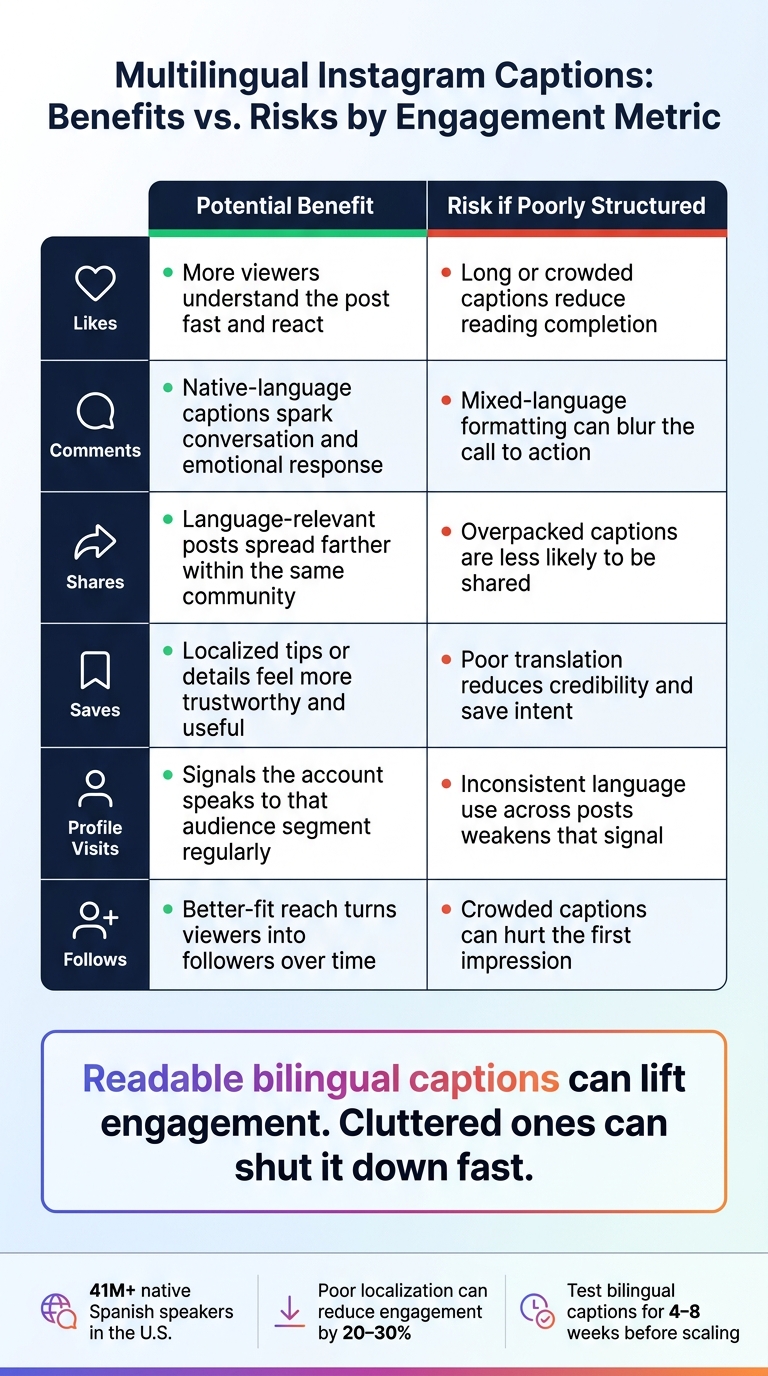
Multilingual Instagram Captions: Benefits vs. Risks by Engagement Metric
Why captions in a follower's native language can increase interaction
Once the translation reads smoothly, the next step is simple: does it change how people respond? In many cases, yes.
Captions in a follower's native language cut friction. People understand the post faster, feel more connected to it, and are more likely to do something next. That can mean more engagement and, over time, more followers.
Eye-tracking research on multilingual social feeds points in the same direction. Participants spent less time looking at posts in another language and said they were more likely to like or comment on posts in their own language.
Comments and shares often see the biggest lift from language match. Why? Because people reply and share when something clicks on an emotional level. A caption that feels natural in their own language is more likely to spark that reaction.
Saves can improve too, especially when the caption gives useful info like a tip, a how-to, or product details in a language the viewer knows well. And when an account keeps speaking to a certain audience in a clear, steady way, profile visits and follows often move up with it.
Where multilingual captions can hurt readability
This only works if the caption stays easy to read.
If you stack several full translations into one post, the caption can start to feel crowded fast. On mobile, that matters a lot. When the text looks like a wall, many people stop reading before they ever like, comment, save, or follow.
A cleaner setup works better: lead with your main language, then place one clear translation underneath with a line break or label. Keep both parts short and easy to scan. If the message is long, separate the languages into different posts.
Multilingual captions by growth metric: benefits and risks
The tradeoff becomes easier to see when you look at each metric side by side:
| Metric | Potential Benefit | Risk if Poorly Structured |
|---|---|---|
| Likes | More viewers understand the post fast and react | Long or crowded captions reduce reading completion |
| Comments | Native-language captions spark conversation and emotional response | Mixed-language formatting can blur the call to action |
| Shares | Language-relevant posts spread farther within the same community | Overpacked captions are less likely to be shared |
| Saves | Localized tips or details feel more trustworthy and useful | Poor translation reduces credibility and save intent |
| Profile Visits | Signals the account speaks to that audience segment on a regular basis | Inconsistent language use across posts weakens that signal |
| Follows | Better-fit reach turns viewers into followers over time | Crowded captions can hurt the first impression |
Readable bilingual captions can lift engagement. Cluttered ones can shut it down fast.
Which markets benefit most from multilingual captions?
High-opportunity markets for localized Instagram content
If multilingual captions can lift engagement, start with the places most likely to react well. The best bets are markets where Instagram plays a big role in discovery, mobile use is high, and a single language won’t reach everyone. In those places, multilingual captions are more likely to help engagement and follower growth.
India, the United States, Brazil, and Indonesia stand out first.
In the U.S., there are more than 41 million native Spanish speakers and about 12 million bilingual speakers. That makes English-plus-Spanish captions a practical way to reach Hispanic audiences from one account.
Brazil and Indonesia also make a strong case. In Brazil, Portuguese is the language most likely to connect with local audiences. In Indonesia, that role belongs to Bahasa Indonesia.
How to match caption language to audience location
After you pick the market, match the caption language to where your followers actually live. Use Instagram Insights to check your top follower locations, then line up your caption language with those places.
For U.S.-heavy accounts, adding Spanish makes sense if followers are clustered in Los Angeles, Miami, or Houston. If you’re trying to grow in São Paulo or Jakarta, Portuguese or Bahasa Indonesia should be in the mix. It also helps to post during local evening hours, when mobile use tends to spike.
A simple test rule works well here:
- Try bilingual captions when 20% to 40% of followers come from a bilingual or non-English market.
- Stick with English-only when English-speaking countries account for more than 70% of your audience.
Caption language by market
| Market | Primary Caption Language | Secondary Phrases | Cultural Notes |
|---|---|---|---|
| U.S. (Hispanic-focused) | English | Spanish CTAs and hooks (e.g., "oferta exclusiva", "solo hoy") | Highlight U.S. Hispanic holidays and regional Spanish variations; post at local evening hours |
| Brazil | Portuguese | Occasional English brand terms | Use Brazilian Portuguese slang; reference local events; mobile-first behavior is strong |
| India (pan-India) | English | Hindi emotional phrases and CTAs | Mix English and Hindi for broad reach; adjust idioms to avoid region-specific confusion |
| Indonesia | Bahasa Indonesia | English for global slogans | Lead CTAs in Bahasa; align content with local trends and key cultural periods like Ramadan |
| Global English-speaking markets (U.S., U.K., Canada, Australia) | English | Localized spelling or regional slang | Use en-US spelling for U.S. audiences; adjust minimally by region; prioritize time-zone-specific posting |
Use these markets as the first group to test in the next section.
How to test whether multilingual captions improve results over time
A simple test plan: bilingual vs. single-language captions
Once you’ve picked the right language-market match, the next step is simple: test it.
The easiest way to see whether multilingual captions are doing anything is to run a clean A/B test. Choose one secondary language based on your current audience data. Then, over 4–8 weeks, publish two versions of posts:
- English-only captions
- English plus your chosen secondary language
Keep everything else the same. That means the content type, posting time, hashtag approach, and call-to-action structure should not change. If you post at 9:00 a.m. PT, keep it at 9:00 a.m. PT for both versions.
Formatting matters too. Put each language in its own block so the caption stays easy to read. Start with English, then add a clear divider like - Español abajo -, followed by Spanish.
Track each post in a spreadsheet. Log the date, content type, caption format, and performance data from Instagram Insights. Check results each week, then compare monthly averages so you’re not reacting to one good or bad post.
The metrics that show whether captions are helping growth
Start with engagement rate. That’s total engagements divided by reach, multiplied by 100.
But don’t stop there. The main numbers to watch are reach, impressions, comments, shares, saves, profile visits, and net new followers. Saves and shares matter a lot because they often point to stronger interest and can help with discovery.
For Reels, look at a few extra signals:
- Average watch time
- Retention curves
- Views by country
If bilingual captions are helping, you should start to see better retention from viewers in your target secondary-language region, along with stronger completion rates overall.
One data point people often miss is follower location shifts. If the share of new followers from your target countries rises over 1–3 months, that’s a strong sign the captions are pulling in the audience you want, not just getting a short burst of activity from people who already follow you.
Using analytics and language targeting to refine your approach
Manual tracking works. But once you’re handling more than one market or client, it can turn into a slog.
That’s where automation starts to make sense. Tools like UpGrow can automate language targeting, location filters, and real-time analytics, which makes bilingual caption tests much easier to monitor.
The table below shows common test setups, along with the KPIs and time frames that matter most for each:
| Test Scenario | Primary KPIs | Evaluation Period |
|---|---|---|
| English-only vs. English + Spanish (feed posts) | Engagement rate, saves, net new followers | 4–8 weeks |
| English-only vs. English + Spanish (Reels) | Watch time, retention, views by country | 4–8 weeks |
| English + Spanish for Latin America vs. global English | Follower location shifts, reach by country | 8–12 weeks |
If bilingual captions deliver steady or better engagement and follower growth after at least one month of testing, that’s a solid sign you can expand the approach. If results stay flat or the caption gets harder to read, adjust the format or rethink the language pairing before you roll it out across your full content calendar.
Use those results to decide whether multilingual captions deserve a regular place in your caption strategy.
Final takeaway: Do multilingual captions help Instagram growth?
Multilingual captions can help if they fit your audience's language mix, stay easy to scan, and are judged by the right metrics. Research on mixed-language feeds shows that people tend to engage more with posts written in their own language. So the main issue isn't whether multilingual captions can work. It's whether they work enough to earn the extra space.
When to use multilingual captions and when to skip them
Add a second language only when your data says it's worth it. If your tests show stronger comments, shares, saves, profile visits, and follows from the secondary-language market, that's your cue to keep going. For most local businesses, one language usually works better. And if the second language isn't moving those numbers, it's just extra text sitting there.
What to check before scaling the strategy
If your test lifts engagement and follower quality, scale the format. If not, stick with a single-language caption. Before you roll this out across your full content calendar, check three things:
- Are comments substantive in both languages?
- Are profile visits and follows per post trending up for bilingual posts?
- Is the share of new followers from your target region growing over 2–3 months?
A steady rise across those numbers is the clearest sign that the setup is ready to expand. If the signals are flat or mixed, tweak the format or rethink the language pair. A clean bilingual caption - primary language first, a short translation below, and a clear divider between them - usually reads better than a crowded caption that serves no one well. UpGrow's language targeting and analytics can help track whether multilingual captions are actually improving growth.
FAQs
Should I use both languages in every caption?
No. Match your approach to the post’s goal.
Use direct translation for simple, low-risk updates like product facts or store notices. For high-impact posts like launches, ads, and creator collaborations, use localization so the tone and phrasing feel natural.
You don’t need to cram both languages into every post, either. UpGrow’s AI-powered language targeting can help you reach the right audience segment.
Which second language should I test first?
Start with the language your current followers already use, along with the markets you want to grow in. Check your audience data and look for places where engagement is most likely to take off.
Don’t guess. Use UpGrow’s AI-targeting filters to split your audience by language. Then test localized captions and watch key signals like saves, comments, and profile visits over four weeks.
If one language starts pulling ahead, that’s a strong sign it deserves more of your time and budget.
How long should I test bilingual captions?
Test bilingual captions long enough to account for normal day-to-day swings and to give Instagram time to show your post to different audience groups.
Run each A/B variant for 5–7 days. If you want a steadier read - or you're testing a bigger shift in approach - run the test for 7–30 days. Before you start, track your usual performance for 2–3 weeks. Then compare engagement, saves, and shares against that baseline.


