
Real vs Fake Instagram Followers: The 2026 Difference (and Why Fake Ones Cost You Reach)
How fake Instagram followers lower engagement, trigger purges, and hurt reach and brand deals — why follower quality beats count.
How fake Instagram followers lower engagement, trigger purges, and hurt reach and brand deals — why follower quality beats count.
4.98 /5 - from 58k reviews
Trusted by 50,000+ creators — get real engagement delivered to your profile in minutes, not days.
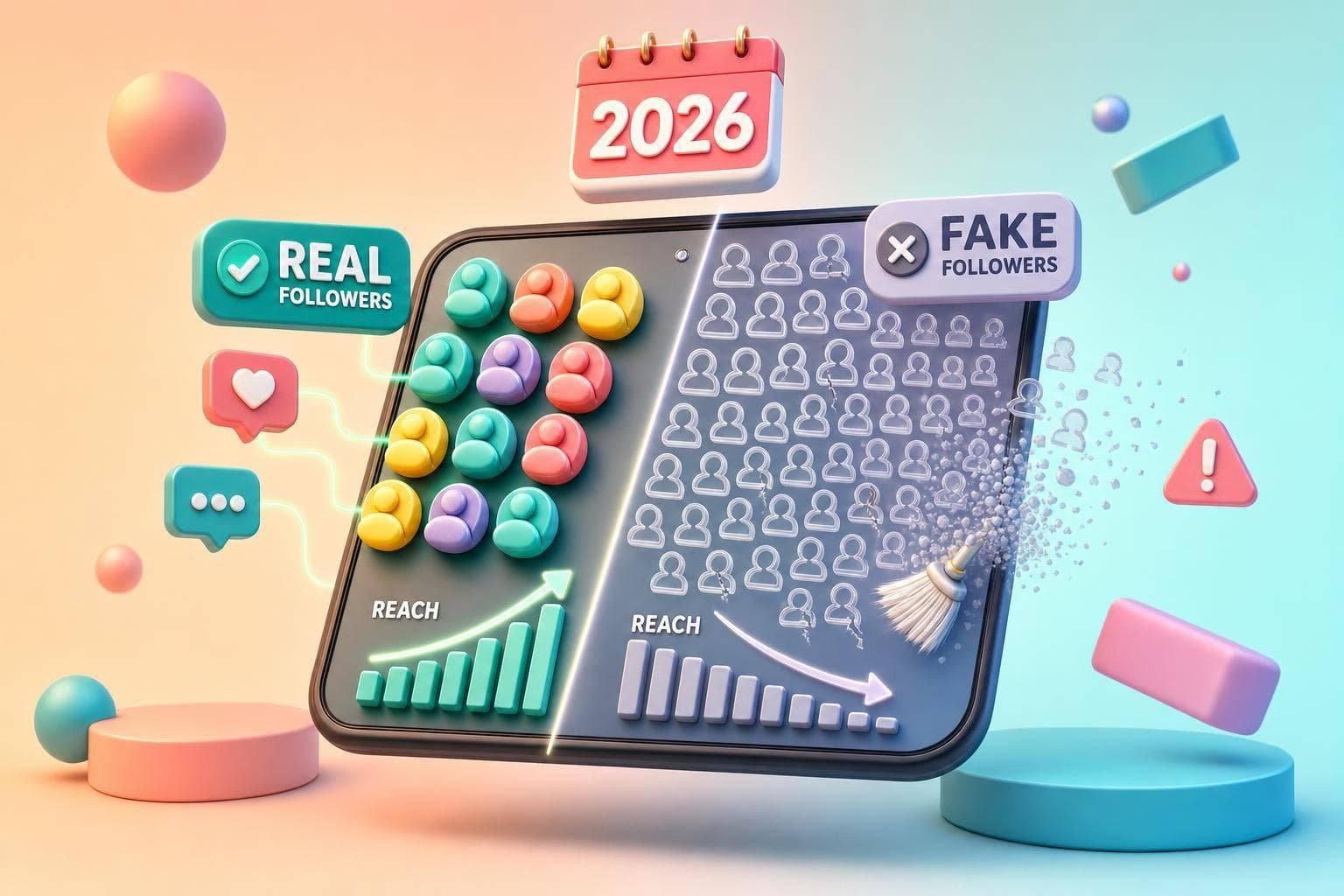
Fake followers can hurt your Instagram reach, lower your engagement rate, and cost you brand deals. In 2026, Instagram keeps removing spam and bot accounts in waves, and brand audit tools often flag accounts with too many low-quality followers.
Here’s the short version:
If your follower count goes up but your likes, comments, and saves stay flat, your content can get shown to fewer people. That’s the core issue: bigger numbers do not mean more reach.
What this article covers:
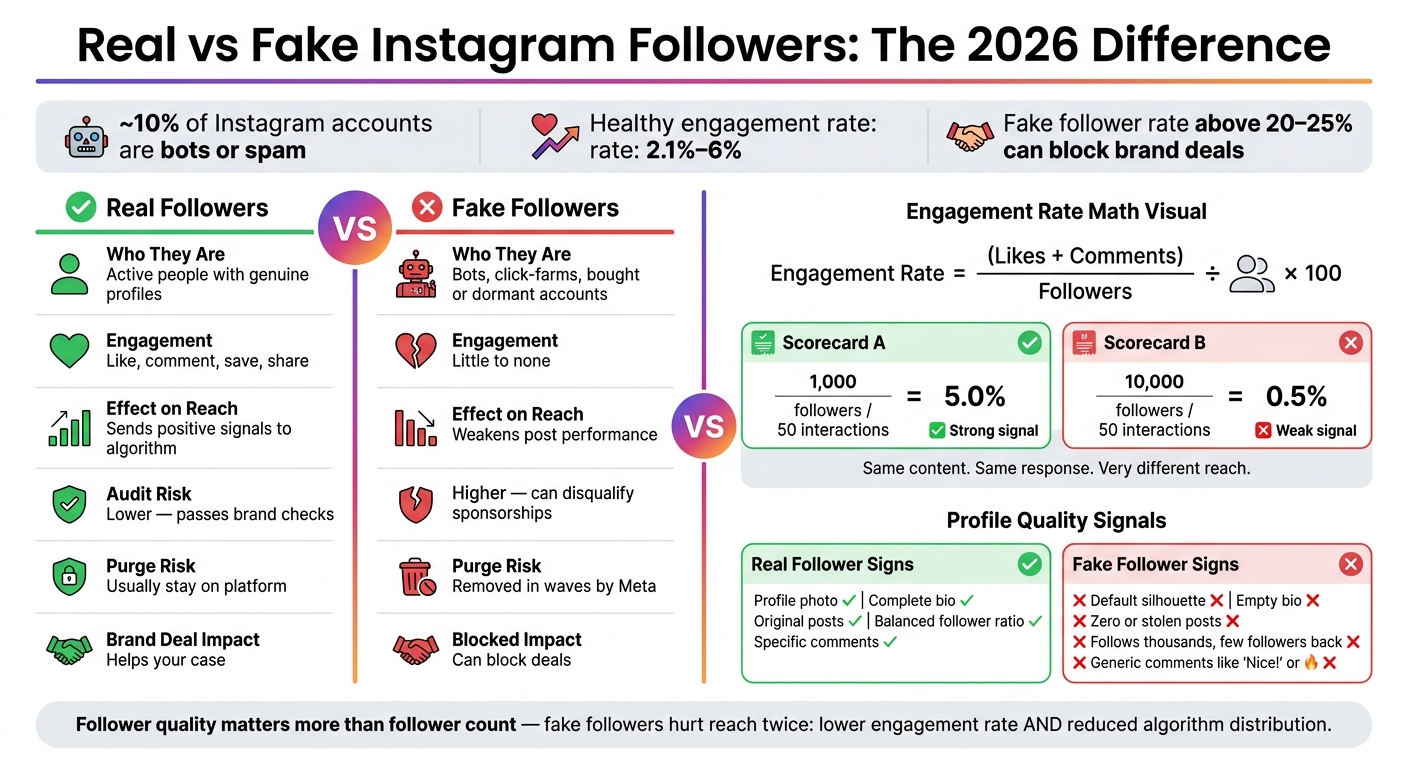
Real vs Fake Instagram Followers: Key Differences at a Glance (2026)
| Factor | Real Followers | Fake Followers |
|---|---|---|
| Who they are | Active people | Bots, spam, bought, or inactive accounts |
| Engagement | Like, comment, save, share | Little to none |
| Effect on reach | Sends positive signals | Weakens post performance |
| Audit risk | Lower | Higher |
| Purge risk | Usually stay | Often removed in waves |
| Brand deal impact | Helps your case | Can block deals and lower your estimated earnings |
I’d sum it up like this: if you want reach, trust, and steady growth, follower quality matters more than follower count.
The difference between real and fake followers is simple: real followers interact with your content. Fake followers just make the number look bigger.
A real follower is an actual person with an active Instagram profile. You’ll usually see a photo, a bio, original posts, and a pattern of activity that built up over time. They follow you because they want to see what you post.
And that matters.
When you publish something, real followers may like it, comment on it, save it, or share it. Those actions tell Instagram that your post is worth showing to more people.
"Fake followers" includes a few different account types, and they don’t all work the same way:
None of these followers add real engagement or help your reach. And when Instagram removes fake accounts, they usually disappear with them.
You can often spot the difference by looking at profile quality and behavior:
| Signal | Real Follower | Fake / Bot Follower |
|---|---|---|
| Profile photo | Personal or branded image | Default silhouette or stock photo |
| Username | Recognizable name or handle | Random string of letters and numbers |
| Bio | Completed with personal info | Empty, nonsensical, or spammy links |
| Post history | Consistent, original content | Zero posts or a few stolen images |
| Follower ratio | Balanced followers-to-following | Follows thousands; very few followers back |
| Engagement | Meaningful likes, comments, saves | Zero engagement or generic comments |
| Account age | Months or years old | Often brand new or created in large batches |
A quick manual check helps. Sample 50 of your followers and look for accounts with no profile photo, scrambled usernames like user836291b, and extreme follow-to-follower ratios.
Real followers tend to leave comments that sound specific and relevant. Bots usually leave generic lines like "Nice pic!" or just a string of emojis.
Those signals matter because low-quality audiences lead to weak engagement, and that’s what hurts reach next.
Those profile-quality issues turn into performance issues as soon as Instagram starts reading engagement.
Fake followers don't just make your follower count look bigger. They weaken the signals Instagram uses to decide how far your posts should go.
The formula is simple:
Engagement rate = (likes + comments) ÷ followers × 100
Fake followers make the denominator bigger - your follower count - without adding anything to the numerator. So even when your content doesn't change, your engagement rate falls.
For smaller accounts, healthy engagement usually lands between 2.1% and 6%. If your engagement rate drops below 0.5%, that's often a red flag that the audience may be padded with real, active followers.
| Metric | Healthy Account | Fake-Follower-Inflated Account |
|---|---|---|
| Total Followers | 1,000 | 10,000 |
| Total Interactions | 50 | 50 |
| Engagement Rate | 5.0% - Strong performance signal | 0.5% - Weak performance signal |
| Likely Outcome | High distribution to Explore/Reels | Reach suppressed |
A quick example makes this hit home. An account with 1,000 followers and 50 interactions posts a 5.0% engagement rate. That looks strong. But if that same account jumps to 10,000 followers and still gets only 50 interactions, the rate falls to 0.5%. Same content. Same response. Much weaker signal.
Instagram puts a lot of weight on early engagement. If fake followers get shown your post and do nothing with it, the post can look weak right out of the gate. Then distribution drops across Feed, Explore, and Reels.
That starts a nasty cycle. Weak early response means fewer real people see the post. Fewer real viewers means fewer likes, comments, shares, or saves. And that gives Instagram even more reason to limit reach.
| Real Followers | Fake / Bot Followers | |
|---|---|---|
| Engagement Impact | Interact with posts, stories, and links | Rarely engage, diluting your engagement rate |
| Algorithm & Reach Effect | Boosts visibility via positive quality signals | Suppresses Feed, Explore, and Reels distribution |
| Purge Survival | Real followers remain stable | Fake followers disappear in sweeps, making performance data unstable |
| Sponsorship & Credibility | Builds trust and passes brand audits | Higher audit risk; can disqualify deals when fake rates climb above 20%–25% |
This is why fake followers hurt twice. They lower your numbers on paper, and they also make Instagram less likely to show your content to actual people.
That's why the next question is whether Instagram can detect fake followers in 2026.
Yes - in 2026, Meta’s systems keep scanning Instagram for inauthentic patterns and remove fake accounts in waves. Automated systems review account behavior and follower networks to spot suspicious profiles. If an account’s risk score passes a set threshold, it can be restricted or removed. So fake followers aren’t just low quality anymore - they often don’t stick around for long. That changes the game because fake growth can turn into temporary growth.
Instagram’s integrity systems look at profile completeness, account age, posting history, engagement variety, network connections, device/IP patterns, action speed, and cross-account identity signals. Fake followers often trip several of these signals at the same time. A profile might use shared or suspicious IP patterns, show zero posting history, and move with fast, repetitive activity that doesn’t look human.
Once those signals get flagged, removals usually happen in waves. Meta reported removing millions of fake profiles in the first half of 2025 alone. That’s why fake followers often vanish during purge waves, while real followers tend to drop off much more slowly.
One of the clearest patterns is a sudden follower spike, then a slow drop as Instagram catches up.
Other red flags show up in plain sight:
user_a8f2k_29385Instagram’s network analysis also flags accounts that mainly follow other bots, with no real peer relationships tying them together.
Brands in 2026 routinely use AI-powered audit tools to score creator authenticity before signing sponsorship deals. A fake follower rate above 20%–25% is often an automatic disqualifier. And with 67% of brands reportedly affected by fake followers in influencer marketing efforts, vetting is now standard practice.
So the next step is pretty direct: do fake followers ever pay off?
Once you factor in purges and audit risks, the answer gets pretty simple: fake followers don't pay off.
They make the number look bigger for a while, then vanish during platform cleanups while engagement metrics stay low. That leaves you stuck in a bad loop. You spend money, lose followers, then spend again to replace what disappeared. And through all of that, you get little to no engagement or conversion value.
Real followers work very differently. They can help growth build on itself. Every like, comment, save, and share gives your next post a better shot at reaching more people. Over time, that can expand your reach. That's why real audience growth matters more than vanity growth.
UpGrow uses patented AI targeting to attract real, AI-targeted Instagram followers based on the filters you choose, including location, language, age, gender, and interest signals. There are no bots, no fake accounts, and no password required.
The Boost™ tool helps speed up growth during key posting windows. On top of that, profile optimization is designed to turn profile visits into follows. If your goal is real audience growth, you can grow a real, engaged audience with a system built to hold up over time.
If your account already has fake followers, start by cleaning up the baseline. You can check if an account bought followers or remove bot followers you've already picked up.
Then move forward with accounts that act like real people. Those are the followers that can make a difference. UpGrow offers a free trial if you want to see how that could look for your account.
Choose the audience that helps your reach grow, not the follower count that only looks big.
Yes. Fake followers - like bots or inactive accounts - can hurt your reach because they don't engage with your content. That drags down your engagement rate.
And that matters on Instagram.
If your follower count looks high but very few people like, comment, save, or share your posts, Instagram's algorithm may take that as a sign that your content isn't connecting. As a result, it can show your posts and Reels to fewer people, including your real followers.
Look for patterns, not just one odd detail.
Common red flags include default profile photos, empty bios, copy-paste bios, generic usernames with random numbers, zero posts, or older accounts that suddenly show a short burst of activity.
Behavior matters too. Fake followers often follow thousands of accounts while having very few followers of their own. Their engagement is usually thin, spammy, or missing altogether.
You can also spot trouble by looking at the bigger picture:
One weird account might not mean much. But when several of these signs show up at once, that’s a pretty clear warning sign.
Yes. Instagram often purges fake followers. Meta regularly removes bot networks and inactive accounts, so those followers can vanish in enforcement sweeps.
When that happens, your follower count may drop all at once. That means the money you spent goes to waste, and you can get stuck paying for the same thing again and again.
Yes, in most cases.
Bought followers are almost always fake. They’re usually bots, abandoned profiles, or mass-made accounts set up to pump up follower counts.
Some sellers say those followers are “real.” But even then, they’re often inactive users or people paid to follow with no actual interest in your content.
And that’s the problem: they don’t watch, like, comment, or buy. So while your follower number may look bigger, your engagement rate drops - and that can hurt your reach.
Share this post&description=How%20fake%20Instagram%20followers%20lower%20engagement%2C%20trigger%20purges%2C%20and%20hurt%20reach%20and%20brand%20deals%20%E2%80%94%20why%20follower%20quality%20beats%20count.&image=https://www.upgrow.com/blog-images/assets.seobotai.com/cdn-cgi/image/quality=75,w=1536,h=1024/upgrow.com/6a486178f6643716137b9705-1783130177293.jpg)


