Ultimate Guide to Swipe File Organization Systems
Create a searchable swipe file: pick one tool, use consistent tags, search with 3+ filters, use AI for tagging, and run regular audits.
Create a searchable swipe file: pick one tool, use consistent tags, search with 3+ filters, use AI for tagging, and run regular audits.
4.98 /5 - from 58k reviews
Trusted by 50,000+ creators — get real engagement delivered to your profile in minutes, not days.
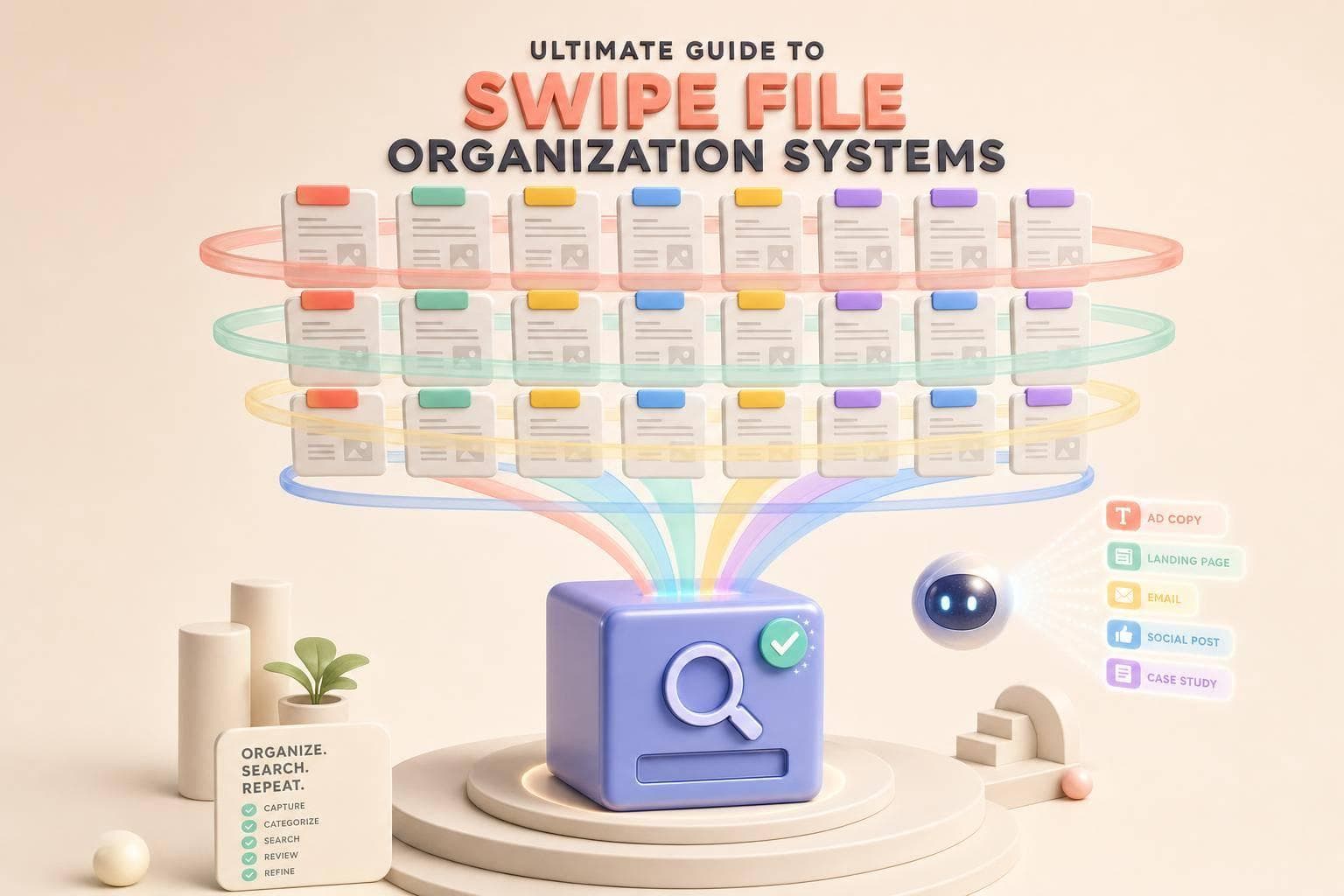
A swipe file only works if I can find the right caption in seconds. The article’s main point is simple: I should use one main tool, keep my setup easy to search, tag entries the same way every time, and review the file on a set schedule so it does not turn into a junk drawer.
Here’s the short version:
A few numbers stand out. The article recommends keeping folder depth to 2–3 levels max, moving outside saves into the main system within 24 hours, checking stale entries after 30 days, and limiting each tag field to about 5–10 values so search stays clean.
If I had to sum it up in one line, it would be this: the goal is not to save more captions; the goal is to reuse good ones faster.
| Area | Best Rule |
|---|---|
| Tool choice | Pick one system your team already uses |
| Folder setup | Use platform-first, goal-first, or a hybrid |
| Tagging | Keep labels tight and consistent |
| Search | Combine at least 3 fields per search |
| Workflow | Use fixed status labels from review to archive |
| AI use | Let AI sort and draft, then I check it |
| Review cycle | Monthly / quarterly / yearly maintenance |
This article is less about saving inspiration and more about building a file I can trust when it is time to write.
Choose the simplest system your team will use every day. A note app works for fast capture. A structured database makes more sense when you need filtering, teamwork, and performance tracking. If your team already drafts in Notion, start there.
Notion works well as a central swipe file because it blends a flexible database with a content workspace. That means swipes, briefs, and drafts can live in one spot.
Start with one database called "Caption Swipe File." Add these fields:
For performance notes, add simple metrics like engagement rate, likes, and saves.
Three views make this useful in day-to-day work:
Preload dropdowns for type, hook, and tone based on your actual campaign patterns. That keeps tagging fast and consistent instead of turning it into a chore.
Airtable is a good fit for structured content operations and scales well for campaign-level reporting, but it needs more setup and comes with a higher per-user cost. Its relational tables, formula fields, and reporting dashboards help content leads roll up performance data across accounts and spot which caption patterns are driving results.
Evernote works well for solo capture. You can save captions fast, tag them lightly, and search by keyword later. Tags like "reel-hook", "carousel-education", "storytelling", "promo," or "UGC" are enough to keep entries easy to find when volume is low.
Dedicated swipe tools and browser-based savers are best used as an inspiration inbox. They’re fast to fill, but they’re not built for workflow management. They do a solid job of capturing ideas, yet they usually miss the status tracking, performance notes, and campaign-level filtering a production team needs. Use them for heavy visual browsing, then move the best caption patterns into a structured database.
| Tool | Setup Speed | Collaboration | Search Depth | Reporting | Best Use Case |
|---|---|---|---|---|---|
| Notion | Medium | Strong | High | Moderate | Central swipe file + content workflow for small to mid-sized U.S. teams |
| Airtable | Medium–High | Strong | Very high | High | Structured content operations and cross-client swipe analysis |
| Evernote / note apps | Fast | Limited–Moderate | Moderate | Low | Solo creators or small U.S. teams focused on quick inspiration capture |
| Dedicated swipe tools | Fast | Varies | Moderate | Low–Moderate | High-volume visual inspiration feeding a curated database |
Once you choose one primary tool, make every other source feed into it.
The biggest mistake teams make is spreading their swipe file across too many apps. Then nothing gets used because nothing feels complete.
Pick one main system and tie it to where drafting and approvals already happen. If your briefs and calendars live in Notion, keep the swipe file there too. If you run a multi-client operation in Airtable, extend that setup instead of adding one more tool.
Anything saved somewhere else should move into the main database within 24 hours - or get deleted. That rule sounds strict, but it saves a lot of mess later. Assign one person as the database owner, agree on tagging standards early, and the system stays clean without a lot of upkeep.
Once the tool is set, the next step is building a folder and tag system that lets your team find what they need right away.
A swipe file only helps if writers can find the right caption fast.
The two most common ways to organize a caption swipe file are platform-first and objective-first.
Platform-first means your top-level folders match where the content lives: Instagram Reels, feed posts, Stories, and carousels. This setup works well when caption format drives the choice and your team thinks in platform terms all day.
Objective-first flips that around. Your top-level folders match what the content needs to do: engagement, follower growth, sales, traffic, and community building. This is especially useful for agencies or brands running campaigns tied to business goals, because you can pull captions by goal instead of format.
| Organization Model | Use Cases | Benefits | Limitations | Best Fit |
|---|---|---|---|---|
| Platform-first | Reels, Stories, feed posts, carousels | Easy browsing by format; clear for format-focused teams | Can hide the bigger goal; the same caption may fit more than one goal | Solo creators and small teams with channel-specific workflows |
| Objective-first | Engagement, growth, sales, traffic, community | Tied straight to campaign goals; faster for planning | Less clear if the team remembers captions by format first | Agencies and brands managing multiple objectives |
| Hybrid | Platform folders plus objective and tone tags | Most flexible; supports browsing and search | Needs steady tagging habits across the team | Teams that need both browsing and search |
In practice, a lot of teams land on a hybrid setup: top-level folders by objective, then platform or format on the second level. For example: Sales > Reels > Launch, Engagement > Carousel > Question Hook, or Traffic > Story > Link CTA.
Keep nesting to two or three levels max. Go deeper than that, and finding things starts to drag. It also makes filing messy.
Once the folder setup is in place, tags cover what folders can't.
Tags do the job folders miss. A caption about a product launch might sit in the Sales folder, but tags let you find it by audience segment, campaign, or performance tier too. That's the whole point.
Keep the tag set small enough that your team will use it the same way every time.
Focus on fields that add search value beyond the database defaults:
Try to keep each field to five to ten values. More than that, and tagging gets sloppy. When that happens, the system stops being dependable.
Each swipe entry should also include a short metadata block. Think of it like the label on a file folder. It should include a one-sentence summary, such as "Short Reel caption with curiosity hook and a direct save CTA", plus a why it works note that explains the structure, the original source, a date saved, and a last reviewed date.
If you have performance data, add that too: saves, comments, click-throughs, or conversions. Metadata isn't just admin work. It's how you sort by what actually worked.
Good metadata only goes so far, though. The team also needs to search in the same way.
Use combined filters. Search by at least three fields at once.
Here’s what that looks like in practice:
Sales + carousel + launch + urgency + direct CTAReels + educational + curiosity hook + save CTATraffic + offer + scarcity + click CTACommunity + question hook + casual tone + comment CTAFollower growth + insight-driven + bold claim + share CTASearch for the pattern, not just the caption itself. That's where teams save time. If you manage more than one client or content theme, you can reuse the same query structure across accounts. It keeps the process tight and the output more consistent.
Use one term per concept. If one person tags something as "direct CTA" and another calls it "hard CTA", search gets messy fast.
Once retrieval is fast, capture and review become much easier to repeat.
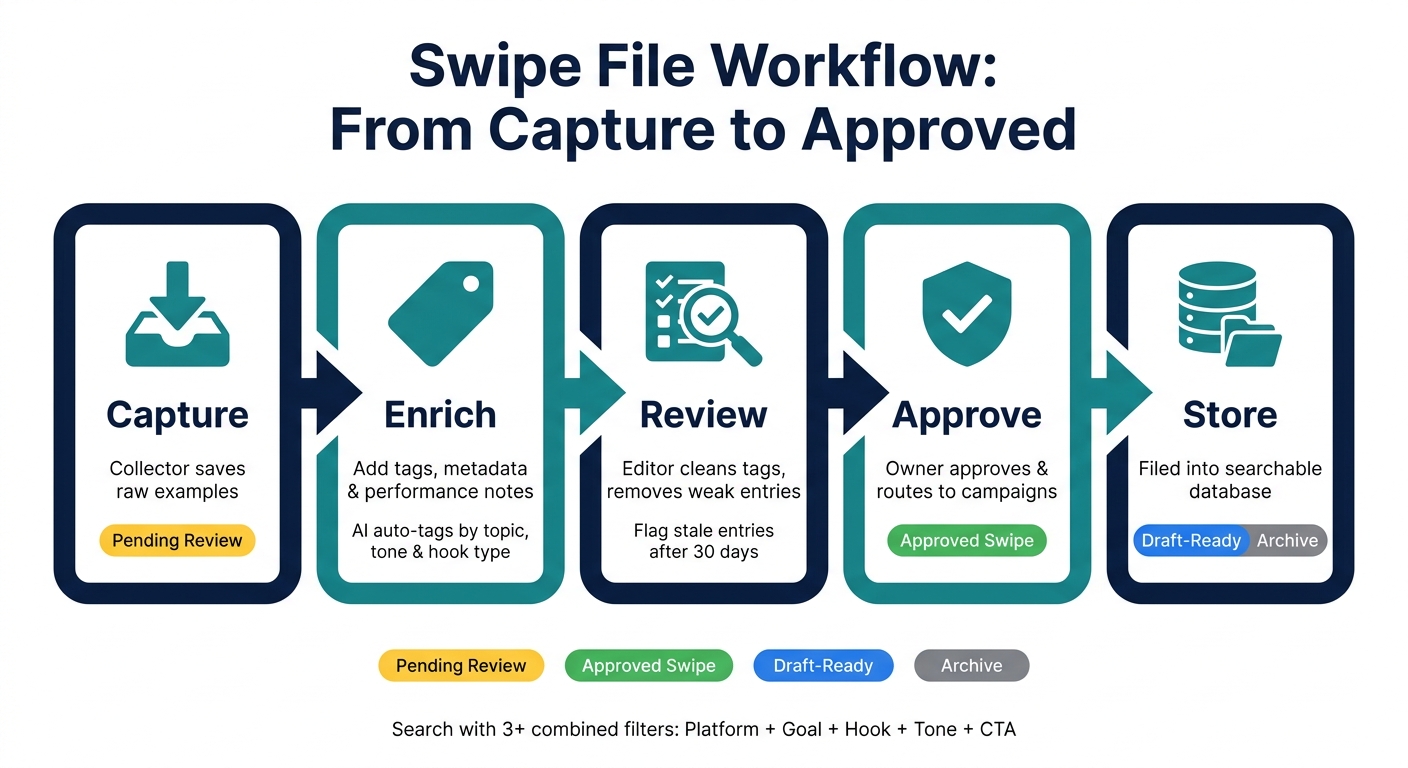
Swipe File Workflow: From Capture to Approved in 5 Steps
Once search is fast, the file needs to support weekly production.
A swipe file that no one uses is just a pile of saved posts. The aim is to turn it into a working system that feeds caption drafts, tests, and updates on a steady schedule.
Every caption in your swipe file should move through five stages: capture → enrich → review → approve → store.
Here’s how that looks in practice: the collector saves raw examples, the editor cleans tags and removes weak entries, and the owner approves swipes and routes them into campaigns, launches, or evergreen funnels. Stick with the same tag vocabulary and status labels already used in the swipe file. That keeps the system clean and easy to search.
Each entry should carry one of four labels:
If you're a solo creator, you're wearing all three hats. That’s fine. The trick is to separate capture, review, and planning into time blocks instead of trying to keep it all in your head.
Once your tags and statuses are in place, AI can speed up the repetitive parts.
It can auto-tag captions by topic, tone, and hook type in seconds. But there’s a catch: give it a controlled vocabulary, meaning a fixed list of approved tags. Otherwise, it may make up new labels that wreck your search system. Ask for structured output, such as a comma-separated list that maps straight into your database fields. Then do a human spot-check each week to catch tagging mistakes.
Tagging is only part of the job. AI can also group similar hooks across your swipe file and surface patterns you might miss by hand, like myth-vs.-truth reveals or step-by-step tips. Those groups can turn into reusable caption frameworks.
It can also help by:
That said, writers should refine the draft. They shouldn’t publish it as-is.

After organization comes feedback. Use Instagram performance data to decide what stays.
Your swipe file should reflect what works on Instagram, not just what sounds clever. That means curation should tie back to actual performance data.
Use UpGrow's live dashboard and performance analytics to compare swipe patterns with real audience response. Keep patterns that beat your baseline. Move patterns that underperform after remix tests into the archive. Then cross-check audience response against your swipe file to spot gaps. If educational Reel captions with a curiosity hook are bringing in the most engaged new followers, but your swipe file is thin in that area, you know what to collect next.
At that point, the system isn’t just storing examples. It starts telling you what to look for next.
Once your swipe file starts feeding drafts, upkeep is what keeps it useful.
Over time, these libraries can get messy. Offers expire. Tags multiply. Folder names stop matching how the team works. Then search gets noisy, and people stop trusting what they find. That’s why maintenance needs a set schedule.
It helps to treat upkeep in three layers. Each one deals with a different kind of wear and tear.
Monthly, do a quick cleanup. Remove near-duplicates, fix broken tags, archive captions that underperform after review, and check any entries stuck in "pending review" for more than 30 days. This keeps day-to-day search fast and the library reliable.
Quarterly, clean up the structure itself. Merge overlapping folders, split overloaded ones, prune unused tags, and line the system up with current priorities.
When the structure changes over time, the archive holds the history without crowding active search.
Annually, move outdated campaign captions to Archive – [Year] and save reusable hooks, CTAs, and structures in Proven Patterns.
| Cadence | Benefits | Risks | Best For |
|---|---|---|---|
| Monthly | Keeps search fast; catches issues early; prevents clutter buildup | Requires consistent discipline each month | Teams posting daily or weekly, multi-person teams, brands with fast-changing offers |
| Quarterly | Fixes structural problems; aligns tags and folders with strategy shifts | Issues can linger for months if monthly cleanup is skipped | Complex libraries with multiple campaigns and evolving content strategy |
| Ad hoc only | Minimal scheduled effort | Libraries become cluttered; search quality degrades; fixes are reactive and larger | Early-stage swipe files under 100 entries, solo creators with low posting frequency |
A shared swipe file without written rules will drift fast. People will make up their own tags, name entries in different ways, and overwrite captions with no clear record of what changed.
A short playbook solves a lot of that. It should cover naming rules like [Platform] – [Objective] – [Campaign/Offer] – [Hook] – [YYYY-MM-DD], a tag glossary with usage examples, source standards such as only adding captions that met or beat your median engagement rate, and editing permissions so everyone knows who can change core fields like tags, status, and performance data.
Use Owner, Status, and Last Reviewed Date to spot stale or unowned entries. Those three fields make it much easier to filter old items, run tight audits, and stop entries from floating around with no clear owner. If a caption variant beats the original, make a new entry instead of overwriting the old one. Label it v2, note the performance gap - for example, +25% saves vs. v1 - and mark the older version as archived.
The point was never to build the biggest swipe file. It was to build one that helps you write faster and produce better captions. In practice, that means using one main tool, setting up a clear folder structure, keeping tags limited, defining search rules, and running a workflow that moves captions from capture to approved without friction.
The goal is not more storage. It is faster reuse.
AI handles repetitive tagging and pattern clustering. UpGrow's analytics keep curation tied to actual Instagram metrics. And a steady maintenance rhythm - monthly, quarterly, and annual - keeps the library lean enough to use every day.
A maintained swipe file stays lean, searchable, and useful.
Start by auditing your existing assets and putting a steady structure in place. Use AI tools to tag each piece of content by hooks, personas, and tones so you can spot what’s already landing and what isn’t.
Then build one central place to track it all, like a spreadsheet or a project management tool. That way, nothing slips through the cracks.
Going forward, use UpGrow insights to curate new additions based on performance data instead of guesswork.
There’s no fixed number. A swipe file has too many tags when it stops being easy to use and hard to search.
Keep your tags clear and consistent around things like post format, goal, or content type. That way, you can find content fast and reuse your best-performing captions and ideas without digging through a mess.
Switch when your swipe file gets too large to search by hand without slowing you down. A notes app is fine for a small collection. But once you need to sort and filter by several fields like hook type, industry, engagement performance, or call to action, a database makes life much easier.
It also helps a lot when you need to track permissions, expiration dates for user-generated content, or A/B testing variables across a team workflow.