
Ultimate Guide to AI UGC Integration
Use AI to source, personalize, and scale Instagram UGC—workflows, tools, compliance, and creative testing for better engagement.
Use AI to source, personalize, and scale Instagram UGC—workflows, tools, compliance, and creative testing for better engagement.
4.98 /5 - from 58k reviews
Trusted by 50,000+ creators — get real engagement delivered to your profile in minutes, not days.

AI UGC (User-Generated Content) is transforming Instagram marketing by automating how brands collect, organize, and use content created by users. This approach saves time, reduces costs, and increases engagement by leveraging AI tools for curation, personalization, and retargeting.
| Type | Cost per Video | Production Time | Best Use Case |
|---|---|---|---|
| Customer-Created | $150–$500 | 5–14 days | Authentic testimonials |
| AI-Assisted | Moderate | Hours | Repurposing existing media |
| Fully AI-Generated | $5–$15 | Minutes | High-volume campaigns |
AI UGC aligns content with audience preferences, improves retargeting strategies, and simplifies workflows, making it a key tool for Instagram marketers.
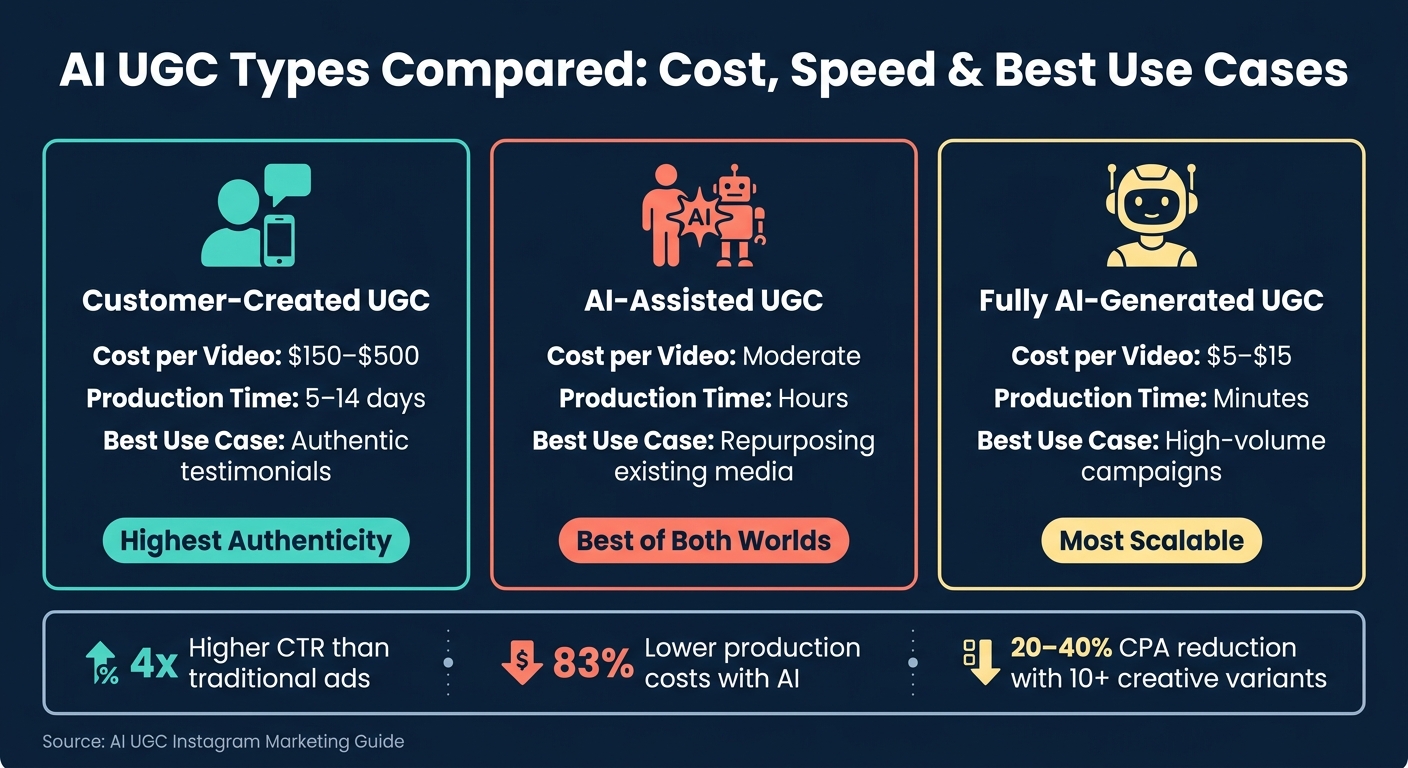
AI UGC Types Compared: Cost, Speed & Best Use Cases
Let’s dive into the essential components that make AI-powered UGC a game-changer for Instagram marketing.
Instagram offers several formats, each serving a specific role in the marketing funnel. Reels are currently dominating, making up over 53% of Instagram ad placements by late 2025. They’re perfect for grabbing attention at the top of the funnel, thanks to their critical 1.5-second hook. Moving further along the funnel, Stories excel at retargeting, providing a more personal and conversational touch for users already familiar with your brand. Carousels shine in the mid-funnel stage, offering an opportunity to educate and engage users with deeper storytelling. Finally, Product tags simplify conversions at the bottom of the funnel, turning UGC into a seamless shopping experience.
| Format | Best Funnel Stage | Key Benefit |
|---|---|---|
| Reels | Top/Middle | Broad reach; quick 1.5-second hook |
| Stories | Middle/Bottom | Personal engagement; 15-second duration |
| Carousels | Middle | In-depth storytelling; encourages saves |
| Product Tags | Bottom | Easy, direct pathway to purchase |
Each format is enhanced by AI UGC, which tailors content to the specific needs of these stages.
AI UGC comes in three main forms, each with unique strengths. Traditional UGC involves authentic content created by real customers, licensed for use in marketing. While highly credible, it’s costly and time-intensive, averaging $150–$500 per video with a 5–14 day production timeline. AI-assisted UGC uses AI tools to enhance human-created footage by adding captions, music, or optimizing visuals for platform-specific requirements. Finally, fully AI-generated UGC relies on digital personas (or AI Creators) to produce content like testimonials or unboxings at a fraction of the cost - around $5–$15 per video.
Each type has its place depending on your goals:
"The competitive moat on Reels is no longer who has the bigger production budget. It's who can ship more native-feeling creative variations per week." - ReelFlood
Understanding these types ensures you can match the right approach to your campaign objectives.
The biggest challenge with AI UGC is maintaining a sense of authenticity. Overly polished content can trigger what Murat Bock, Founder of AdLibrary, calls the "instant skip reflex":
"A studio ad gets categorized as advertising before the first word registers - the skip reflex fires. A phone-camera UGC clip takes 2–3 extra seconds to categorize, and those seconds are exactly when the hook lands."
To make AI UGC feel real, focus on the details: natural skin textures, slight imperfections, and casual styling. Place characters in everyday settings, and use conversational, first-person scripts. Transparency is also critical. Use Meta’s "Generative AI" branded content tag in Ads Manager to disclose synthetic media. This is especially important as the EU AI Act, effective August 2, 2026, requires clear labeling for realistic AI-generated content. Even outside the EU, being upfront builds trust with your audience.
To make the most of AI-generated user-generated content (AI UGC), it’s important to align your strategy with the different stages of the marketing funnel. For awareness, focus on short, snappy Reels (7–15 seconds) with hooks that grab attention fast - think shocked reactions or relatable POV moments. These are designed to stop the scroll in Instagram's critical 1.5-second window.
As users move into the consideration phase, longer-form videos (30–60 seconds) work best. Formats like Problem-Solution-Proof or Skeptic-to-Believer build trust and nudge potential buyers closer to making a decision. At the conversion stage, testimonial-style videos and before-and-after visuals are powerful tools - these formats have been shown to increase add-to-cart rates by 12–25%. Finally, for retention, create Routine Integration clips (15–30 seconds) that highlight long-term product use. These help keep current customers engaged while reinforcing loyalty to your brand.
| Funnel Stage | Video Duration | Recommended Framework |
|---|---|---|
| Awareness | 7–15 seconds | Pattern Interrupt, POV, Shocked Reaction |
| Consideration | 30–60 seconds | Problem-Solution-Proof, Skeptic-to-Believer |
| Conversion | 30–60 seconds | Testimonial, Before-and-After |
| Retention | 15–30 seconds | Routine Integration |
Next, let’s dive into how AI can personalize content to better connect with your audience.
One of the standout benefits of AI UGC is its ability to tailor content for specific audience segments on a large scale. AI tools can adjust character traits like age, ethnicity, and style to make content feel more relatable. For instance, using a 28–35-year-old character in a skincare campaign can significantly boost engagement and relatability. Meta’s data also shows that audiences are more likely to engage with creators who resemble them.
Dynamic Creative Optimization (DCO) takes this personalization to the next level. By seamlessly integrating customized AI UGC into campaigns, brands can achieve consistent growth on Instagram. Brands that upload 10 or more creative variations per ad set on Meta often see a 20–40% reduction in cost per acquisition (CPA).
Once your content is personalized, AI can also refine your strategy through retargeting.
AI UGC shines in retargeting campaigns by keeping creative assets fresh and avoiding repetition. Instead of reusing the same ads, alternate character scenarios to re-engage users effectively.
"Retargeting with AI UGC works best when you show different creative than the initial ad... This fresh angle re-engages without repetition fatigue." - Max Zeshut, Founder, ppl.studio
This approach works particularly well for cart-abandoner ads, post-purchase upsells, and email nurture campaigns. Ads featuring AI UGC with a person-forward focus tend to achieve 15–30% higher click-through rates compared to product-only emails. Plus, with production costs as low as $5–$15 per video, generating new assets every 2–4 weeks is a practical and cost-efficient way to keep your retargeting campaigns fresh.
AI tools are transforming how brands manage user-generated content (UGC), making the process faster and more efficient. By using image recognition and natural language processing, these tools can scan social platforms to identify posts that align with your brand. Then, relevance scoring filters out visuals that don’t meet quality or branding standards, ensuring only the best content gets used in campaigns.
AI doesn’t stop at discovery - it also simplifies the creative process. Automated image editing tools handle tasks like cropping, lighting adjustments, and color corrections, giving your feed a polished look without hours of manual effort. Sentiment analysis adds another layer of value by tagging audience interactions (e.g., negative, questions, or orders), helping you prioritize responses and understand how your content resonates with your audience.
| AI Capability | What It Does | UGC Benefit |
|---|---|---|
| Image Recognition | Identifies brand-relevant posts automatically | Faster content sourcing |
| Relevance Scoring | Filters out low-quality or off-brand visuals | Cleaner, more consistent content |
| Sentiment Analysis | Tags interactions as negative, question, or order | Better community management |
| Predictive Analytics | Predicts which content types will perform best | Smarter pre-deployment decisions |
| Automated Captions | Generates hashtags and optimized copy | Higher discoverability |
These features form the backbone of an efficient AI-powered UGC workflow, which is detailed below.
A streamlined AI UGC workflow typically includes five stages: collection, curation and creation, improvement, deployment, and measurement. This process ensures fast, optimized content production, especially for Instagram campaigns.
UpGrow integrates seamlessly into AI-driven UGC workflows, enhancing every stage of your Instagram marketing funnel. Its analytics dashboard offers real-time insights into how UGC impacts follower growth and engagement, eliminating the need to wait days for results.
UpGrow also uses AI-powered targeting to focus UGC distribution on the most responsive audiences, based on factors like location, age, gender, and language. Additionally, its viral content library helps marketers spot high-performing Instagram trends, guiding decisions on which UGC formats and hooks to prioritize. With 24/7 growth monitoring, UpGrow ensures your UGC efforts deliver consistent results without interruption.
Once you've got the basics of AI-generated user content (UGC) down, these advanced strategies can help boost performance and ensure compliance.
After setting up your AI UGC workflow, you can focus on refining it with smarter creative testing. The key here is variable isolation - changing one element at a time, like the opening line or background, while keeping everything else the same. This approach makes it easier to pinpoint what’s driving results.
Meta Research shows that creative elements influence 56% of ad auction outcomes. To maximize results, test in this order: start with concept angles, then move to the AI persona, and finally tweak the scene environment. Concept angles can impact click-through rates by 30–80%, while the AI persona or expert affects them by 15–40%, and the scene environment accounts for a 10–25% swing. For example, generating 5–10 variations of opening lines can help you determine the best hook.
"The real advantage is production economics - you test 5–10× more concepts for the same studio budget." - Murat Bock, Founder, AdLibrary
Run tests on a 4-week cycle: launch variations, gather data, scale the winners, and then repeat. Make sure each variation gets at least 2,000–3,000 impressions before deciding on a winner to avoid skewed results. Companies using AI-powered ad tools have reported up to a 72% increase in return on ad spend, a 47% bump in click-through rates, and a 29% drop in cost-per-acquisition.
Once you've optimized creative elements, the next challenge is tailoring content for different regional audiences.
After fine-tuning your creative approach, you’ll want to adapt your content to connect with local audiences. Studies show shoppers are 30–40% more likely to convert when the content reflects their own experiences or cultural context. AI makes it easier to create personas tailored to specific regions, accounting for factors like demographics, fashion trends, and visual preferences. This eliminates the need for expensive photo shoots in every market.
Localization isn’t just about translating text. It also means adjusting details like interior design, lighting, and social cues to match regional tastes. For instance, Southeast Asian audiences often prefer vibrant visuals with strong social proof, while North American viewers lean toward casual, authentic-looking content. Tools like HeyGen can even localize videos with lip-synced translations in over 20 languages, keeping your brand voice intact while making the content feel native. Instead of spending $15,000–$40,000 on international photo shoots, AI UGC offers a far more budget-friendly alternative.
"People buy from brands that feel like they understand them." - Max Zeshut, Founder, ppl.studio
As you scale and localize your content, maintaining brand safety and consistency becomes critical. Without proper safeguards, an increased volume of UGC can lead to compliance risks. To avoid this, enforce brand safety at the input stage. This means embedding guidelines - approved claims, banned language, and visual identity rules (like colors, fonts, and logo placement) - into your creative briefs before generating any content.
"Brand safety is enforced at the input level, not the output level." - Tal Yeger, Seasoned Leader in Advertising, AdGPT
To comply with FTC regulations, AI-generated content must include clear on-screen disclosures. These should appear directly on the visual asset, not buried in captions. For example, disclosures could be verbal within the first 15 seconds of a video or displayed as persistent text. Even when content looks organic, brands must secure explicit permission from any real creators whose likeness or work is used. AI platforms can help automate these permissions at scale. Finally, always have a human reviewer approve high-visibility placements, like paid ads, to catch edge cases that AI might overlook.
The integration of AI with user-generated content (UGC) has evolved from a simple experiment to a cornerstone of competitive Instagram marketing. The data speaks volumes: UGC-based ads generate 4x higher click-through rates than traditional ads, and 79% of consumers admit that UGC directly influences their buying decisions. On top of that, AI has drastically reduced costs - programmatic AI UGC tools operate at about 83% lower expenses - and slashed production timelines from weeks to mere minutes.
By streamlining workflows, AI has not only saved brands valuable time but also significantly boosted engagement rates. This level of output is nearly impossible to achieve through manual content creation alone.
However, efficiency isn’t the whole story. That’s where UpGrow makes a difference. While AI tools focus on generating and testing content, UpGrow’s patented AI targeting ensures your UGC reaches the right audience by filtering based on location, age, gender, and language. This targeted approach drives genuine follower growth, amplifying the social proof that makes UGC so impactful.
To succeed, brands should adopt key practices: update creatives every 7–14 days to avoid ad fatigue, monitor hook retention beyond the first 3 seconds on Reels, and always involve a human reviewer for high-visibility paid placements. These steps help maintain quality even as scale increases.
"The demand for content had grown exponentially... manual curation becomes a bottleneck that slows down your entire content pipeline." - Alisia Palczewski, Associate Producer, GoPro
When executed thoughtfully, AI-driven UGC transforms content production into a dynamic growth engine. By blending scalable AI efficiency with human oversight, brands can achieve a strategy that balances authenticity, precision, and performance.
The choice you make should align with your campaign objectives, budget, and the level of control you require. Here's a breakdown:
Each option has its strengths, so the best choice depends on what matters most to your campaign.
When using AI-generated content, transparency is key. Always include clear and visible labels to indicate that the content was created by AI. Avoid tucking these disclosures away in small captions or hard-to-find places.
If you're using AI avatars, make sure it's obvious that they aren't real people or based on actual customer experiences. Misleading users can erode trust. For testimonials, it's essential to verify that the experiences shared are authentic and not fabricated.
AI can be a great tool for speeding up content creation, but it works best when paired with real customer reviews. By incorporating genuine feedback, the final product will feel more relatable and trustworthy to your audience.
To measure the performance of your AI-generated UGC on Instagram, focus on tracking essential metrics. Start with Return on Ad Spend (ROAS) to determine profitability, Click-Through Rate (CTR) to gauge audience engagement, and Conversion Rate to evaluate how well the content drives purchase intent.
Additionally, keep an eye on secondary metrics like Creative Fatigue Rate, which helps identify when assets need refreshing, and Creative Win Rate, which shows how effective your prompts are at delivering results. To ensure your data is accurate, consistently use UTM tagging and implement server-side tracking.


